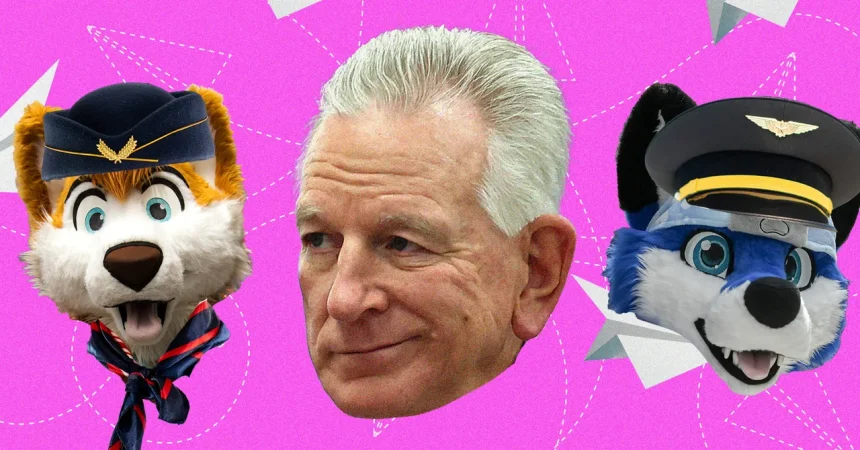
If you had to name the single greatest threat to humanity’s survival, you might point to climate change, artificial intelligence, or perhaps the next global pandemic. Alabama Senator Tommy Tuberville has a different answer: airline pilots who like to dress up as cartoon foxes. In a bizarre speech on the Senate floor, Tuberville warned that “furries”—members of a subculture who enjoy drawing, writing about, or dressing up as anthropomorphized animals—have somehow infiltrated the nation’s aviation system. “Many airline pilots, flight attendants, and air traffic controllers are part of the furry community,” he claimed, before adding, “Lord help us. It’s terrifying when you think about this.” It was the kind of speech that would have felt at home in a satirical sketch, except it was delivered by an actual United States senator. And like many things that sound too absurd to be true, it quickly went viral, leaving many people wondering whether we should be laughing, panicking, or simply asking what on earth he was talking about.
The context of Tuberville’s remarks made them even stranger. He had launched into a lengthy, anti-trans rant about “gender confusion” before somehow arriving at the furry fandom. To back up his claim, he shared an audio clip of airline pilots at Ronald Reagan Washington National Airport apparently meowing and barking at each other over the radio. The clip was certainly odd, but there was no evidence that the pilots involved were furries. In fact, the exchange was widely recognized as a reference to the 2001 comedy Super Troopers, in which state troopers engage in a childish game of making animal noises over their radios. That detail didn’t stop Tuberville from leaning into the fear. “When you walk onto a commercial flight,” he said, “it’s possible that the pilot flying your plane could have a deranged fetish of dressing up like an animal.” It was a stunning display of alarmism, especially considering that the furry fandom is not inherently sexual, and not all furries even dress up as animals. Still, the speech succeeded in doing what it set out to do: it turned a misunderstood subculture into a punchline, and it made an entire community feel like a threat. Jimmy Kimmel and The Daily Show both weighed in, laughing at the senator’s absurdity, but the laughter felt uneasy, because the fear behind his words was real.
But here’s the thing Tuberville got wrong—and also, strangely, the one thing he got right. There really is an unusual overlap between furries and aviation. It’s not the kind of thing you’ll find in any official survey, and there’s little hard data to prove it, but the people inside both worlds have known about it for years. Toby, a professional flying instructor who has run a flight school for the past eight years, is also a prominent member of the furry fandom. His fursona—the animal-inspired alter ego that furries use to represent themselves—is a wolf. When asked about Tuberville’s claims, he didn’t get defensive. He just laughed. “It’s definitely something we’ve talked about before, why there are so many furries in the aviation community,” he said. And he’s not alone in noticing. Vulan, a pilot for a major American airline, uses they/them pronouns and has a fursona who is a fox. They run a group chat for furries in aviation, one of nearly a dozen they know of. “It’s kind of a big deal in the furry fandom because it’s such an odd, out-of-left-field thing,” Vulan said of the overrepresentation of furries in the air travel industry. In other words, Tuberville stumbled onto a truth, but he completely misread what it meant.
There’s no reliable data on how many furries work in aviation, but anecdotal evidence suggests it’s a lot. Toby hosts aviation panels at furry conventions, and he says they’re among the most popular events, with recent panels attracting upwards of four hundred attendees. He’s seen furries who identify as almost every kind of animal, though he notes that airline pilots “do tend to favor birds.” One furry who worked for four years at an airport kiosk says he knew a number of other furry employees during his time there, including a baggage handler who had a tattoo of his fursona. “Some people are more vocal about it than others, but in my experience most don’t talk about it,” he told me. Vulan says that at their airline alone, they know of at least forty other self-identified furries, ranging from pilots to baggage handlers to air traffic controllers. That number might seem small, but it’s remarkable when you consider how secretive many furries are. They don’t wear their identities on their sleeves—or in their fur—because they know how the public might react. And who could blame them? When a United States senator stands up on the floor of Congress and calls you a danger to public safety, you tend to keep your hobby to yourself.
What struck me most in talking to these furries is how normal they sound. They’re not trying to recruit anyone. They’re not pushing a political agenda. They’re not asking for special treatment. They just want to live their lives, do their jobs, and, on the weekends, maybe attend a convention where they can be themselves without fear of judgment. Vulan was careful to draw a line between their identity and their work. “I don’t feel the need to be represented at work, and I don’t know anyone who feels that way,” they said. “I think everybody understands this is something we enjoy at home, and we’re not asking to bring it into work, just like we’re not asking anybody else to bring their home life into work if they don’t want to.” That’s a surprisingly mature perspective for a subculture that’s often dismissed as bizarre. It’s also a reminder that furries are not so different from the rest of us. We all have private interests, secret hobbies, and parts of ourselves we keep separate from our professional lives. The only difference is that most of us don’t have to worry about a senator accusing us of having a “deranged fetish” on national television.
In the end, Tuberville’s speech was less about furries than it was about fear—fear of the unknown, fear of anything that falls outside the narrow boundaries of what he considers normal. It’s easy to mock him, and plenty of people did. But the real lesson is more uncomfortable. The next time you board a plane, the pilot might be a wolf, a fox, or a particularly well-dressed husky. And you know what? That’s not terrifying. It’s just human. The furry fandom is weird, yes, but weird has always been a part of the human story. What’s actually weird is the idea that we should be afraid of someone simply because of what they do in the privacy of their own homes, or because they found a community that makes them feel accepted. Tuberville may have thought he was exposing a national threat, but all he really exposed was his own ignorance—and the fact that, somewhere out there, there’s an airline pilot who has spent years dreaming of the day he can tell people he’s a fox. Lord help us, indeed.