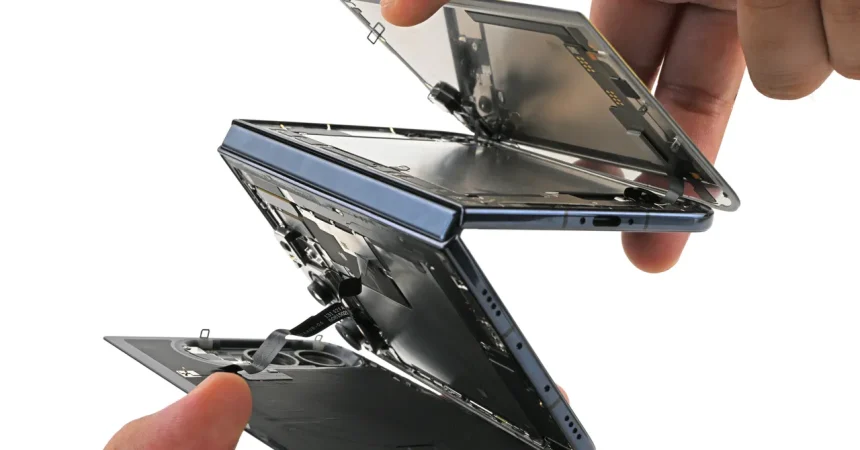
The iPhone Duo is, on paper, a dream come true for people who love cutting-edge tech and also love a good mystery. It folds, it unfolds, it slides into your pocket, and it makes you feel like you’re living in the future. But the future, as it turns out, is fragile. When iFixit took the Duo apart, they found something that should make every owner pause: the inner display is stunning, but it’s also terrifyingly delicate. On top of the OLED screen sits a thin, matte nano-texture finish. It looks gorgeous, it reduces glare, and it feels wonderful under your finger, but it is not just a film you can peel off. It’s an integral part of the display assembly, and Apple has posted strict instructions telling users not to try to remove it. If you do, you could very easily lift that layer away from the screen, leaving behind a permanent, expensive smudge of regret. The whole thing feels like an exquisite piece of furniture in a museum — beautiful, but roped off, with a sign that says “look, don’t touch.” And if you don’t know that before you start tinkering, you might learn the hard way.
Getting past that delicate layer is where the real adventure begins. If you want to replace the inner screen, you can’t just pop it off with a suction cup and a little patience. Oh no. You need a heat gun to soften the adhesive that holds the whole display assembly together, and then you need a startling amount of elbow grease. Imagine trying to separate two pieces of plastic that have been welded together with emotional trauma and industrial glue. You pull, you sweat, you curse, you pray that the screen doesn’t crack under the pressure. And here’s the kicker: many people who have tried this have broken the screen anyway. The inner screen is not only the most fragile part of the Duo, it’s also the hardest to replace. It’s a cruel combination. If you’re lucky enough to break just the inner screen, Apple will fix it for you, but they’ll charge $999 for the privilege. That’s not a repair; that’s a mortgage payment on a device that already cost you a small fortune. So you have two choices: pay nearly a thousand dollars and let a professional handle the terrifying surgery, or roll up your sleeves, heat up the gun, and hope against hope that you don’t turn a bad situation into a catastrophic one. It’s the kind of situation that makes you appreciate repair technicians more than ever.
As if that weren’t enough, the Duo has another enemy lurking everywhere, and it’s smaller than a grain of sand: dust. Every phone collects dust eventually, of course. The USB-C port gets a little fuzzy, the speaker grilles gather lint, the edges pick up whatever is in your pocket, but the Duo has a special problem. It also collects dust in its inner hinge, right where the screen folds. And because of how the hinge works, that dust gets squeezed, ground, and mashed against the moving parts every time you open and close the device. The result is a sound that iFixit and users describe as “crunchy.” Let that word sink in for a second. Your brand-new, futuristic, foldable phone starts to sound like you’re chewing a bowl of cereal every time you flip it open. It’s not a crack, it’s not a click, it’s not a satisfying snap. It’s a gritty, brittle, uncomfortable sensation that goes straight through your fingers and into your soul. You find yourself opening and closing the phone just to see if it’s still there, and every time, the sound reminds you that no matter how sleek the hardware is, physics still wins. Folding devices have to contain moving parts, and moving parts have friction, and friction invites dust to the party. It’s the oldest problem in engineering, and the Duo hasn’t fully solved it. It just learned to live with it, and so will you — whether you like it or not.
Apple’s repair nightmare with the Duo is especially frustrating because the company doesn’t have a sterling history when it comes to letting people fix their own gadgets. For years, Apple treated iPhone repairs like a secret ceremony best performed by certified priests in glass cathedrals. If you opened your own phone, you were essentially committing a sin. Warranty void if removed. Proprietary screws. Glue everywhere. The works. When the company finally started offering real self-repair options in 2021, it was a historic moment, but the launch was messy. Parts were hard to order, instructions were confusing, and the process felt less like an olive branch and more like a reluctant concession. But then something interesting happened. Governments started caring. In the United States, state legislatures began pushing right-to-repair bills. In the European Union, lawmakers got serious about making manufacturers design products that don’t become e-waste the moment a battery dies. Under this pressure, Apple has slowly, reluctantly, started to change. It’s not a full conversion — Apple still loves its proprietary parts and its special screws — but it’s real progress. And for people who remember the bad old days, seeing an Apple repair manual on launch day is nothing short of revolutionary. It’s like watching the villain of a movie rescue a kitten. You still don’t entirely trust them, but you have to admit, it’s a good look.
The iPhone Duo, to its credit, launched with a widely accessible repair manual. That’s not always been the case for Apple products, and it’s a genuinely encouraging sign. The manual is there for you, right from day one, so if your screen cracks, your speaker gets crunchy, or your hinge starts acting up, you’re not left alone in the dark. You have a roadmap. You have diagrams. You have warnings. And that alone could be the difference between giving up on the device and giving it another chance. Now, let’s be honest: the Duo is still not perfectly repairable. Folding phones might never get there. The physics are brutal, the tolerances are tight, and the adhesive is unforgiving. There’s no way to make a foldable display that is simultaneously razor-thin, endlessly flexible, and easy to swap out. Something has to give, and usually it’s the repair experience. But the fact that Apple has acknowledged this and decided to share information anyway is a sign of a culture shift. It’s as if the company finally realized that a phone doesn’t have to be a disposable object. It can be a companion, a tool, a thing you own and care for. And if that phone cracks, you deserve the chance to try to make it whole again. You shouldn’t have to crawl to a repair shop, cap in hand, begging for a $999 miracle. You should be able to at least see the path forward, even if the path is covered in adhesive and upsell opportunities.
In the end, the iPhone Duo isn’t a perfect story. It’s a story about progress, but also about compromise. It’s about wanting something so badly — a phone that folds, a phone that looks like a little piece of future art — that you’re willing to accept its flaws. The inner screen is fragile, the repair cost is staggering, and the dust will make your hinge sound like a bag of chips. But at least now, you know all of that before you dive in. That knowledge is power, but it’s also something gentler. It’s permission to be human. It’s permission to try, to fail, to learn, and to fix your own mistakes. When you repair a device yourself, you’re not just saving money or frustration. You’re building a relationship with the object you own. You’re saying that it matters, that it’s worth the effort, that it’s not just another piece of plastic to throw away when it stops working. The Duo might never be the poster child for repairability, but it’s a step in the right direction. And in a world where so many things are designed to be thrown away, that’s worth a lot. So if you crack your inner screen, go ahead and read the manual. Heat up that heat gun. Take a deep breath. And remember: the future may be fragile, but it’s also fixable.