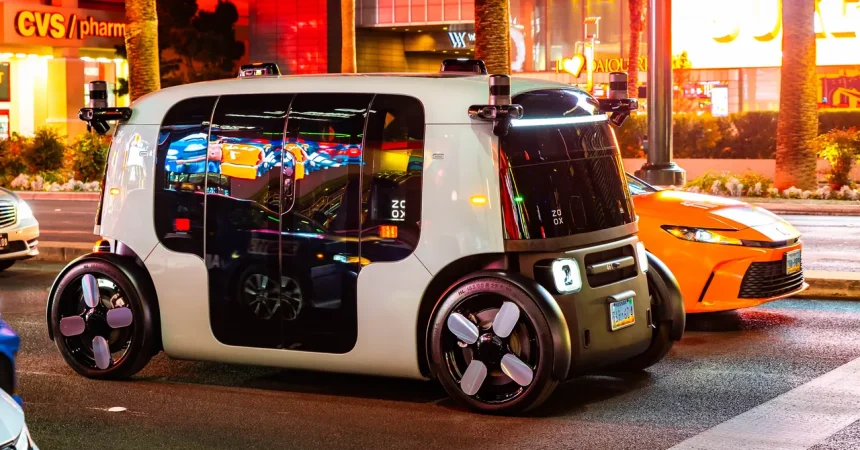
The landscape of urban transportation is undergoing a quiet but seismic shift, as the National Highway Traffic Safety Administration (NHTSA) recently opened the door for a truly driverless future. For the first time ever, the U.S. government has granted approval for vehicles specifically designed without traditional human controls—like steering wheels or brake pedals—to begin operating as paid taxi services. This milestone belongs to Zoox, an Amazon subsidiary, which plans to pivot from its successful free pilot program in Las Vegas to a commercial model. While robotaxis are no longer a science-fiction concept, this specific approval marks a departure from the industry standard, where companies like Waymo have long relied on retrofitted, conventional vehicles that maintain human-centric features for regulatory peace of mind.
For over a decade, Zoox has been quietly challenging the mechanical status quo by reimagining what a passenger vehicle should look like when a human is no longer required to drive. Their design abandons the traditional forward-facing cockpit in favor of a “campfire-style” seating arrangement, where passengers face one another, fostering a communal environment. This design, while revolutionary, required a massive hurdle to clear: federal safety standards that were written decades ago, long before computer-driven navigation was a reality. By securing a two-year exemption from these rigid design mandates, Zoox has effectively proven to regulators that their purpose-built machines can operate at a standard of safety that justifies the removal of traditional mechanical redundancies.
This regulatory victory comes with strings attached, ensuring that the privilege of innovation does not override the fundamental necessity of public safety. Under the exemption, Zoox is permitted to deploy up to 5,000 of its unique robotaxis, but it must operate under a magnifying glass. The company is now obligated to provide the NHTSA with extensive data, including detailed reports on every crash or unexpected stop, providing a level of transparency that goes well beyond the reporting requirements for consumer automobiles. Jonathan Morrison, the head of the NHTSA, made it clear that while the agency is supportive of autonomy, the “exemption” is conditional; should the data suggest any unreasonable risk, the government will not hesitate to pull the plug, emphasizing that innovation must be handled with extreme responsibility.
The broader context of this decision is rooted in a growing tension between technological ambition and municipal reality. Earlier this year, regulators expressed sharp frustration regarding a pattern of autonomous vehicles obstructing emergency responders, noting that a car that cannot coexist safely with police and paramedics is fundamentally a danger to the public. As these companies push boundaries, the pressure is on them to demonstrate that their Artificial Intelligence can navigate not just traffic laws, but the chaotic, unpredictable environments that define urban life. The dialogue between the NHTSA and companies like Zoox is evolving into a strict partnership where “safety first” is not just a marketing slogan, but a mandate for continued existence on the road.
Despite the excitement, the path to mass-market autonomy remains a difficult climb. While Zoox boasts of an impressive track record—having safely transported over 500,000 riders across more than three million autonomous miles—the gap between their current fleet of roughly 105 vehicles and their 5,000-vehicle target is wide. Furthermore, the company recently issued a voluntary software recall after discovering that its sensors occasionally struggled to detect smoke, a sobering reminder that machine perception still has significant room for growth. This serves as a reality check for the entire industry: building the vehicle is only half the battle; the real complexity lies in the infinite variables of the open road and the safety-critical software that mediates those interactions.
Ultimately, we are entering a transition period that pits the bold vision of firms like Zoox and Tesla against the cautious, deliberate oversight of the government. While Tesla continues to tease its own vision of a steering-wheel-free future with the Cybercab, they—like so many others—must watch closely as Zoox navigates the complex bureaucratic maze. The success or failure of these purposeful, robotic transport pods will likely dictate how city planners design our streets for the next generation. We are moving toward a world where the “driver” is an algorithm, and while the convenience of such a future is tempting, the road ahead will be defined by the quiet, iterative work of proving, again and again, that these machines deserve our trust.