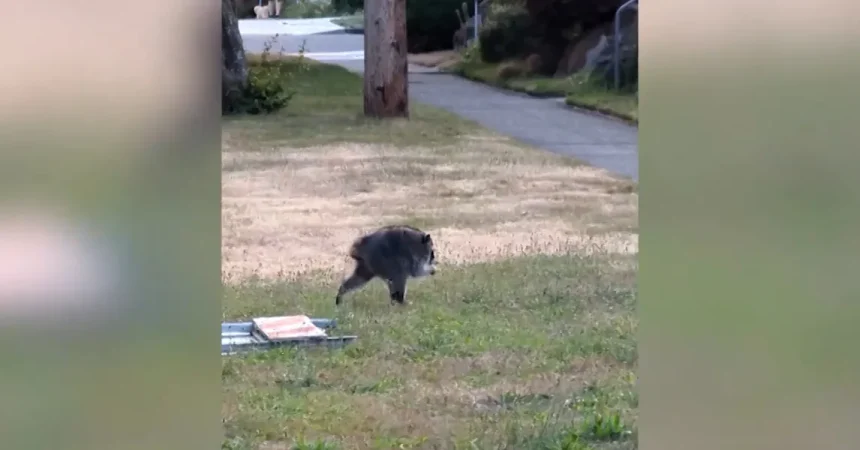
On July 14, a quiet afternoon in Seattle’s Ballard neighborhood transformed into a digital cultural phenomenon when local resident Kiana Hall uploaded a video of an unusual, hunched-backed raccoon to Instagram. With a whimsical name like “Jimothy”—a moniker Hall affectionately coined simply because it seemed to fit—this scrappy, stumpy-tailed creature captured the internet’s imagination almost overnight. What began as a local curiosity quickly exploded into a global sensation, sparking a whirlwind of memes, fan art, and even custom-made plushies. The sheer joy surrounding Jimothy reached such heights that city leaders even declared a “Jimothy Summer,” and the Seattle Mariners organized a special dedicated night at T-Mobile Park. The lore grew deeper when another neighbor, Ben Trammell, surfaced year-old footage of Jimothy as a kit, providing a heartwarming glimpse into his journey from a tiny baby to a neighborhood legend.
However, behind the lighthearted memes and fan theories lies a somber reality: Jimothy lives with a noticeable congenital spinal condition that impacts his movement. While the internet views him as a mascot to be celebrated, wildlife experts are concerned about the daily struggles this condition presents for a creature navigating the concrete jungle. We know from existing data that the average life expectancy for a wild raccoon is a mere two to three years. Since Jimothy is already estimated to be over a year old, his most fervent admirers are rightfully beginning to wonder if their new mascot is facing a precarious road ahead. His physical limitations, which are clearly visible even in the older footage of him navigating backyard fences, raise difficult questions about his survival in a world designed for agile, healthy animals.
Despite these physical challenges, experts remain guardedly optimistic about Jimothy’s resilience. Dr. Rebecca Calisi-Rodríguez, a wildlife biologist at UC Davis, notes that while we cannot fully understand his physiological limitations without a direct examination, the fact that he is active, alert, and successfully foraging in an urban environment is a testament to his adaptability. His ability to navigate the complexities of city life suggests he has found a way to compensate for his condition, though biology often defies prediction. It is a reminder that nature is full of survivors who do not fit the standard mold, and Jimothy’s current success as an urban scavenger speaks volumes about the incredible adaptability of his species under pressure.
The reason for Jimothy’s longevity, according to Dr. Jessica Castillo-Vardaro, a specialist in urban wildlife evolution, lies in both the intelligence of the raccoon species and the protective nature of their family units. Raccoons are notoriously clever, and their mothers provide an unusually high level of care, guarding their offspring long after they have weaned. Having survived his most vulnerable infancy, Jimothy is now in a stage of life where he has largely outgrown typical natural predators in the urban sprawl of Seattle. His biggest challenges are no longer the perils of the wild, but the cold mechanics of human civilization—primarily, the looming danger of motor vehicles. If he has managed to survive this long in a high-traffic area, it is safe to assume he has developed a “street smart” awareness that keeps him safe from the dogs and coyotes that might otherwise target him.
The fascination with Jimothy also highlights our complicated relationship with the natural world. Humans have a natural, often beautiful, inclination to root for the underdog, yet this affection frequently clashes with the harsh realities of wild living. We are used to longer, safer lives, and it can be jarring to apply our sense of permanence to animals whose lifespans are fleeting. Experts like Dr. Castillo-Vardaro argue that while it is tempting to view these wild creatures through the lens of human sentiment, we must be grounded in the understanding that nature is ultimately indifferent to our emotions. Whether it is a viral raccoon or a bird in a nest-cam, the struggle for survival is a raw, inherent part of their biology that we are mere spectators to, rather than protectors of.
The most poignant takeaway from Jimothy’s fame is perhaps the unintended threat that our love poses to him. In the age of social media, the obsession with “clout” often leads to intrusive behavior, with fans or aspiring influencers potentially staging rescues, crowding for selfies, or attempting to domesticate animals that are meant to be wild. Wildlife biologists agree that Jimothy’s celebrity status is currently his greatest liability. The more he is sought after, the more he is at risk of being startled or disrupted by humans who want a piece of his story. Ultimately, the best way we can honor the spirit of Jimothy is by practicing a respectful distance, allowing him to be the wild survivor he has proven himself to be, rather than turning him into a prop for our own amusement.