Some mysteries refuse to fade, no matter how many telescopes stare at them. For years now, astronomers have been puzzled by a class of faint, reddish objects that the James Webb Space Telescope keeps finding in the early universe. They call them “little red dots.” They are tiny on the sky, but they represent something enormous: perhaps the seeds of supermassive black holes, or perhaps something even stranger. You might think that after years of observations, the community would have settled on a tidy explanation. It hasn’t. In fact, the little red dots have become one of the most contentious topics in modern astrophysics. Dale Kocevski, an astrophysicist at Colby College, knows this firsthand. At a conference in Aspen, Colorado, in April 2026, he led a discussion about the objects. He opened with what he thought was a harmless, uncontroversial point about their faint blue light. He barely got through the first bullet point before the room erupted. “The group erupted into argument, and we couldn’t even get past the first bullet point,” he said. That moment captures the state of the field: after years of data, the little red dots still refuse to settle into any comfortable category, and astronomers are still arguing about what they are.
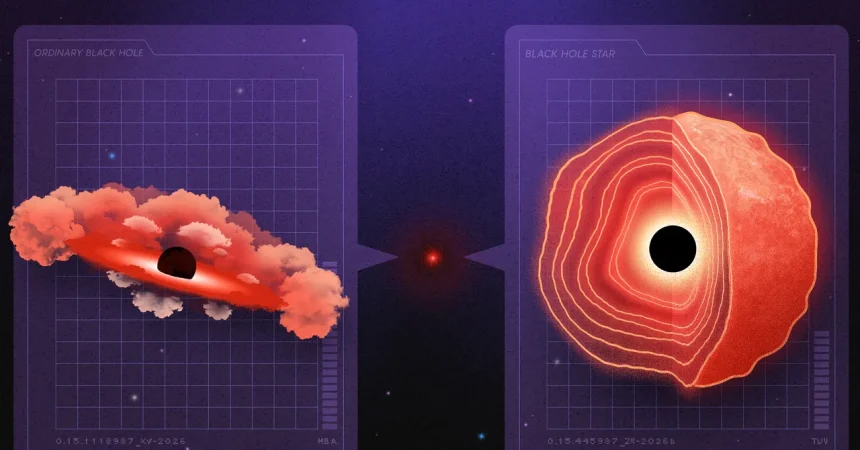
At the center of the fight is a strange identity crisis. The little red dots are compact, red, and surprisingly abundant in the early universe. They show signs of enormous amounts of gas moving at incredible speeds, which usually points to a black hole actively feeding on material. But they also behave in ways that ordinary black holes don’t. They are remarkably steady, showing little of the flickering that astronomers expect from hungry black holes. They emit few or no X-rays, even though black holes usually produce them as infalling gas heats up. And their light is deeply reddened, suggesting that something is blocking or scattering blue light. To explain all of this, some researchers have proposed an exotic new kind of object: a “black hole star.” This isn’t a star in the ordinary sense—not a ball of gas powered by nuclear fusion like the Sun. Instead, it would be a supermassive black hole wrapped in a huge, puffy envelope of gas. The black hole would pull gas inward, releasing energy, but the surrounding shell would trap and reprocess that energy, smoothing out flickers, hiding X-rays, and reddening the light. In other words, a black hole star would look a lot like a little red dot. But many astronomers are not convinced. They argue that the little red dots are probably just traditional black holes, viewed in messy, complicated ways. Roberto Maiolino of the University of Cambridge, a leading voice in the debate, is one of the most prominent defenders of this older, more conventional idea. He acknowledges that the data are striking—”the data is really compelling,” he said—but he is uncomfortable with the exotic interpretation. “I’m a little bit more dubious about the interpretation,” he added.
Maiolino’s position is that there is no need to invent a new kind of object when the standard model of black holes can explain the observations. His approach is simple: for every piece of evidence offered in favor of black hole stars, he has a quick rebuttal. Take the lack of flicker. Astronomers usually expect black holes to be messy eaters, consuming gas in bursts and hiccups, which causes their brightness to vary over time. But in the early universe, Maiolino argues, black holes may have had a steadier supply of food, a constant stream of gas falling in from the surrounding galaxy. If you feed a black hole smoothly, it doesn’t flicker; it glows more evenly. So the absence of variability is not a dealbreaker. What about the missing X-rays? Standard supermassive black holes are often surrounded by a thick doughnut-shaped ring of gas and dust. If that doughnut is oriented the right way, it can block most of the X-rays, leaving only lower-energy light to escape. Maiolino sees no reason to suspect that the little red dots are anything other than ordinary black holes, complete with their own dusty doughnuts. He also challenges the idea that the broadened spectral lines seen in the little red dots require a black hole star. The lines of hydrogen in their spectra are stretched and smeared, which some researchers interpret as a sign of electron scattering inside a dense shell around a black hole. Maiolino agrees that electron scattering probably plays a role—but he points out that it also smears hydrogen lines in ordinary supermassive black holes. In other words, a perfectly standard black hole, surrounded by the usual hot, dense gas, could produce the same signal. For every anomaly, he has a conventional explanation. He isn’t trying to be contrarian; he simply thinks the universe already has enough strange things in it without adding another one.
The redness of the little red dots is perhaps the strongest piece of evidence for the black hole star idea. To make a distant object appear so red, there must be an enormous amount of gas and dust between the black hole and us, absorbing and scattering blue light while letting red light through. That much, Maiolino agrees, is clear. But he argues that this gas doesn’t have to form a spherical shell around a black hole star. It could be the dusty doughnut that we know exists around many black holes. Or it could be a collection of puffy clouds, scattered through the host galaxy, filling in patches of the black hole’s sky. Either way, the result would be the same: the black hole’s light would be reddened, and the object would appear as a little red dot. Maiolino and his collaborator Piero Madau, of the University of California, Santa Cruz, have pushed this interpretation further. They argue that the redness of the dots depends mainly on the angle at which we happen to see them. The reddest little red dots, in their view, are those we see edge-on: our line of sight passes through the dusty doughnut, which blocks most of the blue light. But Webb has also seen what might be the same kind of object in a different guise: “little blue dots.” These, Maiolino and Madau suggested in spring 2026, could be the very same black holes, but viewed top-down. Seen from above, we look straight down into the black hole’s accretion disk, avoiding the obscuring doughnut, and the light appears blue rather than red. This is a neat and elegant explanation, and Maiolino believes it is also the simplest one. He appeals to Occam’s razor: a single population of black holes, seen at different angles, can explain both the red and blue dots. There’s no need to invoke a brand-new class of astronomical object.
But the black hole star hypothesis has its own appeal, and it is not easily dismissed. The idea was born partly out of frustration with the limits of the black hole model. The little red dots are not just red; they are also extremely bright, compact, and numerous. They appear to contain an enormous amount of mass—possibly billions of times the mass of the Sun—at a time when the universe was still very young. How did such giant objects form so quickly? A black hole star offers a possible answer. If a black hole is embedded in a thick envelope of gas, the gas can feed it at a steady, rapid rate, allowing it to grow very fast. The envelope also acts like a cocoon, hiding the messy details of the black hole’s eating habits from outside observers. The result would be a bright, red, steady source of light—exactly what Webb sees. In this view, the little red dots are not just ordinary black holes with cleverly placed gas; they are a distinct, perhaps early phase in the evolution of galaxies and black holes, a time when the black hole was still wrapped in the material from which it was born. The problem is that no one is quite sure how such black hole stars would form, or exactly how they would behave over time. They remain, for now, a fascinating theoretical possibility rather than a proven reality. Mauro Giavalisco, an astronomer at the University of Massachusetts, Amherst, has spent much of his career studying the spectra of distant galaxies, and he is careful not to pick sides. “I don’t think that there is a compelling reason to prefer one or the other,” he said. At this stage, both ideas—black hole or black hole star—can match what Webb has seen. Neither model has yet been pushed to the point where it fails in an obvious, decisive way. That is why the debate is so fierce and why it has lasted so long.
So where does the field go from here? To break the deadlock, astronomers need more than just new observations; they need better theories. In particular, they need detailed predictions of what a black hole star would look like at different wavelengths, at different angles, and at different stages in its life. If one model says that a black hole star should eventually reveal a burst of X-rays, while the black hole model says it shouldn’t, then astronomers can design observations to look for those differences. They need to understand how black hole stars might form, how they would grow, and how they would eventually fade or transform into something else. The little red dots have already been observed for years, but the data are still not enough to settle the question. Future observations with Webb, and perhaps with new telescopes on the ground and in space, might catch some of these objects flickering, or changing color, or varying in brightness in ways that favor one model over the other. Even the absence of variability could be informative: if a little red dot stays perfectly steady for years, that would be strange for an ordinary black hole but natural for a black hole star. For now, however, the mystery remains wide open. The little red dots are a reminder that even in the age of powerful telescopes, the universe can still keep its secrets. They are also a reminder that science is not a calm, orderly march from question to answer. It is a messy, noisy, deeply human process, full of stubborn opinions, sharp disagreements, and the occasional conference room argument. As Kocevski’s experience in Aspen shows, astronomers can stare at the same set of data and come away with completely different stories. And until one story is proven or disproven, the little red dots will remain not just little red dots, but little red arguments—each one a tiny, glowing question mark in the history of the cosmos.