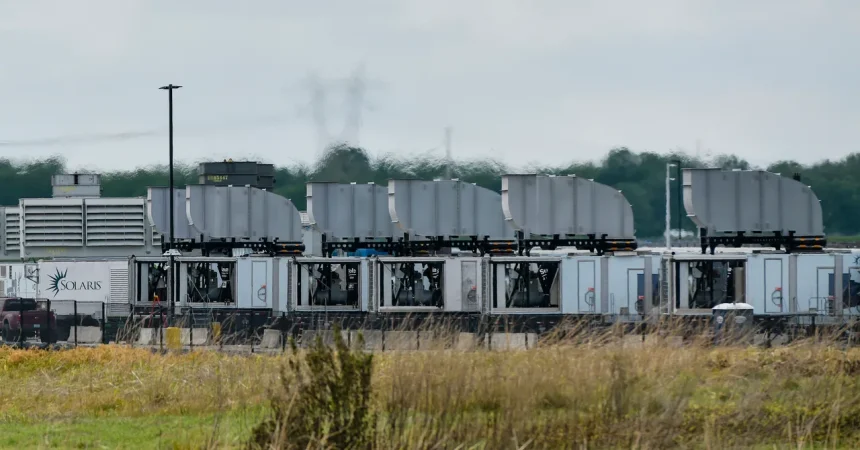
The recent legal battle surrounding Elon Musk’s AI venture, xAI, has taken an unexpected and high-stakes turn. What began as a local community protest in Southaven, Mississippi, has officially escalated into a matter of national security, with the U.S. Department of Justice (DOJ) intervening to back the company. At the heart of the controversy is “Colossus 2,” a massive data center powering the Grok AI model. The NAACP, representing concerned local residents, filed a lawsuit this past April, arguing that xAI is operating dozens of natural gas turbines without the proper environmental permits. They contend that these emissions are a direct threat to the health of nearby neighborhoods, many of which are already disproportionately affected by pollution.
The conflict hinges on a clash between public health advocacy and the rapidly expanding infrastructure required to sustain cutting-edge artificial intelligence. The NAACP originally highlighted 27 turbines at the Mississippi site, but investigative work by the Southern Environmental Law Center revealed that the reality is far more expansive. Leaked correspondence confirms that the site grew to hold 57 turbines by mid-May—nearly doubling the initial count even after the lawsuit was filed. According to environmental data, this rapid expansion has led to a staggering increase in harmful emissions, including nitrogen oxide, fine particulate matter (PM2.5), and formaldehyde, worsening the air quality for local families already grappling with high rates of asthma and heart disease.
The DOJ’s sudden entrance into the courtroom shifts the focus away from local air quality concerns and directly toward the requirements of the American military. In a formal filing, federal attorneys argued that the injunction sought by the NAACP would effectively sabotage critical infrastructure. They framed the continued operation of the Colossus 2 turbines not merely as a business necessity for xAI, but as an essential component of the Department of Defense’s “mission-critical operations.” By siding with xAI and the state of Mississippi, the government is signaling that any legal impediment to these turbines serves as a direct roadblock to the compute power required for national security.
To justify this intervention, the military unveiled the extent of its reliance on Grok, the AI model developed by xAI. Cameron Stanley, the Chief Digital and Artificial Intelligence Officer at the Department of Defense, provided a declaration emphasizing that there are only a handful of AI models globally capable of operating within Secret and Top-Secret classified networks. Grok is one of them. According to the filing, the military has integrated Grok into its decision-making loops, even utilizing it to support recent strikes against targets in Iran. The government’s argument is clear: the energy required to run these models today is synonymous with the speed and efficacy of our military intelligence apparatus.
This leaves the community in a precarious position, caught between the legitimate concerns of environmental injustice and the opaque mandates of national security. Local residents, particularly those in the Memphis and Southaven areas, have voiced deep frustration over a regulatory environment that seems to prioritize rapid tech development over public health. While state agencies in Tennessee and Mississippi have previously claimed that xAI enjoys a one-year grace period to operate without standard air permits, the NAACP maintains that such exemptions violate the Clean Air Act. The divide illustrates a growing tension in American governance: how do we reconcile the “green” requirements of local environmental law with the “gray” requirements of a high-tech, AI-driven defense state?
As the court considers whether to dismiss the lawsuit, the human element of this story remains the most sobering. For the residents living under the plume of these 57 turbines, the legal jargon regarding “economic security” and “classified networks” offers little solace for the tangible health risks they face daily. The shift from 27 to 57 turbines while under legal scrutiny suggests a company operating with a sense of urgency that borders on defiance of local oversight. Ultimately, this case serves as an early blueprint for the future: as long as AI models are treated as vital assets for national defense, the environmental and health impacts of the massive data centers required to build them may increasingly be shielded from local accountability by the very government agencies meant to oversee them.