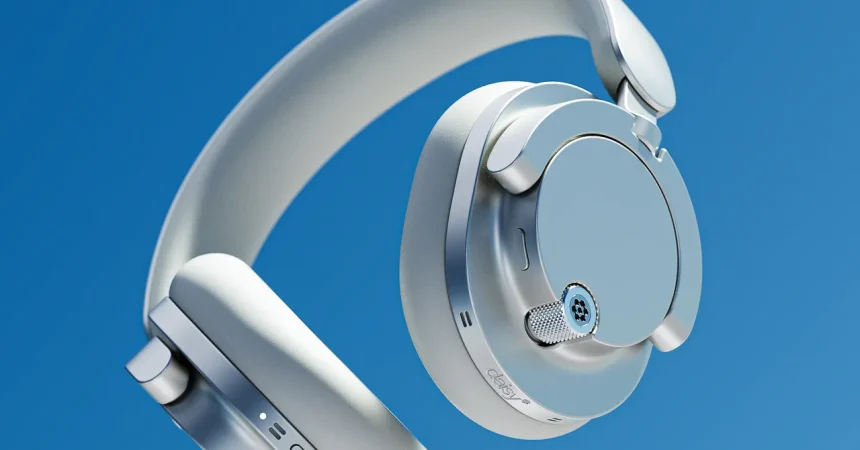
The premium headphone market has become a sea of monotony, dominated by predictable silhouettes and a sterile, tech-heavy aesthetic that prioritizes “spec wars” over actual human experience. Jack Mulroe, the founder of the newly minted audio brand Daisy Sound, recognized this drift early on. To Mulroe, the industry hasn’t seen a truly culturally relevant disruptor since the reign of Beats, leaving a vacuum where personality and soul used to live. With a headquarters planted firmly in California, Daisy Sound is not an audio incumbent trying to iterate on the status quo; it is a collective of industrial designers from outside the traditional audio space, aiming to inject a bit of West Coast ease into a scene that has become far too serious for its own good.
The debut of the “Daisy One” represents an ambitious challenge to the industry titans. Priced at $399, these headphones are positioned to undercut the heavy hitters—like the Apple AirPods Max and the Sony WH-1000 series—without sacrificing the premium feel that consumers have come to expect at that price point. Mulroe is refreshingly candid about the battlefield he is entering, acknowledging the dominance of tech giants like Bose and Apple. Yet, he seems entirely undeterred. He views the saturated market not as a deterrent, but as an opportunity to offer an alternative that feels less like a piece of cold, clinical hardware and more like a lifestyle accessory designed to help the wearer disconnect and recharge.
The physical design of the Daisy One is where the “California chic” philosophy truly comes to life. Abandoning the ubiquitous black-and-silver colorway of modern electronics, the headphones arrive in Pacific blue and a unique, earthy Kelp green, reflecting the natural textures of the West Coast. Beyond the eye-catching aesthetics, the device is built for durability, utilizing aircraft-grade aluminum and resilient TR90 composites. Mulroe even encourages a bit of rough handling, cheekily suggesting that the build quality is sturdy enough for the rigors of daily life. At 318 grams, they have a substantial, weighted presence, and their modular components—like the magnetically snapping ear pads—suggest a design language focused on tactile engagement rather than mere factory-line efficiency.
What truly sets the Daisy One apart is the internal software philosophy. While most premium headphones are tuned to emphasize crisp highs or booming bass for pop music, Daisy has integrated ambient, location-specific soundscapes recorded directly in California. Whether it is the rhythmic pulse of Big Sur’s ocean waves or the quiet rustle of a coastal forest, these tracks are meant to provide a sonic sanctuary in hectic environments. Complementing these soundscapes is a guided breathwork feature, a deliberate nod to the headphones’ primary purpose: to help people find a moment of peace amidst the anxiety of modern travel or the relentless noise of a crowded office.
Of course, no product launch is without its hurdles. Transitioning from high-concept design to mass-market reality has already revealed a few friction points. The Daisy One currently lacks a user-replaceable battery, a feature that environmentally conscious consumers increasingly demand, though Mulroe promises that addressing circularity is a priority for upcoming iterations. Furthermore, early adopters have voiced frustrations regarding the transparency mode—the software that allows ambient sound into the earcups—noting that it doesn’t quite match the seamless clarity found in more mature, software-heavy competitors. However, the company is banking on the agility of its software team, promising that these issues are not design flaws, but rather fixable bugs that can be polished away with future firmware updates.
Ultimately, Daisy Sound is betting that consumers are reaching a point of “tech fatigue.” In a world where gadgets are constantly updated and discarded, the Daisy One attempts to frame itself as a permanent companion—an object of desire, not just a utilitarian tool. By combining the technical expertise of seasoned engineers with the creative vision of industrial designers who prioritize atmosphere over pure data points, Mulroe is carving out a niche for the “mindful listener.” Whether the Daisy One can survive the ruthless competition of the audio world remains to be seen, but for now, they offer a breath of fresh air in a market that has spent far too long holding its breath.