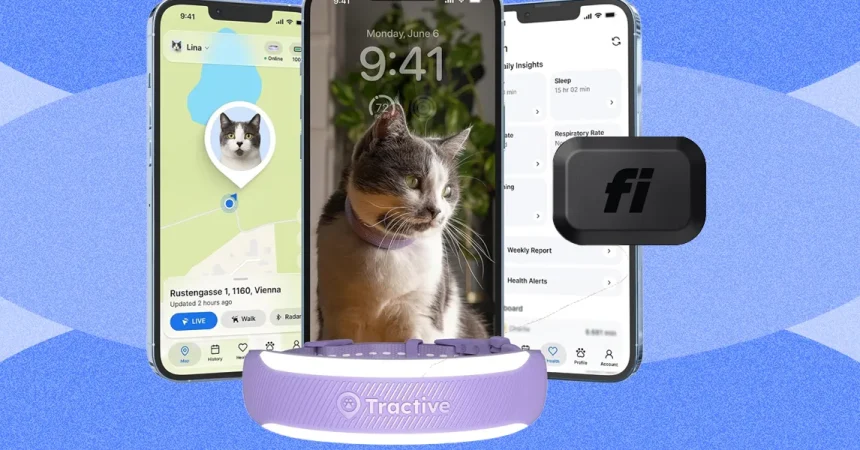
Anyone who shares a home with a cat understands that special mix of affection and alarm when your furry roommate disappears for a little too long. You call the name, rattle the food bag, and eventually start peeking under the couch with a flashlight. A GPS tracker sounds like the perfect cure for that anxiety, and after weeks of living with three different cat trackers, I can say they do bring real peace of mind. But they are not magic. The first and most important lesson I learned is that every single tracker I tested depends on GPS for location. That means the device is only as accurate as the satellite signal it receives, and satellites, as it turns out, can be surprisingly unreliable. If you live in a rural area with fewer towers, or if your cat likes to hide in dense bushes and woodland, the trackers can lose precision or send the data late. Several Reddit and Amazon reviewers specifically called out Tractive for struggling with heavy vegetation, which is a fair warning for anyone whose cat loves exploring overgrown lots or thick gardens. This isn’t a reason to give up on the idea of a tracker; it’s just a reason to adjust your expectations. You may know your cat is within a few hundred feet, but you won’t always get a pinpoint-accurate map marker that leads you straight to a hiding spot. And in the moment when you really need the device, that distinction can matter. Still, there’s something deeply comforting about being able to open an app and see that green dot moving around in the backyard instead of standing on the porch wondering where your little adventurer has gone. The trackers work best as a reassurance system, not a perfect surveillance tool. Once I understood that, I could appreciate what they did offer.
Setting up the companion apps was where the real strengths and flaws started to emerge. With all three trackers, you could draw virtual boundaries and label them as safe zones or danger zones. The app would then send you a notification when your pet walked out of one area and into another, which sounds like exactly the kind of early-warning system a worried cat owner wants. You could set a safe zone around your apartment and a danger zone around the busy street, and then get an instant alert if your cat crossed the line. But I quickly discovered that virtual fences are not as flexible as they seem on paper. My cat Basil is an indoor cat, and my apartment is small, maybe the kind of place that looks great in a magazine but not so great when you need to draw a giant invisible fence around the building. With all three trackers, the smallest safe zone I could create was still too large to fit inside my apartment’s walls. I had to keep expanding it until it extended into the hallway, the sidewalk, and part of the neighboring building. The catch was obvious and a little uncomfortable: if Basil slipped out the door but stayed within that enlarged boundary, I would never receive an alert. He could be sitting right outside my front door, sniffing at the carpet, and the tracker would treat him as being safe and sound. That is the kind of nuance that doesn’t show up in the glossy marketing videos. It made me think about how these devices are often designed with suburban yards in mind, not with tiny city apartments. For someone with a big house and a yard, a virtual fence probably feels natural. For the rest of us, it’s a reminder that technology still struggles to understand the shape of our actual lives.
What surprised me most, though, was how much personality a tracker can reveal. The Tractive app especially made me feel like I was getting to know my own cat in a new way. After I created a profile for Basil, the app used data from similar cats based on age and weight to set daily activity goals for him. It decided that Basil should be active for somewhere between 120 and 230 minutes every day. At first I laughed, because Basil is a professional napper, and I was pretty sure his favorite form of exercise was walking to the food bowl. But over time, the app reported that he was consistently more active than 70 percent of cats in the same group. That statistic did something unexpected: it made me feel proud. Living in a small apartment, I have often worried that Basil is bored or not getting enough stimulation. Seeing that he was moving more than most cats made me feel like all the toys, climbing posts, and little games we play throughout the day were actually paying off. The Tractive app also gives you daily and weekly activity averages, plus estimated calorie burn based on factors like weight and age, so you can spot trends. If your cat suddenly becomes super sluggish, you can see that in the numbers and call your vet if you need to. The sleep-tracking feature is another nice addition, breaking the day into night sleep, day sleep, and calm periods. But the app is honest about its limitations: since it infers sleep from movement and time of day rather than from some kind of cat brain monitor, the data is more of a general pattern than an exact medical measurement. Even so, I found the Tractive app easier to read and much more interesting than the Fi app when it came to activity and behavior. It turned a simple tracking collar into something that felt like a tiny wellness coach for a cat who refuses to wear a Fitbit.
Battery life, on the other hand, is the unglamorous feature that actually decides whether you’ll keep using these devices. A tracker with amazing features is useless if you forget to charge it and it’s dead on the day your cat escapes. That’s where the Fi Mini stood out from the pack. The Fi Mini takes about two hours to reach a full charge, and in my testing that charge lasted around two weeks. Fi itself claims four weeks of battery life, and while my experience didn’t quite match that promise, two weeks is still much better than the Tractive, which died after about five days. I cannot overstate how refreshing it was to not worry constantly about another dead gadget. Charging the Fi Mini was also genuinely convenient because it uses USB-C, which means you can find a cable for it in almost any drawer in your house. The small, compact size is another huge advantage. It didn’t weigh down Basil’s collar or make him look like he was wearing some kind of sci-fi prison device. It also came with multiple easy collar attachments, which made it simple to switch between a breakaway collar for safety and a sturdier strap for outdoor adventures. For a cat, comfort is everything. If a tracker is bulky or catches on things, the cat will soon find a way to make you hate it, and the tracker will end up sitting in a drawer instead of on the animal it’s supposed to protect. The Fi Mini proved that you don’t have to sacrifice compactness to gain battery life, and that alone made it the tracker I reached for most often when I wanted to leave the house without anxiety.
The Fi Mini’s usefulness goes even deeper with the optional Fi Base, a little hub that you plug in at home. This Base does a few important jobs. It can act as a connection source when your pet is at home, which preserves battery life because the tracker doesn’t have to rely on power-hungry GPS as much. It also uses Wi-Fi to improve location accuracy around the house, which is a nice bonus for people who want to know if their cat is hiding in the bedroom versus under the bed. I didn’t get to test the claim that the Base can stretch battery life to six or eight weeks, but the idea alone is appealing. Another lovely bonus for Fi users who wear an Apple Watch is that you can add the Fi app directly to your watch. That means you can check your cat’s location and activity without running back inside to find your phone. You can even enter Lost Mode from your wrist, which is the kind of thing you hope you never need but are grateful to have when your cat slips through a door while you’re carrying groceries and your phone is on the kitchen counter. But the Fi Mini is not flawless, and the pros-and-cons list in the review says as much. Location works best when you’re near your phone, which can be limiting if you’re out while your cat is roaming. The alerts for leaving safe zones can lag, and sometimes the thing fires off false alarms when your pet hasn’t actually gone anywhere. The app also needs to be open on your phone to work properly, and there are no historical location heat maps to show you where your cat loves to hide over time. Those aren’t dealbreakers, but they matter. The perfect tracker would combine Tractive’s rich app data with Fi’s battery life and compactness, but no product does it all yet.
In the end, testing these trackers taught me that there is no single perfect answer, only the best fit for your pet, your home, and your habits. The Tractive is great if you want deep insights into your cat’s activity and sleep, and if you don’t mind charging the battery every few days. The Fi Mini is better if you care about long battery life, easy charging, and a small footprint, and if you can accept the app’s occasional quirks. All of them share the same fundamental reliance on GPS, which means none will ever be 100 percent reliable in every situation. But that doesn’t mean they aren’t worth it. For me, the experience of watching Basil’s activity reports made me feel more connected to his little world. I had proof that he was active, that he was sleeping, that his small apartment life was not a sad existence. And if he ever did slip out, I knew I would have at least a fighting chance to find him before my heart gave out. A tracker is not a substitute for good doors, safe windows, or careful supervision. It’s a backup plan, a nervous-owner’s security blanket, and a window into a cat’s private routines. The trick is to go into it with eyes open, knowing exactly what the technology can and cannot do. Then, when your cat comes home after a night out and meows for dinner, you can smile, glance at the app, and quietly say, “I knew you were safe.” That peace of mind is worth more than any perfect map dot.