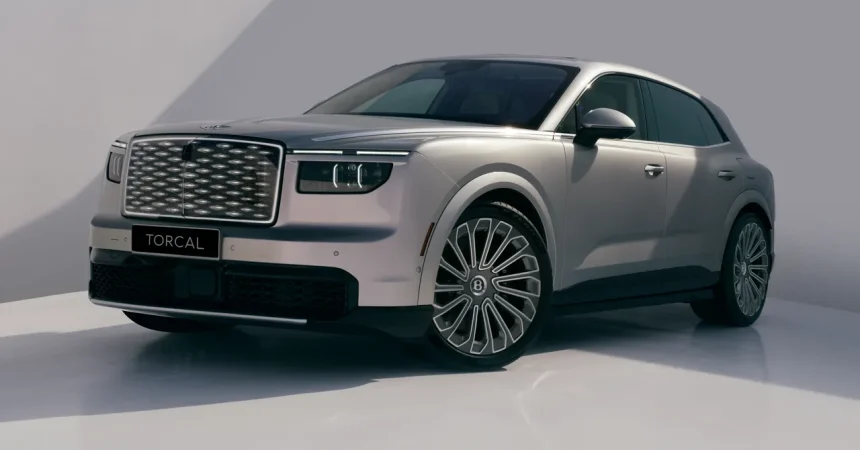
1. The hardest part of building an all-electric Bentley isn’t battery range, charging speed, or even raw performance. It’s the sound—or rather, the sudden absence of it. For more than a century, part of the Bentley experience has been tied to the soundtrack of a large, confident engine, and when that engine vanishes, a big piece of the brand’s personality could vanish with it. So when Bentley began working on the sound for its pure EV, it made a curious choice: no digital fakery, no fake V8 recording pumped through hidden speakers, no attempt to fool your ears into believing there’s still a combustion engine under the hood. Instead, the company went to real instruments—drums, viola, bass guitar—and asked musicians to recreate the rhythm of a Bentley V8 as an actual soundscape. The result is designed to feel organic, alive, and beautifully imperfect, with subtle variations and tiny flaws, much like the animations on the car’s crystal surfaces. If that sounds like a terrible idea, you’re not alone. I was skeptical too. But in the very limited demo WIRED heard, it was remarkably convincing. It doesn’t pretend to be an engine, exactly, but it gives the driver genuine aural feedback—a sense of movement, weight, and urgency that feels musical rather than mechanical. That’s the whole point. Rather than simply imitating engine notes, Bentley is trying to create a new kind of automotive soundtrack that still respects its old one. And mercifully, if you’re not interested in preserving any hint of combustion nostalgia, you can turn the whole thing off. The obsessive attention to detail didn’t stop there. Bentley even recorded the indicator sound using a hammer striking a leather surface, and the digital assistant’s wake note was created by running a finger around the rim of a crystal glass. This is the kind of detail that either strikes you as ridiculous or strangely magical, depending on how much you appreciate old-world craftsmanship. Either way, it’s clear Bentley understands that in an electric car, every sound you hear becomes an identity. When the engine stops singing, the silence has to be filled with intention.
2. All of that audio obsession is only one part of a much larger technology package. Bentley has thrown in an augmented reality head-up display, which projects important information onto the windshield in a way that feels less like a gimmick and more like a genuinely useful tool. There’s also what the company calls Refresh mode, a cabin environment system that uses light and air to make the interior feel more invigorating, presumably for those moments when you’ve been driving too long and need a little extra energy. The car uses face recognition to set itself up for individual drivers, which means it recognizes you, remembers your preferred seating position, your mirror settings, your climate preferences, and probably your mood before you even buckle up. Mobile phone keys mean you can leave the physical key at home, which is becoming more common but still feels futuristic. And then there are the assisted driving systems, supported by some 25 radars, sensors, and cameras scattered around the car. That’s a lot of hardware, and it powers a range of driver assistance features designed to make life easier without taking away the pleasure of driving. One of the more interesting systems is space detection. If the car encounters another vehicle on a narrow road, and there isn’t enough room for both of you, the Bentley can automatically reverse to a point it has already identified as a safe spot to let the other car pass. Having driven on some of the tight, hedge-lined roads of the English countryside, I can tell you that feature alone could save a lot of stress, not to mention a lot of scratched paint. None of this technology is necessarily shocking by modern standards. Lots of luxury cars have head-up displays, face recognition, phone keys, and sensor arrays. But the way Bentley is packaging those features feels intentional. It’s not trying to build a self-driving car that removes the driver from the equation. It’s trying to build a car that supports the driver, responds to the driver, and makes the experience feel more personal. That’s a subtle but important difference, and it’s very much in keeping with the brand’s character.
3. But here’s where I have to pump the brakes a little. As impressive as all of this sounds, none of it is, in the world of automotive, groundbreaking anymore. Chinese brands are coming for the SUV sector with enormous force, and they are offering much, much more for much, much less. Take Xiaomi’s new SkyNomads, for example. These stacked SUVs are expected to arrive in Europe next year, and they will massively undercut both Bentley and Range Rover on price. They also offer more range, more features, and—crucially—they are thinking about car interiors in genuinely new ways. Built-in projector systems, reconfigured seating arrangements, and even heated floors, for heaven’s sake. When you hear that a competitor is offering a heated floor, you have to ask yourself what luxury actually means anymore. Is it hand-stitched leather and a history of Le Mans victories, or is it a cabin that feels like a modern living space with a movie screen and a warm floor under your feet? The Chinese brands are not burdened by heritage. They don’t have to protect an old-world image or worry about diluting a century of tradition. They can just try wild ideas, and some of those ideas are going to land. Xiaomi, a company better known for smartphones and consumer electronics, is already thinking about the car as a connected device in ways that traditional automakers often struggle with. That’s a real threat, not just to Bentley but to the entire premium European automotive industry. It’s easy to dismiss newcomers as lacking soul or history, but you can’t dismiss the straightforward appeal of more range, more tech, and a lower price tag. The market is changing faster than many legacy brands would like to admit.
4. Walliser, Bentley’s chief executive, has a simple answer to this threat from Asia. It’s not to out-tech the Chinese brands. It’s not to engage in a price war, and it’s not to rely on the German engineering reputation alone. Instead, it’s to lean into the one thing he believes Chinese brands cannot copy or improve: heritage. Bentley was founded in 1919, and it has bags of the stuff. There are legendary racing victories, a century of craftsmanship, a particular sense of Britishness that cannot be manufactured or imported. The idea is that while Xiaomi can build a car with a built-in projector and a heated floor, it can’t build a Bentley. It can’t claim the same history, the same pedigree, the same emotional resonance that comes from sitting in a car whose name has been associated with luxury and performance for over a hundred years. That is a powerful idea. People don’t always buy cars based on rational comparisons of range and features. They buy them because of how a car makes them feel, what it says about them, and what it represents. Heritage is not a spec sheet, but it might be more important than any spec sheet. The question is whether it’s enough. Even as Bentley itself is apparently doing well financially, its parent company, the Volkswagen Group, is cutting some 50,000 jobs. That massive restructuring is happening at the same time that Chinese brands are flooding the market, and no brand, no matter how storied, is entirely safe. Walliser is betting that history will carry the day, and that buyers who can afford a genuine Bentley will still choose it over a cheaper, more feature-packed newcomer. But WIRED isn’t sure that’s a winning tactic for the long term.
5. Here’s why I’m skeptical. Heritage is a beautiful thing, but it’s also a backward-looking thing in an industry that is racing toward the future. The Chinese automakers aren’t just offering more equipment for less money; they are redefining what a car interior can be, what ownership means, and what driving should feel like in an electric age. They are experimenting with screens, projectors, seating configurations, and smart-home integration in ways that make traditional luxury feel almost old-fashioned. If Bentley’s response is simply to say, “But look at our history,” that might work for a while, especially with older, wealthier customers who already love the brand. But it’s harder to see how that strategy plays out over the next ten or twenty years, as younger buyers who grew up on smartphones and software begin to enter the luxury market. They may not place the same value on hand-stitched leather or the sound of a hammer striking leather for the indicators. They might prefer a cabin that feels more like a digital lounge, with entertainment systems and reconfigurable seats that adapt to their needs. Bentley doesn’t need to abandon its heritage, but it also can’t freeze itself in the past. The real-instrument engine sound, the glass animations, the carefully crafted user experience—those are all steps in the right direction because they take the old-world craftsmanship and translate it into a new electric vocabulary. The danger is when heritage becomes a crutch, a reason not to innovate, a shield against the uncomfortable reality that the market is moving very fast. The next few years will be a test, not only of Bentley’s engineering but of its imagination.
6. So what does this all mean for Bentley’s continued commitment to fully electric cars? Hopefully, it means we’ll see more of this kind of thoughtful, human approach to electrification—a car that doesn’t just apologize for being electric but embraces the new possibilities that electric power creates. The sound design is the clearest example of that. Instead of trying to recreate a digital replica of combustion, Bentley has chosen to create something different: a rhythm that echoes the old V8, but with real instruments and real imperfections, so that the car feels alive in a way no synthesized noise ever could. That’s not nostalgia; it’s evolution. It’s using the tools of the past to build something for the future. But the threat from Asian competitors remains real, and Walliser’s reliance on heritage is a gamble. Heritage can create loyalty. It can create emotion. It can make someone choose a car even when the spec sheet says another car is objectively better. But it cannot, on its own, guarantee success. It has to be paired with genuine innovation, with technology that feels modern and useful, and with an understanding that the meaning of luxury is shifting. A heated floor, a projector, and a seating system that reconfigures itself might not sound as romantic as a hammer striking leather, but they are exactly the kind of features that make people feel something too. In the end, Bentley has a chance to stand out by combining the two worlds—using its heritage as a foundation, not a fence around it. If it does that, there’s real hope for its electric future. If it just points to the past and hopes that’s enough, WIRED remains unconvinced. The journey ahead will be complicated, but the first sound you hear from that new Bentley might just be the most important one: a sound that says the brand is still learning, still changing, and still refusing to imitate. And that’s something worth listening to.