1.
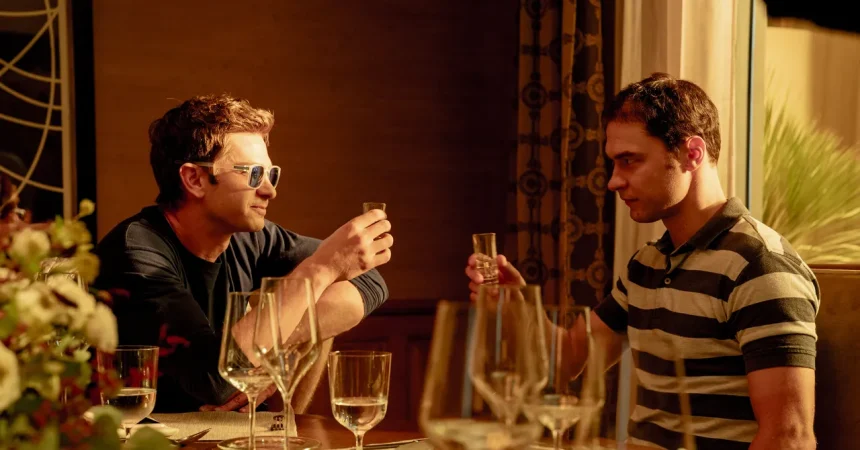
History, it turns out, does not stride. It shambles, skips, lurches, and swaggers. That is the first and most delightfully disarming message of Artificial, the new comedy-drama from Luca Guadagnino about the rise of OpenAI and the larger artificial-intelligence arms race. This is a movie of weird walks, and the walk is the metaphor. As Ilya Sutskever, the brilliant and troubled OpenAI cofounder, the Russian actor Yuri Borisov clomps through scenes like a geeky Frankensteinian monster, his limbs seemingly assembled from mismatched parts and his body perpetually at war with the idea of social grace. As Sam Altman, the controversial and endlessly quoted CEO of OpenAI, Andrew Garfield bounces and skips with boyish, almost manic energy—a gait so recognizable that Altman himself, in one of those strange real-world footnotes that the modern era keeps producing, recently praised its accuracy. And as Elon Musk, Ike Barinholtz slouches and lopes through rooms full of computer nerds like some kind of alpha gorilla, his long, pouting face occasionally recalling the bored, smug expressions of those old Bored Ape NFTs. It is a masterstroke of physical comedy, this trio of gaits, and it suggests something profound about the people who are remaking the world in the image of their own fever dreams. They are not majestic figures. They are not sleek visionaries. They are, in many ways, just awkward people walking awkwardly through the most consequential decades in human history. During the film’s post-premiere Q&A at the New York Film Festival, Barinholtz dryly described his Musk as “a person who walks normally,” which of course made the audience laugh, because nothing about any of these people is normal, least of all the way they move through the world.
2.
It is fitting that Artificial arrived at the New York Film Festival with a cloud of controversy hovering around it, because the story it tells is itself a story of power, money, and the strange forces that shape public narrative. The film was originally set to be released by Amazon MGM, which conspicuously dropped it this summer after Amazon struck a staggering $50 billion deal with OpenAI. That is the kind of detail that would feel like satire if it were written into a screenplay, but it happened in real life, and it hangs over the movie like a warning. The independent distributor Neon swooped in to rescue the film, and NYFF artistic director Dennis Lim made a point of referencing “the circumstances” around the project in his onstage introduction, which was as diplomatic a way as any of saying: yes, we all know that the company that was supposed to release this movie now has more than a passing financial interest in making sure the people it depicts look good. And it is easy to see why OpenAI might have had issues with Artificial. The film is almost completely unflattering to its subjects. It depicts Altman, Sutskever, Musk, and the broader ecosystem of AI executives, engineers, and venture capitalists as vain, reckless, and, perhaps most damning of all, insufferably boring. They are not monsters in any traditional sense; they are something worse. They are people who believe their own press releases, who speak in the flat, buzzing language of metrics and benchmarks, who treat the future of humanity as a game to be won. Where a film like The Social Network succeeded in making Silicon Valley computer savants look like robust titans of industry and architects of the future, Artificial works in exactly the opposite direction. It reduces its tech titans to self-regarding dweebs, and in doing so, it offers a far more honest portrait of power than many of the hagiographic documentaries and biographical dramas that have come before.
3.
The performances are the heart of the film, and they are what elevate Artificial from a mere take-down to something more layered and weirdly tender. Andrew Garfield, who has made a career of playing people on the edge of emotional collapse, brings an almost unbearable intensity to Sam Altman. This is not the Altman of magazine profiles and congressional hearings, the polished and carefully modulated missionary of artificial intelligence. This is Altman as a seducer, a man who is always leaning in, always charming, always calculating the least necessary amount of honesty that will get the result he wants. His wooing of Sutskever is the film’s central relationship, and Guadagnino films it with the rhythms of a romance. There are long looks, late-night conversations, promises made in soft voices. But the romance is, as the film makes clear, entirely transactional. Altman is not in love with Ilya; he is in love with what Ilya can do for him. Yuri Borisov, meanwhile, gives a performance that is almost entirely physical. His Sutskever is a man drowning in his own intelligence, someone who sees further than anyone else and is therefore the most isolated person in the room. He clomps because walking is hard when you are carrying the weight of the future. He struggles to make eye contact because he is always looking somewhere else, somewhere beyond. And Ike Barinholtz’s Elon Musk is a genuinely funny creation, a caricature that somehow feels more real than the real thing. He does not so much enter a room as occupy it, his swagger suggesting a man who has never once doubted himself and never once paused to ask whether he should. The fact that all three performances are grounded in such distinct physical vocabularies makes the film feel almost like a dance, or perhaps more accurately, a funeral procession in which the pallbearers keep stepping on each other’s feet.
4.
Comparisons to The Social Network are inevitable, and they are also useful, because they highlight how much has changed in the way we think about technology and the people who build it. Both films center on Garfield, both deal with the birth of a transformative digital platform, and both feature scenes of betrayal, legal maneuvering, and the moral compromises that come with success. But where David Fincher’s film was cool, polished, and wordy—a Caleb Deschanel-drenched, Aaron Sorkin-penned intellectual thriller—Artificial is pitched as a black comedy that verges on the surreal. Guadagnino and writer-producer Simon Rich are less interested in the mechanics of innovation than in the absurdity of the people who claim to be innovating. The result is a film that feels less like a documentary portrait and more like a fever dream, a satirical fable in which the most powerful men on Earth are also the most ridiculous. It is not a coincidence that the film’s visual language is so plain, so deliberately ugly. The images are flat, functional, and drained of beauty, as if the filmmakers are telling us that there is nothing beautiful about this world. You can almost feel Guadagnino’s more rococo style begging to break out. He is a director who thrives on texture and sensuality, and here he seems to be forcing himself to work against his instincts. The result is uncomfortable, which is exactly the point. The men in this film do not create beauty; they create systems. They do not build cathedrals; they build platforms. And yet the ambition is the same. This is a film about people who want to remake the world, and it is sickened by what they want to remake it into.
5.
Guadagnino is best known for films that pulse with tense eroticism—the coming-of-age ache of Call Me by Your Name, the three-way tennis romance of Challengers—and Artificial contains faint echoes of that sensibility. In particular, the relationship between Altman and Sutskever has a queasy sexual undertone. Altman is constantly inching closer, lowering his voice, making his pitch sound like a promise. He is a seducer, and kissing is the wrong metaphor; what he wants is extraction. But despite these traces, Artificial is, for the most part, literally and figuratively sexless. There is no intimacy in this world, only transaction. There is no touch, only the meeting of screens and the glow of conferences. The one scene that tries to capture joy—a slow-motion shot of a room of gawky programmers dousing each other in bottles of Jarritos, celebrating their AI’s latest self-learning benchmark—is sticky and unsexy, a locker-room celebration that feels like a euphemism for something hollow. Even the climactic confrontation between Altman and Sutskever, staged on a sloping San Francisco street, feels off-kilter, its green-screen backdrops recalling the strange artificial depth of Tommy Wiseau’s cult classic The Room. It is a strange choice, and it is an intentional one. Guadagnino is not trying to create a realistic portrait of San Francisco; he is trying to create a portrait of a place that is already disappearing, being replaced by a world that the men in his film are designing in their own image. After the screening, Guadagnino claimed that the story captured a different strain of desire, something he described as “the desire to prevail.” That is the key to the film. Every character in Artificial is driven by the desire to prevail, to be the one who wins, to be the one who survives, to be the one who is no longer awkward because they no longer have to care what anyone thinks.
6.
What ultimately makes Artificial resonate is its refusal to treat its subjects as heroic or even tragic. The film’s implicit argument is that the AI boom is not a story of genius, despite what its protagonists would have you believe. It is a story of insecurity, ambition, and the desperate need for validation. The men who are building the future are not gods; they are people who have spent their lives being told they are too smart for the room, and they have decided to build a room of their own. The film is not subtle about its contempt for them, but it is also not cruel. It is, in its own strange way, sympathetic. These are people who cannot help themselves. They are afraid of being ordinary, afraid of being forgotten, afraid of being left behind. And so they plow forward, clomping and skipping and loping toward a horizon that they may not even understand. The walk is everything. The walk is the admission that they do not know where they are going, only that they cannot stop. Artificial may be a comedy, but it is also a eulogy for a particular kind of human confidence, the kind that believes technology can outrun the messiness of being alive. The film’s title has a double meaning. It refers to artificial intelligence, sure, but it also refers to the artificiality of the lives being depicted. These are people who have built a world that leaves no room for the very human textures they are trying to escape. They have sacrificed their bodies for their minds, their relationships for their algorithms, their normal walks for the strange, awkward gaits of men who are marching toward something they cannot name. And we are all, in some way, walking behind them, trying to keep up, trying to stay balanced, trying to figure out where the future is heading and whether we still have a place in it.