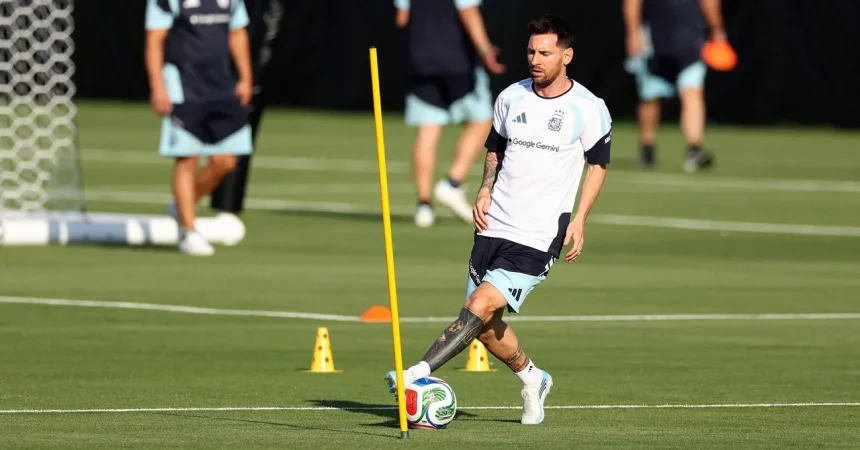
The intersection of technology and professional athletics has always been a space of rapid evolution, but the latest development feels like a leap into a new era. As we approach the upcoming World Cup, artificial intelligence is stepping out from behind the curtain to take center stage. Google has formed a groundbreaking partnership with the Argentine Football Association (AFA), positioning its AI powerhouse, Gemini, as a headline sponsor for the defending champions. This isn’t merely a corporate logo slapped onto a jersey; it is an active integration of machine learning into the very fabric of how a world-class team prepares for the most grueling, high-pressure tournament in sports. By embedding Gemini into the team’s training kits and analytical pipelines, Argentina is essentially inviting the brightest minds in Silicon Valley to sit on the bench with the coaching staff, helping to parse complex game data at speeds human observers simply cannot match.
For the Argentine coaching staff and their players, this partnership is designed to streamline the chaotic, split-second decision-making required in modern soccer. Instead of spending grueling hours manually dissecting hours of footage or poring over static spreadsheets, they will now be able to leverage AI models to identify patterns in opponent formations, track player performance metrics, and simulate tactical shifts in real-time. Flor Sabatini, a spokesperson for Google, wisely acknowledges that the goal is not to automate the spirit of the game, but to test the boundaries of what this technology can actually deliver. By integrating these analytical tools, the team hopes to turn raw data into actionable intelligence, effectively shortening the “knowledge gap” between identifying a weakness in an opponent and actually exploiting it on the grass. The World Cup serves as the ultimate stress test for these systems, proving that AI is no longer just a trend in testing labs—it is a functional teammate.
Beyond the tactical intensity of the locker room, Google is reimagining the fan experience through the lens of Gemini. For the millions of people watching from home, the search engine will transform into a hyper-personalized companion, behaving less like a static directory and more like a die-hard fan sitting next to you on the couch. Fans can ask complex questions about match dynamics, receive deep-dive statistical insights in plain language, or even generate creative content like memes, songs, and cartoons to celebrate their team’s journey. By turning the search bar into a creative studio and an analytical hub, Google is tapping into the emotional heart of the World Cup. It acknowledges that the tournament is more than just ninety minutes of soccer; it is a shared global language, and for the first time, fans have an AI tool designed to help them articulate that passion in real-time.
Securing this partnership was a long-game strategy for Google, beginning as early as March. While the AFA holds the spotlight—largely due to the star power of legends like Lionel Messi—the reach of this project extends to other heavyweights like Brazil and France. For Google, this isn’t just a marketing campaign; it is a declaration that the World Cup remains the preeminent cultural event on the planet. From the perspective of the football federations, bringing in a partner like Google represents a necessary modernization. Soccer is a sport famously anchored in history and tradition, but it is also a massive commercial engine that must constantly evolve to stay relevant. By embracing AI, these storied organizations are ensuring they aren’t left behind as the digital age continues to reshape how global brands engage with their audiences.
However, moving this technology into the bright, unforgiving glare of the World Cup is a risky venture. Unlike a controlled corporate environment, the World Cup is a cauldron of volatility, cultural nuances, and billions of eyes watching for a single misstep. The stakes for Gemini are incredibly high; a single “hallucination”—an error in statistics, a botched lineup projection, or an AI-generated image that gets the details of a team shield wrong—will be magnified instantly across social media. The human element of soccer is defined by the unexpected, and AI is inherently predictable in its logic. If the technology stumbles, the backlash will be swift and public. Google is essentially betting that the utility of its AI will outweigh the inevitable public scrutiny that comes with being a high-profile, real-time participant in the world’s most watched sporting event.
History shows us that the World Cup acts as an accelerant for technological adoption. Just as the tournament once propelled the adoption of color television, and more recently, the controversial implementation of video-assistant referee (VAR) technology, AI is now making its inevitable debut as the next great disruptor. Yet, there is a distinct difference in scale this time around. Never before has a singular tech entity managed to bridge the gap between the physical pitch and the digital smartphone screen simultaneously. By placing the Gemini brand on the players’ chests and the fans’ devices, Google is attempting to weave its intelligence into the very narrative of this tournament. We are witnessing a fundamental shift in how the beautiful game is played, coached, and consumed, and for better or worse, the future of the World Cup is now being written in lines of code as much as in goals.