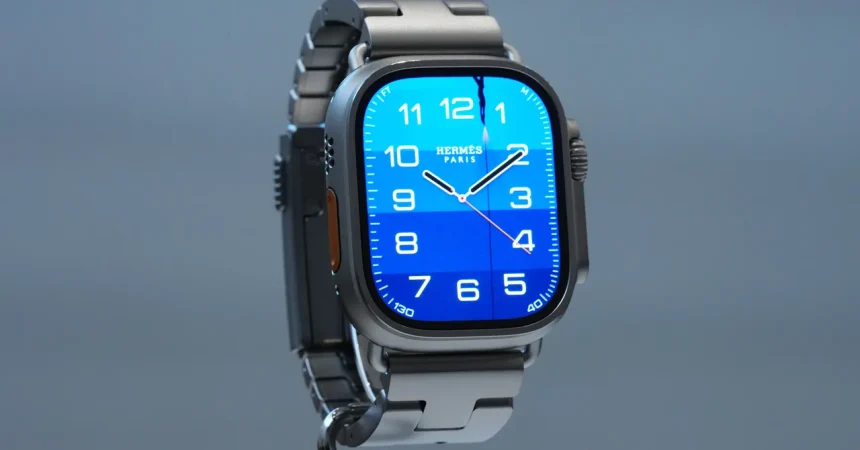
The new Apple Watch Series 12 and Ultra 4 are here, and on the surface they look like the same polished, powerful wearables people have come to expect: sharper screens, better fitness tracking, upgraded noise reduction, and all the usual health-focused refinements. But this year’s announcement comes with something genuinely unexpected, a feature set that isn’t about your heart rate, your steps, or your sleep. It’s about sound. Apple has introduced a suite of four new opt-in “audio intelligence” tools, all powered by the microphones built into the watches, and together they represent a whole new way for a wrist-worn device to interact with the world. These tools can do some remarkable things. They can recognize sounds and music, summarize conversations, and even rewind the recent audio past. Imagine you’re in a meeting and someone mumbles an important instruction, or you’re at a party and a song you love is playing but you can’t place it, or you’re home and you think you hear a smoke alarm in the distance. The new Apple Watch features are designed to help with exactly these situations. They include sound recognition, which alerts you to things like doorbells, sirens, alarms, or a baby crying; music recognition powered by Shazam; a conversation recap feature built into Siri; and something called Live Rewind, which lets you see a transcription of anything that was said in your environment during the previous 15 seconds. All of it is opt-in, meaning nothing activates until you decide you want it to. But the bigger shift here is philosophical: Apple is turning the watch from a passive health tracker into an active listener, a device that is aware of the acoustic environment around you and can make sense of it in useful ways.
It’s not hard to understand why Apple is moving cautiously. Any feature that involves a microphone immediately raises red flags for people who are already worried about phones, watches, and smart speakers listening to private conversations. The idea that your watch might be capturing snippets of audio, even for a useful purpose, can feel like something out of a surveillance thriller. Apple seems fully aware of this, and the company has gone out of its way to emphasize that privacy and security are built into the very foundation of these new tools. In a report shared with WIRED, Apple made some strong promises: the audio intelligence features do not create or store audio recordings, and the raw audio used for processing is completely inaccessible to the operating system, to apps, to the user, or even to Apple itself. That last part is striking. It means that even if someone managed to break into your watch, they wouldn’t be able to pull out the actual audio files, because the audio is never stored in a conventional way in the first place. Instead, the data is handled inside a protected, isolated environment and processed as quickly as possible. Apple says the features are designed to do as much work as possible directly on the device, so that sensitive information never has to leave the watch at all. For the few tasks that do require cloud assistance, the data is preprocessed and transformed before it goes anywhere, and it is sent through Apple’s Private Cloud Compute infrastructure, the same privacy-focused system used for Apple Intelligence and Siri. In other words, the company is trying to thread a very narrow needle: giving you useful audio-based features without making you feel like the walls have ears.
Under the hood, the hardware doing a lot of this heavy lifting is a new component called the Secure Exclave, and it’s part of the reason Apple feels comfortable making these promises. The new Apple Watch models run on the company’s S11 chip, which includes a specially protected memory space designed specifically for sensor data. You can think of the Secure Exclave as a locked vault inside the watch’s brain. It is an isolated buffer that is completely inaccessible to the rest of the operating system and to any apps running on the watch. This means that when audio is collected, it doesn’t get passed around the normal system where other software could potentially access it. It goes straight into the vault, is processed there, and then disappears. This is a fundamentally different approach from the way most microphone-based features work on other devices. Usually, when an app wants to hear what’s happening, the operating system has to hand over a stream of audio, and the app then processes it. With the Secure Exclave, that stream never enters the general system. It remains sealed off, even from the user. This matters because it makes certain features possible without the usual privacy trade-offs. For example, the Sound Recognition feature can listen for important environmental sounds like doorbells, sirens, alarms, or a baby crying, and it can do this entirely on the watch. No data is sent to the cloud. The watch simply recognizes the pattern of the sound locally and sends a notification to your wrist. That’s genuinely useful for people with hearing difficulties, or for anyone who wants an extra set of ears in a noisy home. It also shows how far on-device processing has come. A small computer on your wrist can now understand complex sounds in real time, all while keeping the raw audio completely private.
The music recognition feature, which is powered by Shazam, is another example of this privacy-first thinking. Shazam has always worked by creating a digital fingerprint of a song, a unique mathematical signature that can be matched against a database of known tracks. On the new Apple Watch, the watch is essentially always listening for music, but it’s not recording what you hear. Instead, it generates a signature for any music it detects, and that signature is temporarily stored in the Secure Exclave. If you later want to know what song is playing, you can open Shazam, and the watch will send that signature, not an audio file, to Shazam’s servers for identification. Shazam is an Apple-owned service, so the entire process stays within Apple’s ecosystem. If you never ask the tool to identify a song, the signature is immediately deleted from the watch. If you do ask, it’s sent, used, and then deleted. There’s no library of your listening history being built in the background, and there’s no way to turn the signature back into sound. It’s an elegant approach, and it should offer some reassurance to anyone who has ever wondered what happened to the audio captured by their devices. The raw audio never leaves the watch, and the only thing that travels to the cloud is a meaningless code. This is a very different model from the assistant-style approach of recording a snippet, uploading it, and only then processing it. It’s a model that treats privacy as a feature, not an obstacle.
Perhaps the most ambitious of the new tools is Siri Recap, a conversation summarization feature that feels like it was pulled straight out of science fiction. Siri Recap can be set to run all the time, quietly listening for any substantive conversation that might be worth summarizing, or it can be scheduled to listen at certain times of day, perhaps during your commute or around dinner. But here again, Apple is going out of its way to avoid the creepy interpretation. The feature does not record conversations in the traditional sense. A dedicated AI model on the watch is responsible for figuring out when speech is actually occurring, and it does that without recording or transcribing anything. Only after it detects that a real conversation has started does audio begin flowing into a protected buffer inside the Secure Exclave. From there, the watch encrypts the audio and sends it over Apple’s secure Bluetooth pairing to the Secure Exclave on your iPhone. Then the audio is immediately deleted from the watch. The iPhone takes over, using local speech recognition and language models to transcribe the audio and then generate a minimal version of the transcript, removing nonessential elements like filler words, repeated phrases, and verbal clutter. The raw audio is then deleted from the iPhone as well. Finally, a safety model screens the transcribed text to omit potentially harmful terms before the summary is sent to the cloud. Even at that final stage, the conversation summary is encrypted and transmitted to Apple’s Private Cloud Compute infrastructure, not to some open data center. The result is meant to be a clean, useful distillation of what was said, not a word-for-word recording. You might get a quick note that you talked about dinner plans with your partner, or that your colleague reminded you about a schedule change. What you won’t get is a secret tape of your day.
The last new feature, Live Rewind, is perhaps the easiest to understand and the most immediately practical. If you’ve ever found yourself in a conversation and suddenly realized you missed a key detail, Live Rewind is designed to help. It gives you a transcription of anything that was said in your environment in the previous 15 seconds, so you can catch up without asking someone to repeat themselves. It’s like a tiny time machine for your ears. The feature is opt-in, like everything else, and it works within the same privacy framework as the rest of the audio intelligence tools. It doesn’t create stored audio recordings, and the transcription process happens locally, so you aren’t sending your conversations to some distant server just to catch a missed comment. Taken together, these new capabilities are a reminder of how rapidly AI is becoming woven into every corner of everyday life. It wasn’t that long ago that the idea of a watch being able to summarize a conversation would have seemed like pure fantasy. Now it’s just another feature buried in a product announcement. Apple’s approach stands out because of its commitment to keeping sensitive audio on the device and using specialized hardware like the Secure Exclave to enforce those boundaries. But the broader trend is bigger than Apple. Across the tech industry, AI-powered audio and visual intelligence are becoming standard tools in computing, in our phones, in our cars, and now on our wrists. That shift brings enormous convenience, but it also forces us to confront a uncomfortable question: how much of our daily environment are we willing to let our devices understand? Apple is betting that the answer is “a lot,” as long as users feel they have control and that their privacy is genuinely protected. Whether the new audio intelligence features are embraced or ignored will depend on whether they feel like a genuinely helpful extension of the watch, or simply an electronic ear that nobody asked for. Either way, the new Apple Watch Series 12 and Ultra 4 are still excellent fitness and health companions. Now, however, they are also listening companions—and the relationship we build with them will tell us a lot about the future of ambient computing.