There is something deeply human about the urge to rescue things we love, even when they are old, broken, or far beyond reach. NASA knows this feeling well. In recent years, the agency has performed remarkable acts of space salvage, including the mission that brought home astronauts who had been stranded aboard the International Space Station. But not every rescue is for people. Sometimes it is for a machine that has served faithfully for decades and deserves one more chance. That was the idea behind the attempt to save the Neil Gehrels Swift Observatory, a satellite launched in 2004 to study some of the most violent and fleeting events in the universe. Swift had spent more than twenty years circling Earth, watching the sky with its trio of telescopes, alerting scientists to exploding stars, gamma-ray bursts, and the eerie moments when black holes rip apart passing stars. It had become, in a very real sense, a companion to astronomers, a set of eyes that never slept, always watching for the universe’s sudden fireworks. But time and gravity had caught up with it. The observatory began sinking, slowly losing altitude, and NASA worried that a valuable scientific voice would soon be silenced. So the agency sent up a rescue probe named LINK, carrying robotic arms and a powerful set of thrusters, hoping to grab the aging satellite and push it back into a safer orbit. It was a bold, almost romantic plan, the kind of mission that captures the imagination because it tries to rewrite fate. Everyone involved knew the odds were against them, but they also knew that doing nothing would guarantee the end. So they tried.
The decision to attempt such a rescue was not made lightly. Swift was never designed to be touched by another spacecraft. It had no docking port, no handles, no spare parts waiting in a garage. It was a scientific observatory, not a car on a lift. Yet engineers believed that with careful planning and a little luck, a robotic visitor could latch onto it and give it the boost it needed to keep flying. The mission was called a high-risk, high-reward gamble, and the people who worked on it spoke about Swift with affection, almost as if it were a patient on an operating table. They wanted to buy it more time, not just for the sake of the satellite itself, but for all the discoveries it could still make. In that sense, the rescue attempt was a gift, a way of saying thank you to a machine that had given so much. And even though the rescue would ultimately fail, the effort itself said something important about how we treat the tools we send into space. We do not abandon them easily. We try to bring them home, or at least keep them alive for a little longer.
The rescue plan was as ambitious as it sounded. LINK, the probe built by Katalyst Space, was designed to approach Swift carefully, extend its robotic arms, and clamp onto the old satellite. Once attached, LINK would fire its powerful thrusters, not to pull Swift like a tugboat, but to push the entire combination into a higher, more stable orbit. It was a delicate maneuver, requiring precise timing and flawless navigation. Ghonhee Lee, the CEO of Katalyst Space, acknowledged before the launch that Swift had never been meant to be serviced. There were no handholds, no visual markers to guide a rescuer, no systems designed to accept help from the outside. Still, the team believed it was possible. NASA’s astrophysics division director, Shawn Domagal-Goldman, described the mission as high-risk, high-reward. If it worked, it would not only save Swift, but it would prove that humanity could begin to repair and maintain old spacecraft rather than simply watching them die. That is a future many in the space industry dream about, one where satellites are not disposable but can be refueled, repaired, and pushed back into place. LINK was a step toward that future. The probe launched in July, and for a short time, there was hope. But soon after reaching space, LINK began experiencing problems with its attitude control systems, the complex set of sensors and thrusters that allow a spacecraft to know which way it is pointing and to move deliberately. Without those systems, approaching Swift would have been impossibly dangerous. Trying to grab a satellite while tumbling out of control could have damaged both spacecraft, turning a rescue into a collision. Mission controllers had no choice but to cancel. The dream of catching Swift and lifting it back into orbit died quietly, somewhere far above the Earth, leaving the old observatory to continue its slow fall alone.
To understand why Swift is falling, it helps to think about the thin, invisible atmosphere that surrounds our planet. Even at the altitude where Swift orbits, there is not a perfect vacuum. The uppermost layers of Earth’s atmosphere are incredibly sparse, but they are not empty. As a satellite moves through this faint haze, it collides with tiny particles, and each collision steals a little bit of energy, slowing it down. This drag gradually lowers the satellite’s orbit, pulling it closer and closer to Earth. For most satellites, this is a slow process, but it is also relentless. Swift has been fighting this battle for over twenty years, and for most of that time, scientists expected it to remain in orbit until around 2030. Then something changed. The sun, which goes through cycles of activity, became more turbulent. During periods of intense solar activity, the sun releases bursts of energy and charged particles that heat Earth’s upper atmosphere. Heated air expands, becoming denser at higher altitudes, which means satellites experience more drag. This is what happened to Swift. The atmosphere swelled outward, wrapped itself around the observatory, and began pulling it down faster than anyone had predicted. Now, instead of years of life remaining, Swift may reenter the atmosphere as soon as the end of this year. There is something quietly sad about this. Swift is not failing because of any flaw in its instruments. Its telescopes still work, its computers still think, its heart still beats. It is simply being dragged down by forces beyond its control, a victim of cosmic weather. The same sun that gives life to our planet is also, in a way, determining the fate of one of our most beloved eyes on the universe.
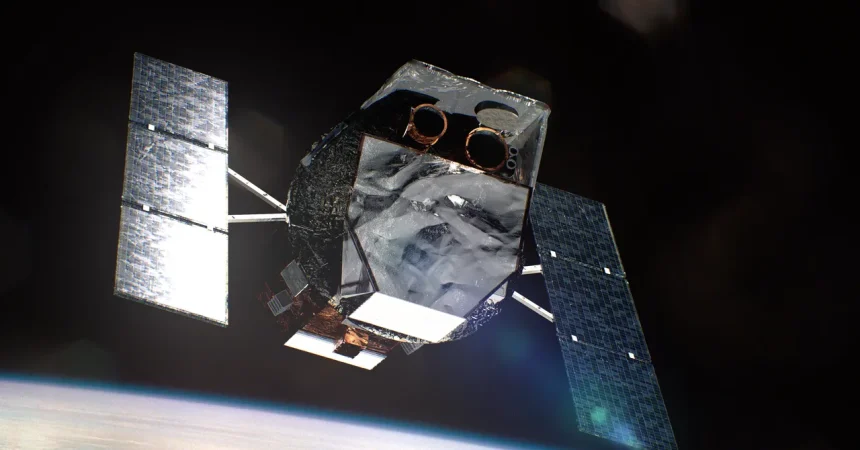
What makes Swift so special is not just how long it has lasted, but what it has spent that time doing. The observatory carries three primary telescopes, each designed to see the universe in a different kind of light. Together, they allow Swift to observe visible light, ultraviolet, X-rays, and gamma rays, a broad range of wavelengths that gives scientists a fuller picture of cosmic events. This versatility has made Swift an essential first responder for the most explosive and short-lived phenomena in the universe. When a massive star collapses into a supernova, when two neutron stars crash together, when a black hole tears apart a passing star, the event often produces a flash of high-energy radiation that vanishes within seconds or minutes. Swift is built to catch these flashes, determine where they came from, and alert telescopes around the world so that everyone can point their instruments in the right direction. Over the past twenty-one years, it has done this thousands of times. It has watched gamma-ray bursts from the edges of the universe, phenomena so powerful that they outshine entire galaxies for a brief moment. It has recorded supernovas that mark the violent deaths of stars, and it has witnessed the slow, gruesome destruction of stars by supermassive black holes. Each of these observations has added a small piece to the puzzle of how the universe works. To astronomers, Swift is more than a satellite. It is a guardian, a lookout, a faithful friend that never tires of watching the sky. The thought of losing it is not just a technical loss. It feels personal, like losing a colleague who has been with you through every long night of observing.
Now that the rescue mission is over, the Swift operations team has shifted into a different mode. Instead of trying to save the observatory, they are trying to squeeze every last drop of science out of its remaining time. Before the rescue attempt, Swift’s telescopes had been shut down as a precaution. The team wanted to conserve power, keep the solar panels pointed at the sun, and minimize air resistance by keeping the spacecraft in a stable configuration. It was a way of preserving the satellite, of keeping it alive and steady in case LINK arrived and managed to grab hold. But once the rescue was canceled, there was no longer any reason to wait. The team began waking Swift up, and two of its three telescopes are already back in action. The X-ray telescope, in particular, has proven that Swift still has fire in its soul. It captured new images of the Tycho supernova remnant, the expanding debris cloud left behind by a star that exploded in 1572, a supernova that was so bright it was visible during the day and was studied by the astronomer Tycho Brahe. The remnant lies about thirteen thousand light-years away, and the images Swift took are a reminder of the observatory’s ability to see across vast distances and through time. The Burst Alert Telescope, the instrument that detects gamma-ray bursts, is still powered down, but engineers are working to bring it back online too, with the goal of resuming full observations within a few weeks. There is a certain joy in this final chapter. The satellite is not going gently into the night. It is still observing, still sending data, still doing the job it was built to do. The people who operate Swift know that the end is coming, but they are choosing to celebrate what remains rather than mourn what will be lost.
Still, the end is coming, and it is arriving faster than anyone expected. Once Swift’s altitude falls below about 185 miles above Earth’s surface, the atmosphere becomes thick enough that operating its telescopes becomes increasingly difficult. The spacecraft will have to work harder to keep itself stable, and the descent will accelerate as the air grows denser. Eventually, the observatory will reenter Earth’s atmosphere and burn up, a bright streak across the sky that will mark the end of a remarkable mission. There is no way to stop it now. But researchers are not spending their final weeks with Swift in sorrow. They are looking forward to what else it might capture before it is gone. Every additional observation, every new image, every flash of gamma-ray light is a gift, a piece of information that will outlive the satellite itself. In a way, Swift is like a brilliant scientist nearing the end of a long career, still eager to make one more discovery, still excited by the mysteries of the cosmos. The universe has been kind enough to keep sending fascinating signals, and Swift has been wise enough to keep watching. When it finally falls, it will not be forgotten. Its data will be studied for decades, and its legacy will live on in the discoveries it made and the questions it inspired. The attempt to rescue it may have failed, but the mission itself was never really about saving a machine. It was about honoring something that mattered. And in that, Swift has already succeeded. It reminded us why we look up, why we explore, and why we refuse to stop trying, even when the odds are against us.