Here is a humanized summary of the provided content, structured into six paragraphs:
It is a humbling realization that the blueprint for intelligence is not confined to the skull, but resides within every cell of our bodies. Scientists have unlocked a profound secret: by carefully coaxing skin cells in a laboratory setting, they can trigger a transformation that turns simple tissue into living, breathing, miniature brains. These “organoids”—clumps of gray matter containing millions of neurons—are far more than mere biological curiosities. Kept in carefully controlled conditions that mimic the warmth of the human body, they begin to fire electrical signals, producing brain waves that are hauntingly similar to those of a premature infant. While they lack the complexity of a fully formed human mind, these clusters serve as a powerful testament to the inherent, irrepressible drive of neurons to organize, communicate, and grow.
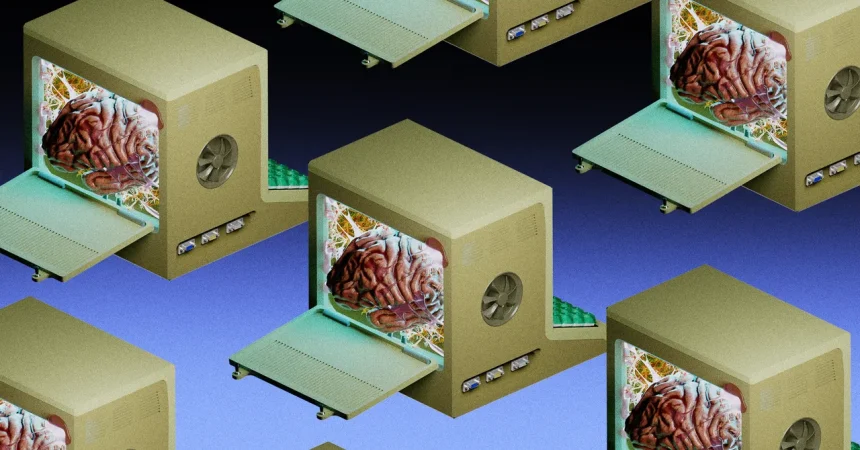
Currently, these lab-grown organoids are serving as the ultimate “neural guinea pigs,” helping researchers understand the mechanics of disease, test the safety of new medications, and observe how toxins impact human tissue. Yet, the scope of their utility is expanding rapidly, moving from the clinical to the almost science-fictional. In laboratories from San Diego to Melbourne, researchers are teaching these organoid clusters to navigate robotic mazes, responding to chemical stimuli like dopamine, and even learning to master rudimentary video games like Pong or Doom. As the world remains fixated on the evolution of silicon-based artificial intelligence, these biologists are pursuing a different path: the creation of “biocomputing,” where the future of intelligent systems is built not from code, but from the raw, living materials of human life.
This intersection of biology and technology is perhaps best exemplified at the University of California, San Diego, a place where the architecture of the Geisel Library—a towering, brutalist structure—seems to mirror the futuristic nature of the work being done inside the nearby labs. Tucked away within these halls are images that capture the essence of our neural potential: microscopic snapshots of brain cells in petri dishes, their threadlike axons stretching outward with a sort of biological desperation. There is a palpable yearning in these images, a reflection of the fundamental human need to connect. When these cells are brought together, they do not remain stagnant; they multiply, weave themselves into networks, and create the very synapses that form the foundation of human thought.
The driving force behind this research is a belief in the “intrinsic property” of our brains to build bridges. At the Sanford Stem Cell Institute, biologist Alysson Muotri oversees the cultivation of these organoids by the thousands, observing how they immediately begin to seek out connections—linking to one another, to the dishes they inhabit, and to the electrodes designed to record their activity. To watch this process is to witness the essence of humanity distilled into a biological process. It is a reminder that the urge to link up, to understand, and to communicate is not just a social behavior but a cellular one, hardwired into the very fabric of our being from the moment we begin to develop.
The motivations behind this work are often deeply personal, rooted in the desire to solve the most complex puzzles of human health. For Dr. Muotri, this is not just about the technical marvel of creating “Neanderthalized” brain organoids or studying the effects of deep space radiation on neural health; it is about his son. By studying organoids grown from the genetic signatures of autistic individuals, he and his team are searching for the precise developmental “divergence” that shapes the autistic experience. It is a labor of love that transforms cold clinical data into a quest for clarity, aiming to provide better care and understanding for those who, like his son, navigate a world that isn’t always designed for the way their brains process reality.
Ultimately, these organoids invite us to rethink the boundaries of intelligence and the definition of a “thinking” machine. We are moving toward a future where the distinction between the biological and the artificial begins to blur, as we learn to interface with the very stuff of life. While large language models dominate the headlines, there is a quieter, more intimate revolution taking place in petri dishes around the world. It is a story of connection—of human cells reaching out across the void to find one another, and of scientists reaching out to bridge the gaps in our own biology. In this dance between the living and the mechanical, we are learning that we are far more than the sum of our parts; we are a masterpiece of self-organizing potential.