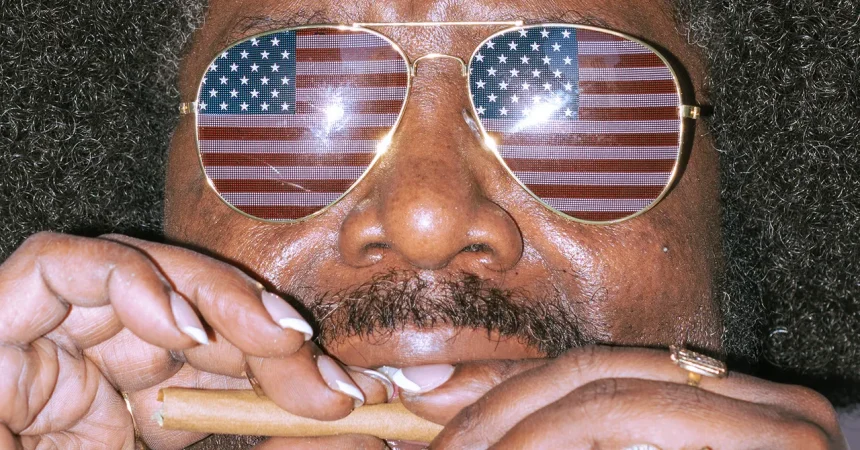
At 51, Joseph Edgar Foreman—universally recognized as the rapper Afroman—remains a master of his own eccentric orbit. Nestled behind makeshift curtains in a Las Vegas hotel room, he sits enveloped in a cloud of smoke, surrounded by an entourage that includes a former pimp and a videographer in sky-high heels. While thousands of fans wait in the cavernous hall for his performance, Foreman sits unmoved, embodying the same unflappable, laid-back persona that defined his breakthrough two decades ago. He is draped in an American flag ensemble, a garment that has transitioned from a defiant choice in a courtroom to his permanent, patriotic uniform—a symbol of both his irreverent style and his recent legal battles.
The irony of Afroman’s current status—performing at high-profile venues rather than the dive bars of his past—is rooted in a 2022 raid on his Ohio home. When police swarmed his property searching for evidence of kidnapping and high-level drug operations, they came up empty-handed, finding only the typical paraphernalia of a stoner’s lifestyle and a stack of cash. Rather than retreating into legal silence, Foreman did what he does best: he turned his trauma into a viral spectacle. By releasing music videos that utilized the very security footage recorded by the raiding officers, he turned a police intrusion into a comedic goldmine, most notably in the track “Lemon Pound Cake,” which relentlessly mocked an officer’s lingering hunger for a pastry on the counter.
The aftermath of that raid proved that in the digital age, mockery is a potent defensive weapon. When the officers involved sued him for millions, claiming defamation and an invasion of privacy, Foreman didn’t just mount a legal defense; he turned his courtroom appearances into performance art. His calm demeanor while cross-examining his accusers played out before a captivated internet audience, effectively rebranding him from a “one-hit wonder” into a cultural champion of free speech. The lawsuit ultimately collapsed, leaving the police as the punchline and cementing the rapper’s status as a folk hero for anyone who holds a grudge against overzealous state authority.
This unlikely pivot toward “freedom fighter” status is precisely why Foreman found himself headlining the Bitcoin Conference in Las Vegas. In a world where crypto-enthusiasts, anti-government skeptics, and libertarian-leaning investors congregate, Foreman’s brand of rebellious, anti-authority humor acts as a unifying anthem. The event’s organizers view his victory against, in their eyes, an overreaching police force as a core tenet of the Bitcoin mission: decentralization, skepticism of institutions, and the right to live life on one’s own terms. It is the perfect marriage of niche culture and mainstream political theater.
Yet, despite his “freedom fighter” status, the reality of Afroman’s life remains refreshingly grounded in the absurd. As the emcee steps into the smoke-filled greenroom to finalize the introduction, the scene is less like a political rally and more like a backstage party from the early 2000s. When asked for his desired introduction, Foreman’s response is quintessentially American: he suggests a tribute to the “hungry, hustling American dream.” It is a sincere, if slightly hazy, nod to his own journey from the college kegger anthem “Because I Got High” to his current reign as a viral icon. The irony is never lost on him; he is fully aware that he is an outsider who found a way to commodify his own rebellion.
The spectacle, however, is always subject to the real world’s limitations. As the weed smoke permeates the hotel’s pristine corridors, the manager’s urgent warning—an impending threat of police intervention—serves as a reminder that even for someone who has successfully sued the law, the authorities are never far away. Through it all, Foreman remains, at his core, the same artist who first made the world laugh at the consequences of his indulgence. He has evolved from a comedic musician into a symbol of modern dissent, proving that with enough charisma, a little bit of petty humor, and an American flag suit, even a guy who just wants to get high can become an accidental revolutionary.