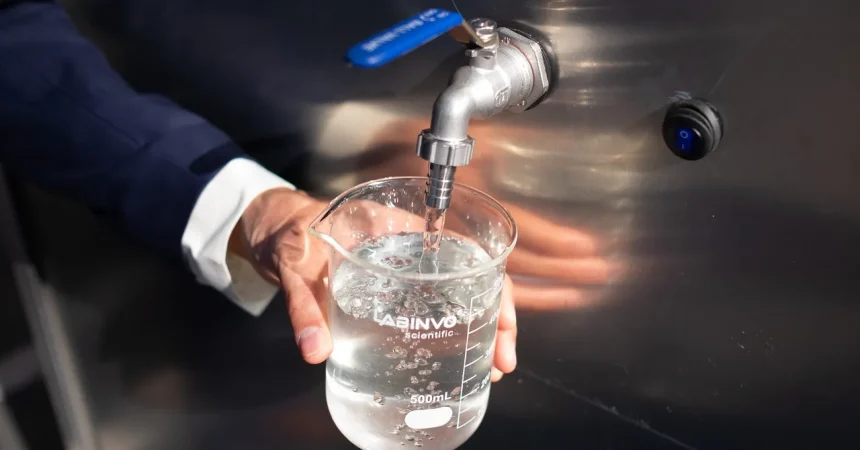
Water is everywhere and nowhere at the same time. It falls from the sky, flows through rivers, and hides in the air as vapor, yet for more than two billion people, clean water is painfully scarce. For decades, the search for a solution has centered on big infrastructure—desalination plants, pipelines, dams—expensive, energy-hungry projects that many water-stressed regions simply cannot afford. But Omar Yaghi, a chemist who won the Nobel Prize for his work on metal-organic frameworks, or MOFs, has spent his career chasing a different vision. What if the answer wasn’t about moving water across great distances, but pulling it directly from the air we breathe? And what if the only energy needed to do that was the low-level heat that’s already being wasted by the machines around us? That’s the idea behind Atoco, a startup built on Yaghi’s breakthrough chemistry. Atoco has developed a family of materials that can harvest water out of the atmosphere, release it when warmed, and do it all over again, countless times. The company’s technology is not about creating water from nothing—it’s about capturing the water that already surrounds us, making it drinkable, and doing so with remarkable efficiency. The dream is to give communities in arid regions a reliable, local source of water, a way to take control of a resource that has become increasingly unpredictable. And while that mission began long before the current artificial intelligence boom, the explosive growth of AI data centers has handed Atoco an unexpected and powerful ally. Those centers generate enormous amounts of waste heat, and they consume vast quantities of water to keep their servers cool. Atoco’s materials can run on exactly that kind of waste heat, turning a byproduct of the digital age into a lifeline for a thirsty planet. It’s a convergence of problems and solutions that nobody saw coming—and it might be exactly what the world needs.
To understand how Atoco works, you have to understand the strange, beautiful world of MOFs. When Yaghi was a PhD student, he says, creating something like this was “every chemist’s dream.” For the past twenty years, he has taken that dream from theoretical chemistry into practical reality, building stable molecular structures that combine organic materials with metal ions. The result looks, according to Seth Cohen, the dean of the School of Physical Sciences at UC Irvine, “like a jungle gym on a playground.” But that playful description hides something extraordinary. MOFs are molecular sponges—solid materials with an almost magical ability to absorb other molecules. Just as a sponge holds water in its tiny pores, a MOF can capture gases and vapors in its microscopic cavities. And, like a sponge, it can be wrung out. Apply heat, and the material releases whatever it was holding onto. The structures themselves are almost impossibly porous. The internal surface area of a single gram of MOF can cover two football fields. That means a tiny amount of material has an enormous amount of space to capture molecules. Over the years, scientists have used these frameworks to store hydrogen for clean energy, to capture carbon dioxide for cleaner air, and, in Atoco’s case, to trap water vapor. The key is the precise architecture of the material. The “jungle gym” creates open spaces at the microscopic level where water molecules can cling. By tweaking the design, researchers can create more interior space, more surface area, more capacity. It’s a feat of molecular engineering that feels almost like science fiction—but it’s very real, and it’s already working in labs and small-scale demonstrations.
What Atoco has done is take this foundational science and turn it into something practical. The company has developed what CEO Samer Taha calls “precision materials” with a very specific job: harvest water, release it, then do it again and again. That might sound simple, but it’s a delicate balancing act. As Benjie Limketkai, Atoco’s vice president of R&D, puts it, the material has to like water—but not love it. If it loves water too much, it won’t let go easily, and you’ll need too much energy to release the water. If it doesn’t like water enough, it won’t capture enough to be useful. Atoco’s scientists have dialed in the chemistry to find the sweet spot. “The scientists reach a level of precision [where] we really know even the angle of the atom,” Taha says. That precision is crucial for commercial success, because the entire point is to use as little energy as possible. Traditional methods of pulling water from air often require lots of electricity or complicated machinery. Atoco’s materials can work with just low-level heat—the kind of heat that would otherwise be wasted. Imagine a small, tabletop device filled with this special material. It sits in the open air, silently absorbing moisture. When it’s saturated, a gentle warmth is applied, and the water is released, condensed, and collected. The process is clean, quiet, and decentralized. No giant pipes, no chemical treatments, no massive energy bills. Just a simple, repeatable cycle that can run almost anywhere. In a world where water scarcity is becoming more urgent by the year, that’s a revolutionary idea. And it’s not just about drinking water—it’s about giving communities the ability to produce their own water, on their own terms, without depending on distant infrastructure or unpredictable rainfall.
The path to that future took an unexpected turn when artificial intelligence began its explosive growth. AI data centers are now springing up all over the world, packed with powerful servers that crunch through enormous amounts of data. Those servers generate a tremendous amount of heat, and they need constant cooling. In many cases, that means using vast amounts of water, which strains local supplies and creates tension in drought-prone areas. But that waste heat—the very thing that makes data centers so water-hungry—is exactly what Atoco’s materials need to operate. “We were not really thinking of AI data centers,” Taha admits, looking back at the company’s early days four or five years ago. But the massive buildout of data centers has created an opportunity that Atoco could hardly have imagined. Hook its water-harvesting technology to a data center’s cooling system, and the waste heat can be used to drive the water-releasing process. The data center gets a more sustainable way to manage its thermal load, and Atoco gets a reliable, always-available source of low-grade heat. Meanwhile, the water produced can be used for cooling, for drinking, or for other local needs. It’s a symbiotic relationship, a way of turning one industry’s waste into another community’s resource. The timing is almost perfect. AI is not slowing down, data centers are only multiplying, and the need for sustainable water solutions is growing right alongside them. For Atoco, this is more than a business opportunity. It’s a chance to prove that the technology works at scale, to show the world that water can be harvested from the air efficiently and affordably. And if it works in the demanding environment of a data center, it can work just about anywhere.
At its heart, Atoco’s mission is about something deeper than technology. It’s about water justice. The people most affected by water scarcity are often the ones with the least power to change their situation—rural villages, informal settlements, communities in developing nations that have to walk miles for a single bucket of clean water. They are also the ones least likely to benefit from large, centralized infrastructure projects. Atoco’s materials, by contrast, are modular and decentralized. They can be deployed in small units, placed in individual homes or community centers, and operated with minimal training. They don’t require a grid, a pipeline, or a government contract. They just need air, a little heat, and the sun or a waste-heat source to get going. This is what Taha means when he talks about giving people control over an increasingly precious resource. Water is not just a commodity; it’s a basic human right. And the ability to produce your own water, in your own community, is a form of freedom. It means not having to wait for a tanker truck to arrive. It means not having to ration every drop. It means not having to choose between drinking water and water for crops. Atoco’s technology is not a silver bullet, and there are still challenges ahead—scaling up production, reducing costs, ensuring the materials last for years, and finding the best ways to integrate them into existing systems. But the direction is clear. The science is sound, the materials are real, and the need is urgent. The company is moving from the lab to the real world, and every new partnership, every new pilot project, brings it closer to the day when water scarcity is not an inevitable fate but a solvable problem.
There is something quietly beautiful about the idea that the same heat that powers the digital world could also give us the water to sustain our physical one. The AI revolution has been criticized for its enormous environmental footprint, but Atoco’s technology offers a way to turn that footprint into a positive. Waste heat, which was once just a problem to be managed, becomes a resource. Data centers, which were once seen as water-hungry villains, become part of a water-positive ecosystem. And for the people living in water-stressed regions, this could be a genuine game-changer. Imagine a village in a dry region, where the air is hot and the ground is cracked. A small device hums quietly in the corner, powered by the heat from a nearby solar panel or a data center. Inside, a material that looks like fine sand is doing what seemed impossible for so long: pulling water from thin air. Drop by drop, glass by glass, it fills a container. It’s not magic. It’s chemistry. It’s the result of decades of research, of scientists dreaming about structures that could reshape the world. Omar Yaghi’s jungle gyms, once a laboratory curiosity, are now on the verge of changing how we think about water. And the story is still unfolding. As Atoco grows, as more data centers come online, as more communities embrace this technology, the future becomes clearer. Water is all around us, even in the driest places. We just needed the right tool to reach out and take it. That tool is here. The dream is no longer just a dream—it’s a beginning.