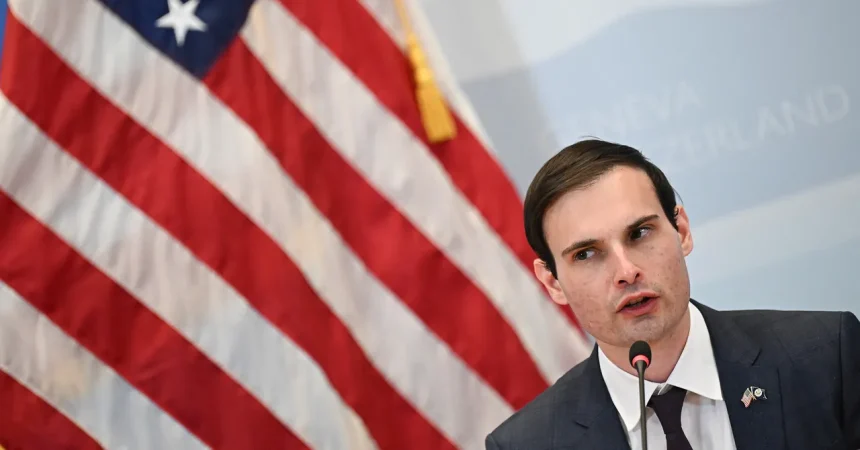
On March 18, 2025, the United States Agency for International Development changed hands in a way that felt less like a transition and more like a quiet takeover. Secretary of State Marco Rubio handed the agency’s leadership to Jeremy Lewin, a 28-year-old Harvard Law School graduate, former investment banker, and affiliate of Elon Musk’s Department of Government Efficiency. On paper, Lewin’s appointment invited criticism because he lacked any meaningful background in government, diplomacy, or foreign assistance. But inside USAID’s Washington headquarters, the reaction among career staff went far beyond concern about a thin résumé. It was a kind of institutional dread. For at least two months, senior USAID employees had no idea how Lewin had appeared out of nowhere—an unknown policymaker on an obscure detail from the General Services Administration—and suddenly begun exercising the powers of the agency’s top official. USAID is not a think tank or a consulting firm. It is an agency whose decisions are literally life-and-death in some of the most fragile places on Earth. Its people know what it means to distribute food to the starving, to vaccinate children in conflict zones, and to dig wells in drought-stricken villages. To have someone walk in and start making decisions about those programs without anyone being able to explain how he got there was not merely unsettling. It felt like watching a stranger stand at the helm of a ship in the middle of a storm, holding a map no one else had ever seen.
Over the following three weeks, Lewin began canceling lifesaving aid programs and personally signed off on the termination of thousands of USAID employees. Yet internal emails reviewed by WIRED reveal something astonishing: Lewin did not sign the paperwork normally required by law to begin working at the agency, despite repeated requests. Between March 18 and April 4, while he was making some of the most consequential decisions in USAID’s history, the bureaucratic machinery that usually tracks every employee, every appointment, and every legal authorization appeared to have been bypassed entirely. His appointment was so mysterious that USAID security could not even issue him an ID badge because they had no records of his employment. Picture that for a moment. Imagine walking into your office and discovering that a 28-year-old man with no badge, no human resources file, and no official record is suddenly deciding which contracts get canceled and which of your colleagues lose their jobs. The federal government runs on paper. It runs on chains of custody, signatures, and accountability. But for Lewin, those rules seemed not to apply. Career staff inside USAID were left in a Kafkaesque nightmare: the man dismantling their agency did not seem to exist in any official system, and yet his orders were carried out. The absence of paperwork was not a minor technicality. It was a sign that normal checks and balances had been suspended, and no one could say who had authorized the suspension.
Lewin, who is now director of policy planning at the State Department, has defended his role. He told WIRED that before Rubio delegated powers to him, he was “both detailed and dual appointed to work at USAID by Secretary Rubio according to well-established authorities and with the advice of State Department and White House counsel.” That is a carefully worded claim, but experts say it does not settle the matter. While Lewin performed the duties of a top USAID leader under the title Rubio handed him—deputy administrator of policy and programming and chief operating officer—it is far from clear that he had the legal authority to do so. The U.S. government is not supposed to work through shadow appointments and improvised reversals. There are laws about who can hold federal office, how they are appointed, and what authority they may exercise. When those laws are bypassed, the entire system of accountability begins to crumble. The questions surrounding Lewin are not unique to USAID. Similar DOGE affiliates have stepped into top roles across many federal agencies, often with unusual titles and murky chains of command. These appointments are at the heart of dozens of active lawsuits targeting DOGE and the Trump administration over federal workforce reductions, firings, and agency dismantlings. At stake is not just one man’s résumé, but the basic question of whether the government can operate through an unofficial shadow class of operatives who answer to no one but the people who installed them.
The legal filings in the case J. Doe 4 v. U.S. DOGE Service offer a timeline that only deepens the mystery. According to a declaration submitted to the court, Lewin began serving at USAID as a senior adviser as well as a director for strategy and programs on January 28, 2025. Then, on March 18, Rubio—acting as USAID’s acting administrator—delegated to Lewin the authority of the deputy administrator for policy and programming and chief operating officer, and also signed a document appointing Lewin an “officer of the United States.” That sounds official. But the internal emails tell a more chaotic story. On March 20, two days after Rubio placed Lewin atop the USAID hierarchy, White House liaison to USAID Adam Korzeniewski notified human resources to begin the process of onboarding Lewin as a senior adviser performing duties as deputy administrator. Four days later, after prompting from HR, Korzeniewski provided a proposed start date: March 18. The next day, Lewin was sent a temporary job offer. So the date he supposedly began his authority was only discovered after the fact. The paperwork was not completed before he seized control; it was scrambled together later, like an administrative afterthought. If Lewin had been lawfully appointed on March 18, why did it take until March 25 to issue even a temporary job offer? Why did security have no record of him? Why was there no paper trail until WIRED asked questions? These contradictions suggest that whatever authority Lewin was exercising was not rooted in the usual hiring and appointment procedures, but in something far more informal and opaque.
The human dimension of this story is easy to lose in legal jargon, but it is perhaps the most important part. USAID is an agency of human beings who have dedicated their careers to alleviating suffering. They are not anonymous bureaucrats. They are the people who show up after earthquakes, famines, and civil wars. They are the ones who help refugees cross borders with documentation, who fund clinics treating malaria, who support teachers in communities where girls were once forbidden from going to school. When Lewin began canceling lifesaving aid programs and terminating thousands of staff, he was not rearranging abstract budget lines. He was cutting off food to hungry families. He was telling a nurse in a conflict zone that her job no longer existed. He was telling a humanitarian partner that a shipment of medicine would not arrive. For the career staff still inside USAID, the terror was both personal and moral. They lost their own jobs, but they also watched an institution built over decades be reduced to rubble by someone whose official identity was so uncertain that he could not even get a badge. There is something deeply dehumanizing about being fired by a person who does not appear in any database. There is something even more dehumanizing about knowing that your life’s work, and the lives of the people you served, were sacrificed by a 28-year-old with no experience, no public mandate, and no traceable record of employment.
In the end, this story is not just about one agency or one young man. It is about what we expect from government. We expect that people who hold power have been chosen through processes that can be understood, reviewed, and challenged. We expect that their names appear on official documents, that they are paid through official channels, and that they can be held accountable when they make terrible decisions. The mystery of Jeremy Lewin’s appointment to USAID undermines all of those expectations. It raises uncomfortable questions that go far beyond the lawsuit currently unfolding in federal court. If a 28-year-old with no diplomatic experience can be placed at the top of a major federal agency without proper paperwork, without a security record, and without any meaningful confirmation process, then the machinery of democratic accountability has broken down. Paperwork may seem boring. Human resources forms may seem like unnecessary red tape. But those forms, badges, and signatures are the physical evidence of consent. They are how a democratic society keeps track of who is allowed to make decisions on behalf of others. When they are ignored, power becomes untethered. And when power becomes untethered, the vulnerable are the first to suffer. The story of Lewin and USAID is ultimately a reminder that democracy is not a set of ideas; it is a set of practices, and when those practices are abandoned, we should never be surprised by what follows.