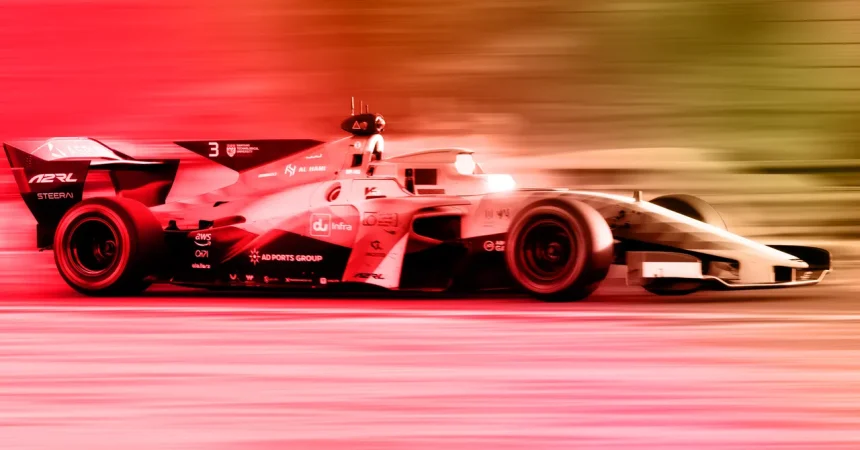
The grandstands at Imola erupted in something between a gasp and a groan, the kind of sound reserved for moments when a race suddenly stops making sense. Down in the paddock, engineers clutched their heads, watching telemetry screens that had just gone red with warnings. On the track, two driverless race cars were tangled together near the Rivazza corner complex, one having plowed into the back of another that was slowing ahead of it. It looked like a traditional racing accident—the sort of dramatic shunt Formula 1 fans have seen for decades on this famous circuit. But there was one crucial difference: when the dust settled and the carbon fibre fragments stopped bouncing across the tarmac, nobody climbed out of the cars. There were no drivers to be checked, no helmets to be removed, no drivers to wave at the crowd. The cars had been running completely on their own, guided by algorithms, sensors, and software rather than human hands and feet. The crash was a heavy hit, physically and metaphorically, and it exposed a raw truth about the young world of autonomous motorsport: the technology has learned to go fast, but it has not yet fully learned what to do when something goes wrong at that speed.
This was the latest event in the Abu Dhabi Autonomous Racing League, known as A2RL, which was launched in 2024 with a bold and fairly simple mission. The league wanted to push self-driving cars into motorsport, not as a novelty act, but as a serious test bed for what autonomous vehicles are actually capable of when they are forced to operate at the absolute limit. In that sense, the crash at Imola was not an interruption of the experiment; it was the experiment. The race at the Autodromo Internazionale Enzo e Dino Ferrari was the league’s first international competition outside its home base at Abu Dhabi’s Yas Marina Circuit, and it was never meant to be comfortable. Teams arrived with only nine days of physical testing before the race, and even those sessions were complicated by rain and hail, conditions that are difficult enough for human drivers and especially brutal for sensor-dependent machines. By the time the final got underway, the drama had already begun. One of the strongest teams, TUM, which had won two previous events, was forced to withdraw during the formation lap when a brake problem appeared, leaving the race without one of its most impressive competitors. By the end, only two of the five cars that started crossed the finish line intact. The UAE’s Kinetiz took first place, followed by Germany’s Constructor Racing in second. PoliMove managed to be classified in third place, but only after a battered car had to be replaced with a different shell for the podium ceremony. The scene was equal parts triumph and absurdity, a small-scale wallop of high-speed ambition colliding with the still-evolving reality of autonomous technology.
The question, of course, is why anyone would choose Imola for such a young and fragile competition. The circuit is one of the most unforgiving in motorsport, a beautiful and dangerous sequence of elevation changes, blind crests, and quick corners that have humbled some of the greatest Formula 1 drivers in history. The Rivazza area, where the crash happened, is the final complex of the lap, a pair of fast, tricky bends that reward precision and punish hesitation. It is not a place for beginners, and it is certainly not a place where one would expect machines still learning the basics of wheel-to-wheel racing to look comfortable. But that is exactly the point. Nicola Palarchi, engineering director at Aspire, the company that founded A2RL, put it bluntly: “Because everybody can do ‘easy’, right? We have to show we go where it matters.” His words cut through the obvious concern about safety and spectacle. If the goal was simply to demonstrate that autonomous cars can complete laps at high speed, an empty oval or a smooth modern facility would work perfectly well. But the real objective is not to prove what the technology can do in ideal circumstances; it is to test what it can do in the most demanding circumstances imaginable. Choosing Imola was a deliberate statement that autonomous racing is not meant to be a watered-down version of human motorsport. It is meant to be its own discipline, with its own standards, risks, and rewards. Palarchi also made it clear that this is not an attempt to replace human racing. On the contrary, autonomous racing exists alongside traditional motorsport, and could even support it by providing a controlled, experimental environment where dangerous situations can be studied without putting human lives on the line.
At its core, autonomous racing is designed to function as a laboratory with guardrails. Every run on the track is a high-speed experiment involving a complex chain of actions that must happen in milliseconds. First, the vehicle’s sensors—cameras, LiDAR, radar, and other instruments—must perceive the environment around it, identifying the track boundaries, the position of other cars, and any unexpected obstacles. That information is passed to planning software, which analyzes the current situation and chooses a trajectory, deciding where the car should go next and how aggressive it should be. Finally, a control system takes that plan and translates it into physical actions: steering inputs, throttle openings, brake pressure. In a normal driving environment, this chain has time to work through false readings, uncertain detections, and unexpected changes. At racing speed, however, time nearly disappears. A car traveling at more than 250 kilometers per hour covers the length of a football field in about a second and a half. The sensors are constantly receiving incomplete, noisy, and sometimes contradictory information. The planning software has to predict not only what the car itself is doing, but what another autonomous car is likely to do next—whether it will brake earlier than expected, take a different line, or behave erratically under pressure. And the control system has to execute the chosen maneuver with a level of precision that would be remarkable for a human, let alone a stack of servos and hydraulic systems. Racing makes every stage harder because the penalty for hesitation or miscalculation is immediate and physical. The crash between PoliMove and Unimore was exactly that kind of failure: a misjudged relationship between two machines, a moment when perception, prediction, and control did not align quickly enough to avoid contact.
The deeper significance of this crash has far less to do with racing itself than with the future of autonomous vehicles on public roads. Proponents of A2RL insist that the league is not an entertainment sideshow; it is a safety laboratory at high speed. The same perception and planning systems that allow a race car to chase another vehicle at 200 miles per hour are, in a less extreme form, the systems that will allow driverless taxis, trucks, and delivery vehicles to navigate streets filled with pedestrians, bicycles, and unpredictable human behavior. The difference is that racing deliberately pushes the technology to the edge of what is possible, and sometimes past it. When an autonomous car crashes on a closed circuit, no human being is injured, but the data from that crash is extremely valuable. Engineers can study exactly why the vehicle made the decision it did, what sensor signals were present, how the planning software evaluated the options, and where the control system failed to recover. These lessons can then be applied to future software versions, making the technology safer for real-world conditions where the cost of a mistake is much higher. This is why Palarchi and his team insist on racing at demanding tracks like Imola, and why they accept crashes as a necessary part of the process. A self-driving car that looks flawless on an easy course may still be hiding serious weaknesses. A self-driving car that fails under extreme pressure, on the other hand, reveals its limits clearly and honestly. In that sense, the pile of broken carbon fibre near Rivazza was not merely a failure; it was a rich source of information, a lesson learned in full safety.
Yet for all the talk of algorithms, sensors, and software, there is a deeply human story underneath the machine noise. The engineers who clutched their heads when the cars collided were not reacting to a video game glitch. They had spent months building, programming, and refining these vehicles, often with very little sleep and enormous amounts of passion. They felt the crash personally, not because it hurt them physically, but because it represented the collapse of plans they had poured their efforts into. And when the battered PoliMove car was replaced for the podium, the scene was almost touching: a machine too damaged to stand proudly for the ceremony, swapped out for a stand-in so that the team could still celebrate a third-place result. That small moment revealed something essential about autonomous racing. The cars are driverless, but they are not humanless. Every lap is the product of a vast team of people—engineers, strategists, software developers, mechanics, and scientists—who watch the cars not with passive observation but with constant anxiety and hope. This is what makes the spectacle both exciting and meaningful. It is not a competition between machines alone; it is a competition between teams of humans using machines to extend their own abilities beyond what the human body could survive. The cars may not need drivers, but they still need minds, instincts, and judgment, all of which are provided by people working far away from the cockpit. As autonomous technology improves, it seems likely that these races will become faster, closer, and more reliable. But the crash at Imola will remain a valuable reminder that progress is not linear. It is full of setbacks, surprises, and moments of alarming speed followed by sudden, violent stops.
Looking ahead, the future of A2RL is likely to involve many more crashes, many more moments of shock, and many more valuable lessons. That is what it means to push a technology toward its limits. The league has made a deliberate choice to operate on the edge, to race at some of the most difficult circuits in the world, and to accept that autonomous vehicles will make mistakes before they learn to avoid them. This is not a weakness; it is a strength. The same fidelity to real-world danger that makes the racing frightening is what makes it worthwhile. If the technology can survive Imola, if it can navigate the final corners of Rivazza while judging another car’s braking point and responding instantly to the changing grip of the track, then it might one day be trusted to navigate the far more ordinary but equally unpredictable world of public roads. The fact that only two of five cars finished the race says less about the failure of autonomous racing than about the extraordinary difficulty of what is being attempted. Every collision, every withdrawal, every broken component is part of a process of learning that will eventually make self-driving cars safer and more capable. At Imola, the grandstands witnessed something that looked like a crash, but was really a test. And in the strange, new world of driverless motorsport, that test is exactly the point. The cars will get better. The crashes will become less frequent. But the memory of that moment under the Italian sun, when two machines met unexpectedly in the shadows of Racing history, will remain a vivid reminder that even the most advanced technology has to learn to fall before it can truly fly.