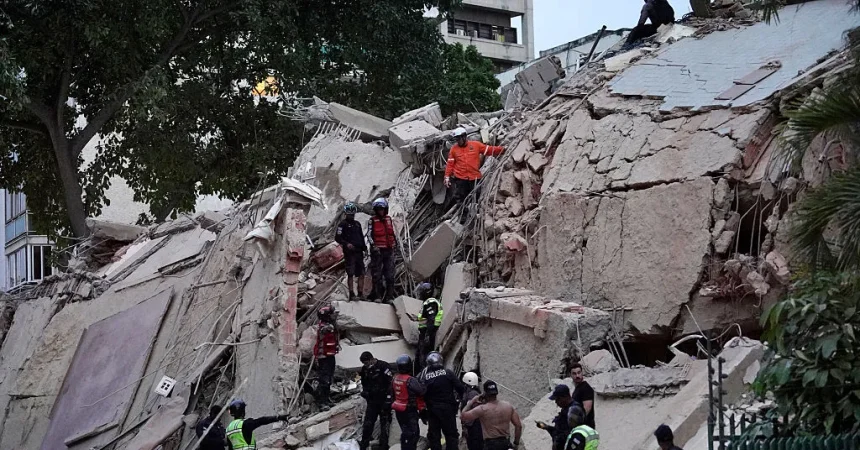
The morning of June 24th began like any other in Caracas, but it soon descended into a nightmare that would forever fracture the sense of security for thousands of Venezuelans. For Verónica Cañas, the ordeal began in a frantic, blurred heartbeat: she barely had time to snatch her six-year-old son from his play and shove her feet into her shoes before the world around her began to disintegrate. As she sprinted down the stairwell of her apartment complex, the structural integrity of her home betrayed her, with walls splitting open and the exterior facade sloughing off in great, suffocating clouds of dust. Across the city in Altamira, Eduardo Burger stood frozen, watching in disbelief as the skyline he had known his entire life transformed into a scene of chaotic physics, with skyscrapers swaying like reeds and neighboring structures crumbling into heaps of twisted rebar and concrete.
What these survivors did not know in those terrifying initial moments was that they were caught in the grip of a rare and violent seismic anomaly known as a “doublet.” Occurring in the Yaracuy region, a magnitude 7.2 earthquake struck with immediate, brutal force, only to be followed—just thirty-nine heartbeats later—by an even more catastrophic magnitude 7.5 tremor. Because both quakes originated at a shallow depth of only ten to twenty kilometers, the seismic energy was unleashed with unfiltered intensity. The reach of this destructive force was staggering, vibrating through the earth with enough power to cause alarm and structural concern as far away as Colombia, northern Brazil, and the islands of the Dutch Caribbean.
For many, the aftermath of this “one-two punch” has been a grueling test of human endurance. Cañas recalls the visceral horror of the dining room table dancing under the force of the earth, followed by the terrifying realization that her ceiling was actively turning into shrapnel. She and her family eventually scrambled to a nearby sports field, finding themselves huddled among neighbors in a primal display of shared trauma. Being in that open space provided a momentary reprieve, but it did not shield them from the psychological toll; the community stood in a circle, clinging to one another, united by a profound, paralyzing fear. Many survivors noted a distinct vulnerability: because major earthquakes are not a frequent occurrence in Venezuela, the population lacks the ingrained, reflexive “seismic culture” found in places like Mexico or Chile, where drills and alerts are woven into the fabric of daily life.
Civil engineer Alan Damián Sánchez Pulido notes that this lack of preparedness is perfectly understandable given the region’s geological personality. Venezuela sits precariously along the boundary of the Caribbean and South American plates, but unlike the subduction zones where one plate dives beneath another, the movement here is largely lateral. This “sliding” motion means that while massive earthquakes are not the daily reality they are in other parts of the world, they remain a lurking, low-probability event that the earth is perfectly capable of triggering. When these plates interact in this specific, parallel fashion, the tension can accumulate over long periods, leading to seismic events that are infrequent yet devastatingly powerful when they finally snap.
The sheer destructive power of this particular event, however, is attributed primarily to that thirty-nine-second gap. Sánchez Pulido explains that when a building is subjected to a massive force, it sustains internal “stress signatures”—tiny, invisible fractures that render it fundamentally weaker than its original architectural design intended. Under normal circumstances, there would be time to inspect the damage, evacuate residents, and reinforce the skeleton of the structure. When the second, even stronger quake hit less than a minute later, the buildings were already compromised. They were no longer the rigid, standing towers they had been moments before; they were fragile, wounded organisms that simply could not withstand the second round of seismic energy.
Ultimately, the tragedy in Venezuela underscores the fragile relationship between human structures and the tectonic forces beneath our feet. As the dust settles and rescue efforts continue, the story of this doublet serves as a haunting reminder that nature does not always follow the rhythms or probabilities we assign to it. The survivors, like Cañas and Burger, are left to rebuild more than just homes; they must navigate the psychological shock of realizing how quickly the solid ground beneath them can become a weapon. In the wake of this destruction, the focus now turns to the challenging path of recovery, acknowledging that while we cannot prevent the shifting of the earth, we can certainly learn from the devastating lessons of how structures fail when caught off guard by the impossible.