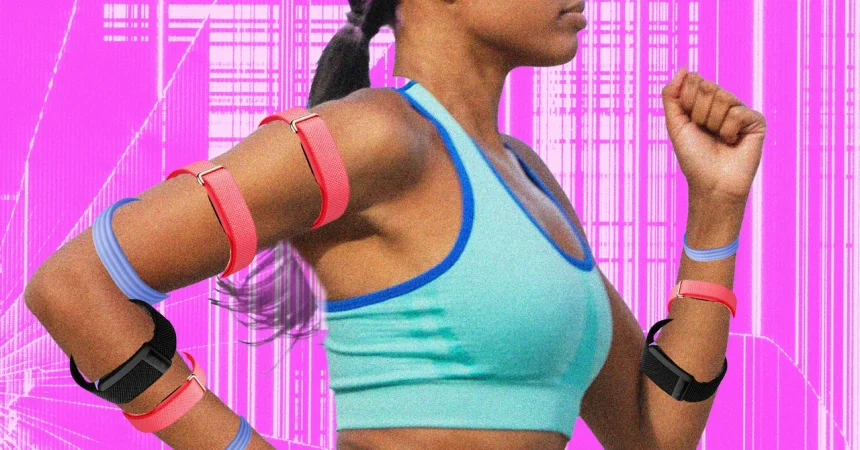
Ten years is a lifetime in technology, especially on your wrist. When Whoop released its first proper product in 2015, it wasn’t trying to be everyone’s life coach. It called itself a “performance optimization system exclusively designed for elite athletes and teams”—a phrase so self-serious it could have been engraved on a trophy. The device had no screen, no notifications, no rabbit holes—just a small band of sensors and a subscription that told you, in stern terms, whether you were ready to push hard or needed to back off. Fast-forward to today, and that same screen-free band is now pitched to just about anyone with an extra $199 a year, with a promise that sounds almost gentle: “help you improve how you sleep, train, andreel—starting day one.” Maybe you’re not an Olympian; maybe you’re just a tired parent, a recovering overachiever, or someone who spends too much time doomscrolling before bed. Whoop claims its system his for you, too. This isn’t merely a rebrand; it’s a cultural repositioning. Think aboutwhat else was happening in 2015: the Apple Watch had just landed, promising notifications and apps on your wrist; Fitbit was still essentially a step-counting clip; the idea of a “screen-free” wearable seemed almost perverse. Why would you want a device that couldn’t buzz you with tweets? Because a decade later, we know exactly why: because buzz is the problem. Whoop didn’t just soften its language; it noticed what a lot of us are starting to admit—we’re exhausted, overstimulated, and increasingly suspicious of the glowing rectangles in our pockets. Training readiness, the idea that your workout today should depend on how well your body recovered last night, has gone from elite shorthand to everyday vocabulary. And “low-distraction” has shifted from a niche selling point to a survival strategy. The change from self-serious performance system to consumer wellness companion captures something bigger: a decade that began with gamified step-counting is ending with a quieter question: how do we live with technology without letting it run us? What a change a decade makes.
But there’s an uncomfortable twist in this low-distraction story: artificial intelligence is both the reason we need these devices and the way companies hope to make money from them. On one hand, AI has become the engine of sporty new upsells. Nearly every Whoop rival now insists you can use its device without a subscription—Apple Watch, Fitbit, Samsung, Garmin, nobody wants to look greedy. But the fine print often pushes you toward a paid plan, and AI is the premium sauce. Take Google Fitbit, for example. Without a subscription, the app looks cute enough but fairly spare: you get stats and charts, zigzag arrows, rings, estimated scores, but what do they mean? If you want chatty explainers that connect your sleep score to yesterday’s 11 p.m. glass of wine or your stressful 3 p.m. meeting, you’re going to need Google Health Premium at $10 a month. Those graphs and numbers suddenly become paragraphs, and because, as humorist John Hodgman once put it, “specificity is the soul of narrative,” those paragraphs can feel shockingly personal. They reference quirks or events of your actual day, which is both magical and, depending on your mood, a little intrusive. If you’ve ever stared at a sleep staging chart and wondered whether “time in REM” was something you should be optimizing or simply observing, you know how easy it is to drown in data. This is just the beginning, though. Peter Richardson, vice president and cofounder of Counterpoint Research, has noted that “the use of AI in monitoring and guiding health and wellness is still at the early stage of development but will likely become significantly more advanced as AI matures.” In other words, these first chatbot explainers are the clunky prototypes of something much more sophisticated—an AI that doesn’t merely chart your sleep cycle but cooks up an entire life narrative around it. On the business side, that’s an obvious monetization opportunity. On the human side, it could be either a gentle relief or another layer of digital noise.
I have to confess that I find Google Fitbit’s chatbot ramblings quite annoying, with not-too-rare dips into the condescending. “Your heart rate variability was lower last night,” it informed me once, as if I were a malfunctioning appliance due for a firmware update. There are days when I’d almost prefer the subscription-free experience—boring charts, no virtual coach judging my sleep debt. But here’s the thing: I’ve also had a job that pushed me through the unenviable task of learning what VO2 Max actually means, what heart-rate variability trends indicate,and how acute/chronic workload ratio works. That is not normal. Most people don’t know a CPAP from an APAP, and they certainly don’t want to learn one. They just want the wearable to tell them, in plain English, whether they’re okay and what to do tomorrow. And that’s where AI might genuinely save the wearable industry. For years, the biggest problem with fitness trackers hasn’t been hardware; it’s been data abandonment. People strap on a band, get excited for two weeks, then glaze over as soon as they see anything beyond step count. Graphs alone don’t hold attention; stories do. An AI that translates numbers into gentle, actionable insight could solve that long-standing issue. Maybe I’m being unfair to the chatbot—it is trying to help, after all. But the tone matters, and right now it often feels less like a friend and more like a boss who read a book about wellness. What’s interesting is where this intelligence lives. It makes more sense on the phone than on the watch screen, which is exactly why a screen-free device like Whoop might be an advantage. Instead of dinging your wrist every hour with another metric, your phone can quietly deliver a summary, chat if you want, disappear if you don’t. The lack of a screen stops being a limitation and becomes a strength: it forces the interface to be intentional. The AI does the talking; the screen stays dark, and you stay in your actual life.
But the deeper influence of AI on this market isn’t just about how it sells subscriptions—it’s how AI has made us feel so frazzled in the first place. We are living through the relentless tech-ification of daily life, and AI is the latest accelerant. I have heard from multiple friends about how their recent work appraisals focused on higher-ups demanding greater AI use within their “personal workflow.” Not “would you like to learn AI?” but “you need to demonstrate that you’re leveraging AI tools to do more, faster.” That pressure is real, and it lands on top of an already overloaded digital existence. Elizabeth Marsh, a doctoral researcher at the University of Nottingham who studies the dark side of the digital workplace, has found that digital tools consistently trigger a familiar cluster of harms: technostress, information overload, constant interruption,and blurred work–home boundaries. Sound familiar? It’s the Slack DM that breaks your focus at 10 p.m.; the email that arrives Sunday afternoon with an innocuous “just sending this over”; the Teams status that turns your living room into an extension of the office. We have more ways to communicate than ever, yet somehow less time to think. And this isn’t just about work, either. We check our phones hundreds of times a day, not because we want to, but because the habit has burrowed into our nervous system. Every notification is a tiny interruption, and every interruption is a tiny tax on our attention. This is why the low-distraction selling point works. It’s not about being a Luddite or rejecting progress. It’s about carving out one small corner of your life where a screen doesn’t glare, where notifications can’t interrupt, where a piece of tech asks almost nothing of you except that you wear it. Whoop’s screen-free band is a quiet rebellion against the noise—and AI, by turbocharging that noise in our workplaces and inboxes, is partly responsible for making this rebellion necessary.
This brings us back to Whoop’s transformation. It’s tempting to say Google’s Fitbit and company are playing catch-up with Whoop, but that’s not quite it. The bigger, more accurate story is that the entire market has drifted toward Whoop’s weird little corner: recovery, sleep, readiness, low-distraction design. What once sounded like an elite athlete’s obsession—“I’m not training today because my HRV is low”—has become a normal thing to say at dinner parties. The self-serious Whoop of 2015, with its talk of performance optimization systems exclusively designed for elite athletes,and teams, now feels almost comically out of step with the times. That company would have told you to push through; this company tells you it’s okay to rest. In 2015, wellness was a hustle: optimize everything, measure your sleep, hack your cortisol, do more, be more. A decade later, wellness has become something humbler: recovery, boundaries, breathing. It’s the difference between training like a machine and treating yourself like a fragile, finite human being. And yet Whoop still isn’t cheap—$199 a year is real money, and that subscription model means it’s not for everyone. It also means the company has a financial incentive to keep you engaged, which is worth remembering whenever your “recovery score” feels a little too dramatic. But the shift in language matters. “Help you improve how you sleep, train, andreel—starting day one” is not the same mantra as “performance optimization exclusively designed for elite athletes.” It’s an invitation, not a directive. It speaks to an uncomfortable truth: most of us don’t need more pressure; we need less. We don’t need another screen demanding attention; we need something that helps us listen to our bodies in the middle of a chaotic, always-on world. Whoop was grounded in training readiness from the very beginning, but now that concept belongs to everyone—not just professional athletes trying to find an edge, but ordinary people trying to find a little bit of steadiness
So what should we make of all this? On the surface, it looks like a simple product story: a niche fitness wearable went mainstream by being ahead of its time. Underneath, though, it’s a story about technology and exhaustion. AI is both the good guy and the bad guy. It is the bad guy because it’s making our days noisier, our workloads heavier, our boundaries leakier—and then it struts in as the good guy by offering to interpret our heart rhythms and sleep cycles, provided we pay a monthly fee. But it doesn’t have to be that way. The most hopeful version of this future isn’t an AI that nags you from a bright screen; it’s an AI that stays mostly behind the scenes, taking in all that messy biometric data and offering a calm, plain-language summary when you’re ready to listen. It’s the technology equivalent of a friend who knows when to text and when to leave you alone. Perhaps that’s why Whoop’s original “no screen” choice, which seemed like a stubborn quirk in2015, now feels almost visionary: because the screen is not the interface; attention is. The best wearable in an age of AI might have no screen at all, because the point is not to give us more information but to help us understand the information we already have—without adding more distraction. That’s a hard balance for companies whose revenue depends on subscriptions and engagement. But it’s also an opportunity. As AI matures, it could turn wearables from gadgets that quantify us into companions that understand us. The companies that win won’t be the ones with the most charts or the biggest notifications; they’ll be the ones that help us feel less fragmented, less behind, less alone. A decade after Whoop first strapped a sensor to an elite athlete’s wrist, the most radical thing a wearable can do is not measure more. It’s to help us be present, recover, and remember what it feels like to be human.