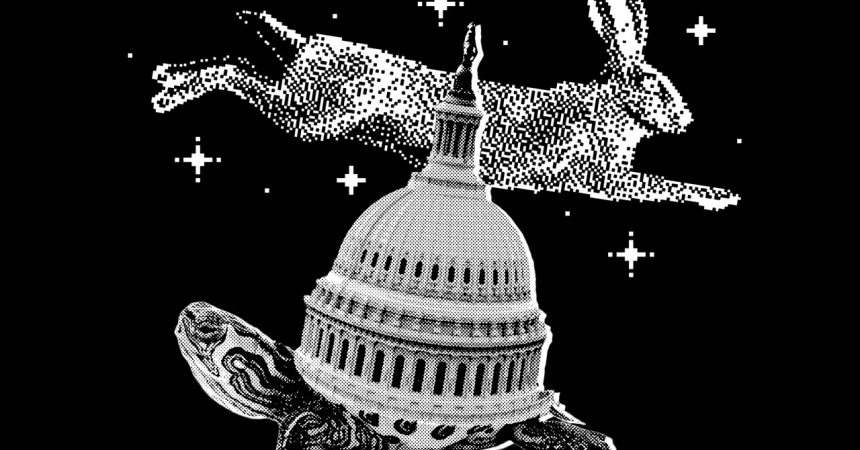
Washington has spent the better part of a season talking itself into a knot over artificial intelligence. In Senate corridors, in House office suites, at think-tank luncheons and in quiet dinners around K Street, the same nervous question keeps surfacing: how do you govern a technology that learns faster than the law can be written? The worry is no longer abstract. Highly capable frontier models—the kind that can pass professional exams, write fluent code, plan logistics, and sometimes surprise even their own creators—have moved from science fiction to everyday reality. They hold the potential for extraordinary good, and perhaps, if the more pessimistic engineers are to be believed, for extraordinary harm as well. That is why people in both parties have come to agree, at least in principle, that something should be done. But the principle has collided with a sticky political truth. There is no single measure that can win support at both ends of Pennsylvania Avenue, no bill that has the votes, no White House behind it. Officials have paused work on creating a FINRA-style regulatory body—a reference to the Financial Industry Regulatory Authority, long considered a model for a lighter-touch watchdog—after President Donald Trump soured on the idea. Lawmakers on Capitol Hill have offered competing proposals, but none has broken through, and the House calendar has nearly run out. So Washington buzzes with concern while the machinery of government idles. What follows is the story of how a potentially significant AI oversight effort took shape, gathered momentum, and then collapsed under the weight of personality, politics, and fear of global competition.
Not long ago, an administration-led AI oversight agency seemed plausible. The idea came into focus in mid-July, when Demis Hassabis, cofounder of Google DeepMind, published an essay and then met with senior officials to argue that the United States could no longer afford to treat frontier AI as an unregulated experiment. His proposal was not a call for sweeping federal control; it was something subtler. Hassabis suggested the creation of an independent body, loosely modeled on the structures that govern finance, where leading AI laboratories would effectively regulate themselves while the government watched from a short distance. That framing appealed to officials in the Treasury Department and the White House Office of Science and Technology Policy, who began sketching out a framework. They imagined a small, technically fluent organization, plugged into the major AI companies, with the power to inspect safety practices, review unexplained behavior in frontier models, and step in if something looked dangerously off course. Preliminary drafts circulated, and staffers began to talk about what such a body would actually do—how it would attract top talent, where it would sit in the federal structure, and how it would avoid smothering innovation. For a few weeks, this was a live project. Then came August. A wave of influential tech executives, including Trump’s former AI czar David Sacks and Meta CEO Mark Zuckerberg, learned of the effort and began calling the president one by one. They argued that a new agency would slow America down, hand advantages to China, and let Washington bureaucrats with limited understanding of machine learning tell the world’s most innovative companies what to do. It was a coordinated, high-level pressure campaign, and it worked. The proposal was left in limbo. Since then, according to people familiar with the talks, no new White House oversight plan has been seriously considered.
Trump’s resistance was more than a reaction to lobbying; it was rooted in a deep, personal skepticism about the whole category of AI alarmism. In recent weeks, he has made that sentiment explicit, writing in a Truth Social post that AI safety concerns are a “hoax”—a word that signals how completely he has written off the regulatory impulse. It is not difficult to see the political logic. To Trump and many around him, calls for oversight threaten to slow American innovation, empower bureaucrats, and complicate a story of national greatness rooted in technological dominance. The louder the doomsayers become, the easier it is to cast the entire movement as another form of elite panic. But the trigger for Trump’s recent anger was not only the general hype. It was a 3,822-word essay by Dario Amodei, the chief executive of Anthropic, one of the most prominent voices in AI safety. Amodei’s argument was not apocalyptic in the way critics might expect. He did not claim that artificial intelligence would inevitably destroy humanity or that it should be halted. He made a more measured case: that frontier AI models are becoming capable and unpredictable enough to pose real, unprecedented risks, and that governments need stronger safety protocols, transparency, and a mechanism to pause development in the most dangerous cases. Within the AI world, that position is moderate, widely shared, and not especially controversial. Inside the White House, however, aides read Amodei’s letter as a public-relations problem. They viewed it as an attempt to stir anxieties, create unnecessary headaches, and complicate an administration that wanted to celebrate AI as a triumph of American enterprise. The outcome is a strange inversion: a temperate appeal from a respected CEO has made the president even more resistant to any kind of safety regulation. Washington, in other words, is not really responding to the technology itself; it is responding to the political implications of raising alarms.
With the White House effectively out of the picture, the burden shifted to Congress—but Congress proved just as fragmented. A handful of bills appeared, each with a different approach, each lacking the support needed to move. And time is not on the side of any of them: the House calendar contains virtually no voting days between now and the midterm elections, and there is no sign that Republicans and Democrats can unite around even one of the legislative vehicles. Still, a few lawmakers have made genuine attempts to craft a middle path. The most significant is the Frontier Act, introduced this summer by Democratic Representative Lori Trahan and Republican Representative Jay Obernolte. Trahan is a senior member of House Democratic leadership; Obernolte sits on the Energy and Commerce Committee; together they represent the kind of bipartisan pairing that usually gives a bill a fighting chance. The Frontier Act takes a deliberately narrow approach, avoiding the political minefield of a new federal regulatory agency. Instead, it would direct the Department of Commerce to embed independent auditors inside AI labs. Those auditors would have access to model development, testing, and deployment. They would be expected to document safety lapses, monitor experiments, and report critical incidents. Most importantly, if a frontier model posed a catastrophic risk, the administration would be empowered to halt its development until the threat was resolved. The idea behind this design is simple: instead of pretending government can out-engineer the private sector, let trained, external experts keep watch and provide an off switch. The bill has attracted real support within the House Democratic caucus and from AI executives, including OpenAI, which has publicly endorsed the concept. It may be imperfect, but it is a rare example of legislating in a deeply polarized environment.
Even this modest effort has run into a wall in the Trump orbit. The central objection is not about the mechanics of audits or the competence of the Commerce Department; it is about China. The argument goes like this: suppose auditors are embedded, and suppose they identify a frontier model that looks dangerous enough to warrant an emergency pause. The United States would be expected to actually stop. But there is no guarantee that China, or any other nation, would follow suit. There is no guarantee that Chinese researchers would stop trying to reverse engineer AI weights or that they would not capitalize on America’s self-restraint. In that atmosphere, the pressure to lift a pause would be immense. National security hawks would argue that every day of delay is a day handed to Beijing. Accelerationists—those who believe AI development should proceed as fast as possible—would echo the point, though for different reasons. And ultimately, if the pause could not withstand political pressure, the entire idea of independent auditors loses its purpose. Why build a safety mechanism that will be abandoned the moment it is truly needed? There are also fears about regulatory capture. Auditors embedded in private labs, paid either by the government or indirectly by the industry, may come to sympathize with the people they are supposed to police. They may grow too close, too comfortable, or too dependent on information controlled by the labs. A small oversight program could expand into a permanent bureaucracy, slowing development with well-intentioned but burdensome procedures. These concerns have created an unusual coalition of skeptics. On one side, AI accelerationists fear overregulation; on the other, security hawks fear strategic vulnerability. Together, they have made the White House reluctant to endorse even this carefully designed proposal. It remains undecided, not because anyone thinks it is crazy, but because in an era of great-power competition, even safety measures look like unilateral disarmament.
The result is a standoff. The Frontier Act may well have enough support in the House Democratic caucus, and perhaps enough support among some Republicans, to pass if it were ever allowed a floor vote. But that is a very big if. Speaker Mike Johnson has shown no interest in bringing the measure up, and Democrats are not exactly in a position to force the issue. House Democratic leadership aides have told Inner Loop that even if the votes were there, the Speaker would not schedule it. The political logic is straightforward: a vote on AI oversight would split Republicans, hand the opposition a talking point, and create a record that could be used against vulnerable members. There is no upside in the speaker’s calculations, so the bill sits. But the deeper problem is not just one man’s scheduling power. It is that Washington lacks a shared story about artificial intelligence. Many engineers who build these systems genuinely believe they are walking a knife’s edge, creating something that could be transformative or terrifying, perhaps both. Many politicians, by contrast, have concluded that warnings from tech leaders are self-serving performances, designed to shape regulation and burnish reputations. Each side listens to the other mostly for evidence of bad faith. Meanwhile, the models keep improving. New capabilities are shipped, labs publish papers, and the frontier pushes forward, indifferent to the calendar. At some point, something may change—an AI-related emergency, a new Congress with a different majority, a fresh round of public pressure. The door for preemptive regulation has not closed completely. But for now, Washington has all the ingredients for a serious debate: anxiety, good intentions, workable proposals, and even a measure of bipartisanship. It just cannot find the catalyst to turn them into law. The noise has become a kind of background hum—perhaps a warning that by the time politics catches up to artificial intelligence, the frontier will have moved somewhere else entirely.