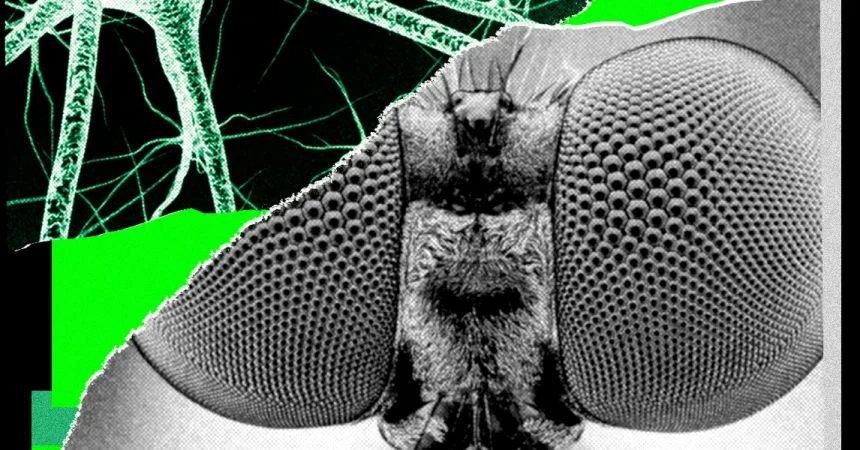
Meet PitchFly, WIRED’s latest editorial recruit. He is small, he is determined, and he has 165,112 neurons, all of them devoted to one job: coming up with story ideas. PitchFly is, for all intents and purposes, a fruit fly with a press pass. Somewhere along the way, someone gave him a tiny little hat, and I don’t know why he wears it, but I respect the energy. In his short career, he has already produced gems like “The Hidden Weather Problem Inside Surveillance,” “The Engineers Who Think Elon Musk Needs Less Computer Security,” and—my personal favorite—“Everyone Wants Cooking. Nobody Has Solved Donald Trump.” The last one sounds like the title of an experimental indie film, or perhaps a podcast where two people argue about dinner and politics and never quite get to the point. It is not a headline anyone at this magazine could have written, and maybe that is exactly the point. PitchFly is not human. He does not read, he does not think, and he has never once felt the existential dread of a deadline. But he is now part of the team, in the only way that matters in this strange new age of media: he is a very small piece of artificial intelligence, and he is doing his best. What makes him genuinely interesting is that he is not built from a giant language model trained on the entire internet. He is built from a real biological brain, or at least a detailed computer simulation of one. The brain belongs to a male fruit fly, and it has been mapped down to the last tiny connection. PitchFly is the result of importing that map into a project and asking it to do something slightly absurd: generate headlines for a technology magazine. It works, sort of. It also raises questions about intelligence, consciousness, and whether we should be giving little hats to neural reconstructions in the first place.
To understand PitchFly, you have to start with the connectome. Researchers from Google and a number of academic institutions spent years mapping the brain of a male drosophila—the common fruit fly—and the result is a stunningly detailed diagram of how 166,000 neurons and 125 million connecting synapses fire in response to stimuli. The map, known as a connectome, is not just a static picture. It captures the wiring logic of a living brain, which means you can use it to simulate how a fly might react to things: to light, to smell, to an aggressive hand waving nearby. In essence, it is a very simple form of artificial intelligence, except it is not purely artificial. It is based on charting real biological intelligence, preserving the messy, organic architecture of an actual creature. Because the researchers open-sourced the connectome, anyone with a little curiosity and enough patience can import it into their own projects. That is exactly what I did. I vibe coded a project in which the tiny digital drosophila brain generates story ideas. The process was a little chaotic, and a lot of it was handled by Codex, an AI coding tool. I scraped together hundreds of the most popular story headlines from WIRED over the past year, fed them into the system, and let the digital fly do its work. Codex decided the most efficient approach was to turn the headlines into words and phrases, then transform them into a representation that a neural network could understand. The connectome was given all those high-performing stories and told to generate its own ideas based on what it saw. The result is a remix machine with the brain of an insect and the ambition of a junior freelancer pitching their first riveting feature on the state of modern dining.
What PitchFly is doing is not what people usually mean when they talk about AI writing. He is not a fly-based language model, although someone has apparently made one of those, because of course someone has. The fly brain has no idea what any of the words mean. It has never read a sentence, never felt the urge to correct someone’s grammar, never sat through a meeting about audience engagement. It certainly has no concept of Donald Trump or cooking or weather problems inside surveillance systems. All it does is remix the patterns it has seen in new and sometimes beautiful ways. It takes the structures and rhythms of WIRED headlines and rearranges them like a collage artist working with stolen phrases. A cynic might suggest this is exactly how some journalists generate their own pitches, and I think that is a bit unfair. Most journalists have never generated anything quite as unhinged as what PitchFly produces. Its early ideas include: “The Tiny Shift in Agentic AI Is Rewriting the Rules of Food and Drink,” “What Security News Is Quietly Doing to Donald Trump,” “The Race to Reinvent Privacy Before Artificial Intelligence Breaks,” and “Is China About to Make Digital Syndication Obsolete?” These headlines have the rhythm of real journalism. They sound like stories that could exist in some parallel universe where the news cycle is slightly tilted off its axis. But they are also bonkers. They are what happens when an insect brain that has never experienced time, politics, or food is asked to predict what human beings want to read. It is poetry, sort of, but not reporting.
In the future, maybe PitchFly can keep learning. I could feed him new WIRED headlines as they are published, let him absorb more data, and watch his ideas evolve from nonsense into something closer to an actual pitch. For now, though, this seems like a decent proof of concept. It is also, at last, scientific evidence that the average WIRED writer is intellectually superior to a fruit fly. That may not sound like the highest bar, but these days we take what we can get. After the connectome’s release in early September, dozens of other weird and wonderful projects powered by fruit-fly intelligence sprang up across the internet. People who had never touched a connectome before suddenly found themselves inspired by the idea of putting a tiny biological brain inside a piece of software. It became a playground for the curious, the bored, and the gently unhinged. Some projects were silly, some were surprisingly ambitious, and all of them seemed to be driven by the same basic thrill: seeing what happens when you turn a living brain into a toy. The fruit fly has long been a hero of scientific research, but now it is also a kind of accidental muse for the AI era. It offers a way to explore intelligence without the terrifying scale of a human mind, and with none of the panic that comes from talking to a chatbot that insists it can feel emotions. A fly brain is small enough to hold in your imagination, and weird enough to keep you entertained for hours.
Take, for example, an X user called Lyra Bubbles, who demoed a project that involved training the virtual fly brain to play the VR game Beat Saber. In Beat Saber, you slash glowing blocks with lightsabers in time to music, and apparently a simulated fly brain can learn to do that. It is not a great player, presumably, but it is a fly brain, and it is swinging a lightsaber in virtual reality. That is the kind of sentence I could never have imagined writing a few years ago. Lyra Bubbles is not alone. Alex Wormuth, a software engineer at Coinbase, created StonkFly, which uses the fly’s tiny brain to decide how to trade stocks. The results, according to Wormuth, are not great in terms of profitability—the fly is losing money—but it is doing surprisingly well, all things considered. A fruit fly is making financial decisions with the same neural machinery it uses to avoid being swatted, and somehow it has not completely crashed the portfolio. That is either a miracle of biological intelligence or a dark indictment of the stock market, and I choose to believe it is both. Wormuth told me in a direct message that “the fly brings lighthearted, humorous relief” at a time when everyone is worried about the existential risks of AI. He also said playing with the fruit fly connectome sparked deeper thoughts. “It sparks questions about ethics of this and whether there is any consciousness in the replication of fly’s brain,” he said. It is a strange feeling, watching a simulated insect make decisions and wondering whether it minds what it is doing. The fly probably does not mind anything. But the question lingers anyway.
Maybe that is the real lesson of PitchFly. In a world where artificial intelligence feels increasingly enormous, inscrutable, and frightening, the fruit fly brain is a reminder that intelligence can be small, quirky, and even a little bit silly. It is the opposite of a doom-scrolling superintelligence. It is a speck of life that has been copied into software and encouraged to play. StonkFly may not make anyone rich. PitchFly may never write a story that is actually publishable. And the Beat Saber fly will never be a champion. But none of that matters. What matters is that we have reached a point where we can take a real brain, reduce it to data, and watch it dream up impossible headlines or trade imaginary stocks with the confidence of an economist. It is a tiny experiment in the ethics of consciousness, a curiosity machine built from biology and code. It might not be true intelligence, and it might not be anything close to sentience, but it is a strange and wonderful thing. It makes you wonder what else is hiding inside the wiring of ordinary creatures, and what we could learn if we only bothered to look. In the meantime, PitchFly is still here, wearing his little hat, offering us headlines we did not ask for and cannot use. “Everyone wants cooking,” he seems to say. “Nobody has solved Donald Trump.” And maybe that is the most honest pitch of all.