David Jiang used to yell at his son. That is how he begins the story, not with pride, but with a kind of quiet admission. His ten-year-old boy played tennis, and during tournaments, Jiang found himself standing at the edge of the court, shouting instructions, critiquing every missed shot, every bad stance, every moment of hesitation. He believed that pressure was love. He believed that pointing out mistakes was how a father prepared a child for a competitive world. It was the way he had been raised, the inherited logic of discipline and high expectations. It made sense to him at the time. There was no cruelty in it, just a stubborn belief that success required a sharp voice. But then something strange happened. His company’s newest smart glasses, a product that had not even been released to the public yet, sent him a message unprompted. The AI assistant inside the Vonder glasses had been listening to him through the microphone, had recognized a pattern in his behavior, and had decided, perhaps more bravely than most humans would, to tell him what he was doing wrong. Stop shouting. Stop criticizing. Just be there. Be present. Show your son that you support him. Jiang read the words and felt something crack open inside him. He tried it. He stopped yelling. He stopped dissecting every mistake. He simply stayed close and watched, and the relationship between father and son began to change. He says that moment made him a better father. He says he never understood his own pattern until a pair of glasses showed it to him. “I didn’t know this until Vonder could find my pattern,” he says. “This is not only a tool that can summarize your life, but also a tool that can help yourself to be a better person.”
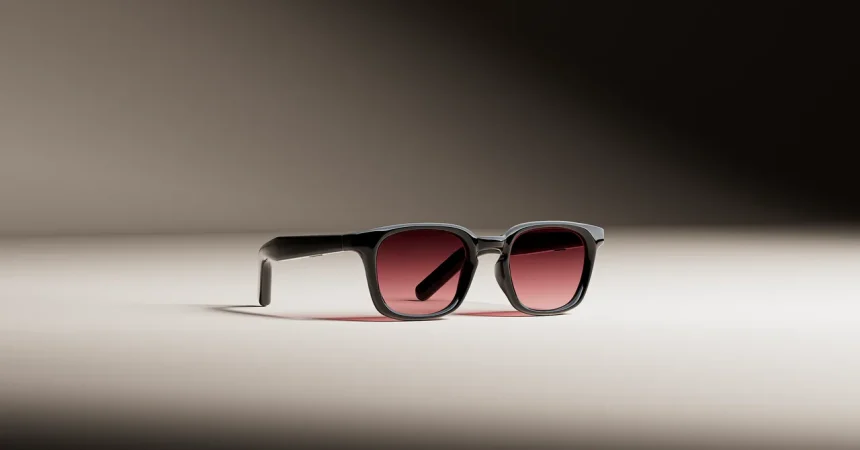
That moment is the heart of a much larger story about Viture, a San Francisco-based company known for its plug-in virtual display glasses, and its surprising pivot into a very different kind of wearable. Viture built its reputation on products like the Viture One and the Viture Beast, chunky face computers that connect through a USB-C cable to a phone, a game console, or a laptop, and project a giant screen in front of the wearer’s eyes. These devices were designed for gamers, for travelers, for anyone who wanted a private cinema strapped to their face. They worked well for that purpose, but they were not the kind of glasses you would forget you were wearing. They were pieces of technology, thick and functional, and they looked like it. The new Vonder glasses, however, are a deliberate break from that identity. They look remarkably like normal eyeglasses. There is no virtual display inside the lenses, no digital screen floating in your field of vision. At first glance, they are almost unremarkable. But inside those ordinary frames is a far more ambitious idea. Vonder aims to map out your memories, your ideas, and your goals, and place them on a digital vision board that lives in the cloud, a kind of externalized mind that can be revisited, sorted, and reflected upon. And it does all of this without embedded cameras, which is a conscious choice in a world where the idea of a camera on your face makes many people deeply uncomfortable. It is a quieter kind of intelligence, one that listens and thinks rather than watches and records.
The Vonder glasses are designed to be ambient rather than intrusive. The arms of the glasses contain microphones and speakers, so they can play music, read out map directions, make phone calls, and receive notifications without ever pulling the wearer’s attention away from the world in front of them. You can ask a question out loud and hear an answer in your ear. You can dictate a thought while walking down the street and know it will be stored somewhere, waiting for you later. But the most distinctive feature is the built-in AI assistant, which is not tied to any single large language model. Instead, Vonder AI draws from a combination of the leading models available today. It can trigger OpenAI’s ChatGPT, Anthropic’s Claude, Google’s Gemini, or even DeepSeek, depending on the task. The system evaluates the complexity of a request and routes it to whichever model is fastest and most economical for that particular job. A simple search might go to one model, while a complicated question that requires deep reasoning might go to another. The user does not need to know or care which model is working behind the scenes. The glasses simply handle it, invisibly, the way a good assistant would handle a scheduling conflict without explaining every logistical detail. This multi-model approach is a practical acknowledgment that no single AI model is perfect. Each has strengths and weaknesses, and the most useful wearable should be able to move between them fluidly. But what makes Vonder truly interesting is not the technical plumbing. It is the way the glasses are meant to be used as a companion to memory and self-reflection. A digital vision board is not just a list of tasks. It is a way of externalizing the things we hold inside ourselves, the dreams we are afraid to name, the patterns we cannot see in ourselves, and the choices that shape our lives.
The tennis story is the clearest example of that ambition. The Vonder glasses were not simply transcribing Jiang’s words. They were interpreting his behavior in context, noticing a pattern across time, and then offering a suggestion for behavioral change. That is not a simple feature. That is something closer to a coach, or perhaps a very honest friend. It raises a strange and uncomfortable question: should an artificial intelligence be allowed to tell us who we are? In Jiang’s case, the message was not an accusation. It was an invitation to step outside his own perspective and see his son through fresh eyes. The glasses recognized that shouting was not helping, that criticism was not building resilience, that the old way of fatherhood was causing distance where connection was needed. It told him to be present, to be supportive, to trust that his son’s growth did not require a soundtrack of corrections. And the strange thing is that it worked. Jiang says he did not know he had a pattern until the glasses found it. That is both humbling and hopeful. It means that our habits, even the ones we think are intentional, are often invisible to us. We act on autopilot, following scripts that were written long ago by our parents, by our culture, by our own fears. Sometimes it takes an outside voice to break the loop. Sometimes that outside voice is another person, but more and more often, it might be a machine that has listened to us long enough to notice what we keep doing to ourselves and to the people we love.
Of course, there is a deeper tension here. The same technology that can tell a father to stop shouting at his son could also be used in more controlling ways. A device that listens to your conversations and analyzes your behavior is a device with enormous power over your inner life. Viture’s decision to leave out cameras is a choice that deserves attention. It is a recognition that people are more comfortable telling their secrets to a device that cannot see what they are doing, than to one that watches every move. But the microphones still remain, and the AI still hears the tone of your voice, the words you choose, the way you speak to the people around you. That is already a lot of information. The ethical questions around such a device are not going to disappear just because it looks like ordinary eyeglasses. There is also a risk of dependency. If we begin to rely on an AI to point out our flaws, we may lose the habit of noticing them ourselves. If we need a wearable to remind us to be present, we may become even less present when the device is not available. Jiang would likely say that the goal is not to replace human judgment but to supplement it. The glasses are not meant to make decisions for you. They are meant to show you patterns, to surface the things your mind hides from itself, and then leave the choice to you. In his case, the choice was clear. He wanted to be a better father. He just needed someone, or something, to show him how.
The Vonder glasses have not yet been released to the public. They are still mostly a promise, a vision of what wearable intelligence could become. But the story Jiang tells about his son is part of the sales pitch, and it is a compelling one. It suggests that the next generation of smart glasses will not be judged by how well they display a movie or how comfortably they sit on your nose. They will be judged by whether they help us understand ourselves a little better. Viture has made a surprising move from gaming hardware to something much more personal, and the pivot says a lot about where the industry is heading. We are moving beyond screens, beyond notifications, beyond the endless feed of information. We are moving toward devices that listen, that remember, that reflect. The name Vonder, like wonder with a V, is meant to evoke curiosity and possibility. It is an ambitious name, and perhaps an arrogant one. Can a pair of glasses truly teach us to be better people? Maybe not by itself. But perhaps it can do something more modest and more practical: it can hold up a mirror to our habits, point out the patterns we ignore, and whisper, at the right moment, that there is another way to act. In David Jiang’s life, that whisper came just in time. It reached him on the edge of a tennis court, in the middle of his own yelling, and it told him to be still. He listened. His son, he says, is doing better now. And so is he.