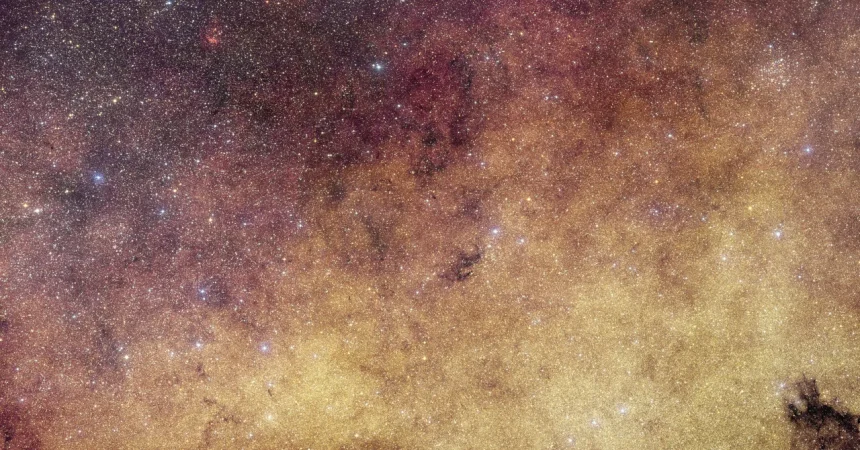
The European Space Agency’s (ESA) Euclid space telescope has recently achieved a monumental feat, capturing the most expansive and detailed visible-light portrait of the Milky Way’s galactic bulge ever assembled. This central, densely packed region of our galaxy has long been a complex puzzle for astronomers, largely because its overwhelming brightness and sheer volume of stars make it notoriously difficult to study without losing detail. By successfully resolving over 60 million individual stars, along with intricate nebulae and far-reaching star clusters, Euclid has proven that even though its primary mission is to peer at the furthest reaches of the distant universe, it possesses an extraordinary capacity to serve as a high-precision camera for our own cosmic backyard.
The technical prowess behind this image is perhaps the most impressive aspect of the mission. On March 23, 2025, Euclid dedicated a mere 26 hours to gathering nine distinct exposures of the galactic center. Each of these exposures covers a section of the sky significantly larger than the full moon, stitched together into a seamless, high-definition mosaic. While the clarity of Euclid’s optics is often compared to the legendary Hubble Space Telescope, Euclid’s true advantage lies in its sheer efficiency and field of view. A single pointing by Euclid covers an area approximately 270 times larger than Hubble’s view, and to replicate this specific survey using ground-based equipment like the Keck Observatory, astronomers would have to invest a staggering 2,000 hours of observation time. Euclid accomplished the Herculean task in just over a day.
Beyond the aesthetic beauty of millions of glimmering stars, this data serves a vital scientific purpose: the search for exoplanets through a technique known as gravitational microlensing. This method relies on the chance alignment of stars; when a foreground star passes in front of a background star, its gravity acts like a magnifying glass, briefly brightening the background light. If that foreground star hosts a planet, that planet leaves a detectable “hiccup” or distortion in the light curve. Because these events occur most frequently in the crowded, bustling heart of the Milky Way, Euclid’s massive, high-resolution mosaic provides the foundational map necessary to identify these planetary systems with unprecedented accuracy.
The image currently contains 51 known planetary systems, but its long-term value lies in its role as a cosmic time capsule. By capturing this region with such precision, Euclid has created a “before” photograph that future telescopes—most notably NASA’s upcoming Nancy Grace Roman Space Telescope—will rely on. When these future missions detect a new microlensing event, they will be able to look back at Euclid’s archived data to see exactly how those specific stars appeared before their alignment occurred. Having this chronological reference point is invaluable for scientists, as it allows them to calculate the masses of newly discovered exoplanets far more accurately than they could through current observation methods alone.
The implications of this dataset extend well beyond the hunt for new planets. According to Valeria Pettorino, the project scientist for Euclid, this bounty of information is a multi-purpose tool that will benefit various branches of astrophysics. Researchers can now dive into these images to study the complex life cycles of brown dwarfs, analyze the orbital dynamics of binary star systems, track the chaotic motions of stars within the bulge, and map the distribution of interstellar dust that filters our view of the galaxy’s heart. In this sense, a single day of data collection has transformed from a mere test run into a foundational building block for years of future research.
Ultimately, Euclid’s contribution to our understanding of the Milky Way highlights the synergy of modern space exploration. By combining the speed of specialized optics with the ability to archive precise data for future, more advanced missions, the ESA is essentially building a collective memory for the scientific community. We are no longer just looking at the sky; we are documenting it with such rigor that the questions of tomorrow can be answered by the data gathered today. This glimpse into the heart of our home, while born of complex technology and abstract physics, reminds us of the profound scale of our galaxy and the relentless human drive to catalog and understand every hidden corner of the cosmos.