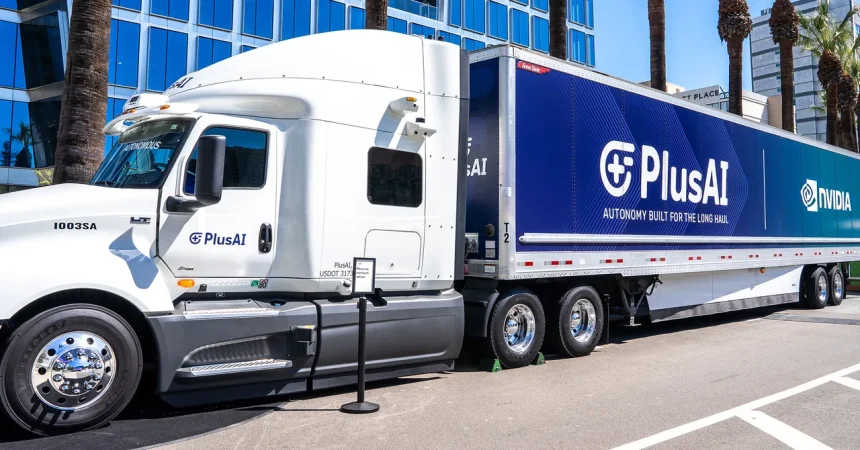
On Thursday morning, a top executive at PlusAI received an unexpected text that should have been pure delight. An acquaintance had spotted two trucks bearing the company’s logo near an office in Newark, California, and sent a warm, encouraging message: “I have been proud of you for your adventure and success at Plus. Just saw two of your trucks near my work place! :)” It was the kind of out-of-nowhere compliment that can make a person smile before the day really begins—someone seeing your company’s name in the wild and thinking of you. But for this executive, the smile probably did not last long. The trucks, as far as the company knew, were not supposed to be there. They were supposed to be outside PlusAI’s warehouse, half a mile away, securely docked and waiting. The fact that they had somehow appeared near an office park meant either someone had moved them without authorization, or something much worse. The trailers, after all, were deliberately easy to notice: they were emblazoned with logos for PlusAI and Nvidia, two names at the center of autonomous trucking and artificial intelligence. Nvidia, at the peak of the AI boom, is routinely described as the most valuable company in the world. PlusAI is part of the next wave of transportation, developing the software and systems that may one day make long-haul trucking safer, cheaper, and more efficient. A trailer with both logos on it is not just a vehicle; it is a brand statement, a sign of where the freight industry is heading. It also, in the eyes of a thief, could look like a moving treasure chest. And for a company whose entire business is built on making trucks smarter, there was a sharp irony in the way this particular problem was discovered: not by a sensor, a camera, or an autonomous system, but by a human being who sent a friendly text message.
According to police, officers arrived at the scene to help recover the two trailers. By the time the authorities got there, the people who had taken them were gone. What they left behind told a fairly clear story. The trailers had been broken open, their hand locks forced or damaged. Someone had clearly gone to the trouble of attaching a truck cab to the trailers and driving them a short distance, expecting to find something valuable inside. Instead, they found sand. All of it. PlusAI later confirmed through spokesperson Lauren Kwan that the company uses simulated loads in its trailers as part of its research and development testing. These are not ordinary deliveries; they are carefully weighed payloads designed to mimic real cargo so engineers can test how autonomous vehicles behave under realistic conditions. In this case, each trailer was loaded with about 20,000 pounds of sand. Combined, the two trailers carried 40,000 pounds of what the company described as “sand intact”—meaning the thieves did not make off with a single pound of it. The company’s truck cabs, where a driver normally sits and controls the vehicle, were parked inside its warehouse and were never taken. What the thieves managed to steal, therefore, was a pair of heavy, awkward, almost impossible-to-sell trailers with broken locks and no secret payoff inside. The case is still under investigation, and no arrests have been made, according to Amy Gee, a spokesperson for the Fremont Police Department. Nvidia did not immediately respond to requests for comment, and PlusAI declined to say much beyond the basic facts. But the obvious question hovered over the entire incident: what did the thieves think they were going to find?
The incident did not happen in a vacuum. Across the United States, cargo theft has become a serious and growing problem, and much of it is aimed at exactly the kind of high-value computer equipment that a PlusAI trailer might reasonably contain. In August, WIRED reported on two California incidents in which thieves deliberately attacked the vehicles of security escorts who were following loads of high-value tech equipment. The criminals did not just break into parked trailers; they made plans, used violence or intimidation against security personnel, and then drove the trucks to secondary locations to unload them. As of that reporting, millions of dollars’ worth of data center equipment had not been recovered. Elsewhere in the country, thieves have targeted Tesla batteries and bitcoin mining machines. Metals and enterprise-grade computer and networking gear have become some of the most common stolen cargo categories in recent months, according to Verisk CargoNet, a firm that tracks and analyzes cargo theft data. This is not the work of random vandals or desperate opportunists, at least not usually. It is a shadow economy of organized crews who know where chips, GPUs, and other expensive electrical components are manufactured, shipped, and stored. They know which trailers have GPS devices and which ones do not. They know which roads are quiet at three in the morning. They know what a Nvidia logo is worth. It makes sense, then, that someone would look at two PlusAI trailers sitting outside a warehouse and decide they were worth the risk. The name on the side suggested artificial intelligence, cutting-edge sensors, maybe graphics cards, computer boards, or whole racks of equipment destined for a data center. Instead, the thieves found something the company itself uses as a stand-in for reality: sand, dense granular filler, no better than a load of rocks.
Now, there is an almost comic layer to this story. A trailer full of sand is the kind of boring, low-stakes cargo that thieves normally ignore. It is heavy, difficult to unload quickly, and nearly impossible to sell for a profit. It is also, in a perverse way, the perfect decoy. PlusAI was not trying to trick anyone; it was doing legitimate engineering work, using measured weights to test braking, acceleration, lane changes, and how the truck’s autonomous systems respond to different road conditions. But the sand happened to be exactly the kind of cargo that makes a theft pointless. The people who heaved those trailers open probably expected to see boxes of Nvidia-powered computing hardware or other sophisticated components. Instead, they saw 20,000 pounds of sand in each trailer, and they walked away. Yet the incident is also a reminder of how much is at stake as autonomous trucking moves closer to commercial reality. PlusAI and Nvidia are working together on AI software and autonomous driving technology, the sort of innovation that could transform freight transportation. The logos on the trailer are not just decoration; they represent millions of dollars of engineering, partnership, and investment. If the thieves had been looking for physical equipment, they badly misread the target. But if they had been interested in the technology housed in the cabs, the outcome could have been much worse. The cabs—the brains of the operation—were safely parked inside the warehouse. That detail may have been the real reason the story had a happy ending. It is hard not to imagine the moment the thieves broke open the first trailer and saw sand. Maybe they laughed. Maybe they cursed. Maybe they simply stared in disbelief. They had taken something from a company with a shiny name, but what they got was a load so ordinary that nobody would bother to steal it.
Behind the headlines and the odd image of sand-filled trailers, there are real people whose Thursday morning suddenly became much more complicated. The executive who received that congratulatory text must have felt a strange mix of emotions: surprise at being recognized, pride in the company’s visible progress, then a growing unease as it became clear that those trucks were not where they were supposed to be. Maybe the acquaintance thought he was paying a compliment; in the end, his message served as an early warning. The employees who discovered the missing trailers and then saw their cargo described as “40,000 pounds of sand intact” probably felt relief mixed with disbelief. The spokesperson had to field questions from reporters and explain why a self-driving truck company would fill trailers with sand. The police had to investigate a crime that looked serious—branded trailers, broken locks, logos of a trillion-dollar company—but ended up being a test payload no one could fence. There are still unanswered questions. Who broke the hand locks and attached a cab to the trailers? Why did they choose those specific trailers? Did they think the sand was a cover for something more valuable? Were they trying to steal the trailers themselves, perhaps to resell them for parts? No arrests have been made, and the Fremont Police Department continues to investigate. In a climate where cargo theft rings operate with increasing sophistication, a crime like this cannot be dismissed as a simple mistake. Even if the criminals got nothing, they demonstrated that they knew how to spot a trailer, take it from a property, and move it. The fact that they came up empty does not mean the next attempt will be as harmless. For the people involved, the incident is a reminder that the supply chain runs on vigilance, not just software. Sometimes the best outcome is not a glamorous catch; it is simply getting your trailers back in one piece, with the sand still inside.
By Thursday afternoon, according to the Fremont Police Department, the sand trailers were back with PlusAI. That simple sentence is probably the closest thing to a happy ending the company could hope for under the circumstances. The vehicles were recovered, the cargo was untouched, and the only real cost was the time spent dealing with police, logistics, and all the awkward explanations. But the story is not merely a funny footnote about thieves getting fooled by sand. It is a small window into the strange new landscape of modern freight and artificial intelligence. As companies like PlusAI push toward a future where trucks drive themselves, the physical infrastructure of that future—the trailers, the cabs, the sensors, the computing units, the test cargo—will become increasingly valuable and increasingly attractive to criminals. The hand locks that protected these particular trailers were not enough; they were broken, after all. It may take more advanced security, better tracking, and smarter logistics to keep these assets safe. It may also take the kind of human connection that began this story: a friend who saw a familiar logo on a truck and sent a cheerful note, not knowing he was alerting a company to a theft. In that way, the incident is both heartwarming and cautionary. The kindness of a stranger’s text message helped set the recovery in motion. But the fact that the theft happened at all is a reminder that no technology is immune to old-fashioned criminal intent. The sand is safe. The trailers are home. No one is in handcuffs, and the mystery remains unsolved. For now, though, PlusAI can get back to work, testing autonomous trucks with loads of sand that proved, in a completely unintended way, that even worthless cargo can be priceless when it belongs to you.