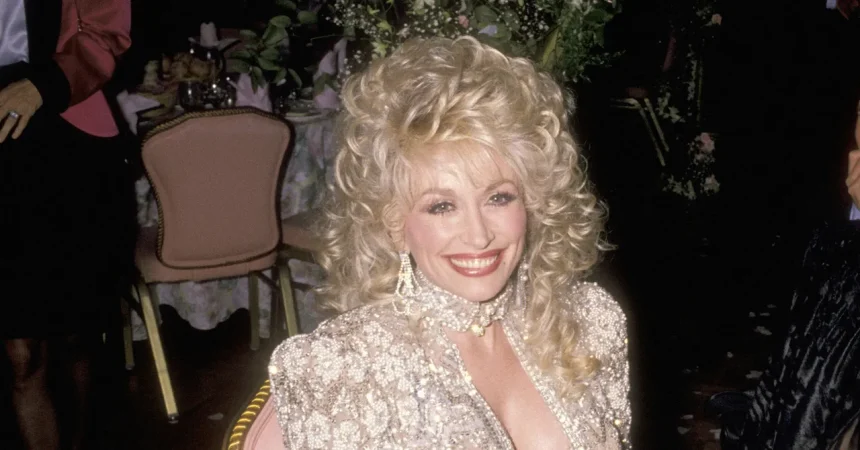
Few American entertainers have ever occupied a place in the public heart quite like Dolly Parton. She was the woman who rose from a tiny cabin in the Great Smoky Mountains to become one of the most beloved figures on earth, carrying with her a warmth, wit, and generosity that felt genuinely rare. So when word came that Parton had died at 80 after a short battle with cancer, the natural response was grief, gratitude, and the quiet ache of losing someone who felt like family. Instead, the internet unleashed something darker. Within hours, social media was flooded with conspiracy theories claiming her death involved satanic rituals, cloning, and—most prominently—a mysterious condition called “turbo cancer” supposedly caused by the Covid-19 vaccine. Not one of these theories has a shred of evidence. Her family issued a simple statement: she died after a short battle with cancer. But for a large and noisy corner of the online world, that simple truth was never enough. They needed a villain. They needed a story. And they found one in the vaccine. The cruelty of this is hard to overstate. Parton was not just a celebrity; she was a symbol of kindness, resilience, and quiet decency. She spent decades giving books to children, supporting communities, and spreading joy through her music. In death, she deserved dignity. Instead, her name was twisted into a political weapon.
Understanding why Parton became such a target requires remembering exactly what she did during the pandemic. In 2020, she donated one million dollars to Vanderbilt University Medical Center to help fund research that contributed to the Moderna Covid-19 vaccine. She did not do it for publicity; she did it because she believed in science and wanted to save lives. The following year, she sat down publicly, rolled up her sleeve, and got vaccinated on camera, singing a rewritten version of her hit song Jolene. “Vaccine, vaccine, vaccine, vaccine, I’m begging of you, please don’t hesitate,” she sang, her eyes twinkling with her trademark humor. It was pure Dolly: brave, playful, and generous. She used her platform to encourage others, especially rural and southern fans who might have been skeptical. That simple act of kindness made her a marked woman in the eyes of anti-vaccine influencers. For years, they had been searching for a famous face to attach to their claims of vaccine injury. Parton’s later illness gave them a twisted opportunity. In May, she had shared that she was responding well to treatment related to her immune and digestive systems. Cancer is cruel and fast, and it does not care about timelines or narratives. But instead of accepting the tragedy of a woman dying of cancer at 80, many online chose to connect dots that were never there, treating correlation as causation and turning a beloved woman’s death into evidence for an agenda. It is a deeply unkind way to remember someone who spent her entire life trying to make the world a little brighter.
The loudest voices pushing this lie came from the fringes of right-wing media, where conspiracy theories about vaccines have become a sort of religion. Wayne Allyn Root, a far-right radio host who recently interviewed President Donald Trump on his show, wrote on X: “Was Dolly Parton yet another Covid vaccine victim? She took the vaxx on TV. She changed the name of her hit song ‘Jolene Jolene’ to ‘Vaccine, Vaccine.’ She encouraged fans to get it. Now she’s dead of cancer. This sounds like another case of ‘turbo cancer. RIP Dolly.’” The term “turbo cancer” is not a medical diagnosis; it is a phrase invented by anti-vaccine activists to describe aggressive cancers in vaccinated people, with zero scientific support. Root’s post was echoed by Toby Rogers, who works with the Brownstone Institute, a think tank founded to oppose Covid restrictions and with deep ties to the Trump administration. Rogers wrote: “Dolly Parton thought she was doing the right thing by backing the Moderna mRNA Covid shot. But it very well may have killed her.” Neither man offered a single piece of proof. No medical records, no autopsy report, no expert testimony. They simply took a heartbreaking death and bent it to fit their narrative. Earlier this month, Root had urged Trump to declare a national emergency during the midterms when the president appeared on his show; Trump’s response was famously noncommittal: “Let me just say, stranger things have happened, OK?” The connection between these figures and the vaccine misinformation machine is not accidental. It is an ecosystem of influencers and political operatives who profit from fear.
The institutions behind these claims deserve scrutiny. The Brownstone Institute was founded by Jeffrey Tucker, a close ally of Health Secretary Robert F. Kennedy Jr., who has spent years undermining trust in a variety of vaccines. Kennedy himself has not publicly commented on Parton’s death, but his broader behavior reveals the pattern. In the same week that two unvaccinated people died of measles in Pennsylvania, Kennedy blamed the Covid lockdowns, rather than the measles virus, for the deaths. That kind of logic—blaming protective measures instead of the disease that actually kills—is exactly why anti-vaccine narratives flourish. It also matters because figures like Kennedy and Tucker now hold real power. When they cast doubt on vaccines, they are not just spouting nonsense on social media; they are shaping public health policy and endangering lives. Parton, who spent her life helping children learn to read and funding medical research, would almost certainly have been horrified to see her name used to discourage vaccination. She was not a symbol of vaccine injury. She was an example of public-spirited courage. The attempt to turn her into a martyr for a false cause is not only dishonest; it is a betrayal of everything she stood for. We do not have to agree with every public health mandate to recognize that this woman acted out of love, not malice, and that her death should not be used to score political points.
Social media gave these theories oxygen. Valerie Anne Smith, a health influencer with 273,000 followers on X, shared multiple posts about Parton’s death, all suggesting the vaccine was responsible. “Soon after being injected she developed severe autoimmune, liver and kidney issues,” Smith wrote. “Cause of death … CANCER.” No evidence was offered. Similar posts flooded Facebook, filled with wild allegations and no proof. One of the most popular themes focused on a video Parton made just weeks before her death, in which she thanked Taylor Swift and Travis Kelce for a two million dollar donation to Imagination Library, her childhood literacy charity, and joked about asking the couple for their firstborn child. The video had nothing to do with vaccines, but that did not stop people from mining it for hidden clues. This is how modern misinformation works: it takes small, human moments and twists them into something sinister. Travis View, cohost of the QAnon Anonymous podcast, explained to WIRED why Parton was such a useful target. “Dolly Parton was as universally beloved as a person can be,” he said. “That’s exactly what made her a target for conspiracists online. Many anti-vaccine conspiracy theorists despised Parton because she not only encouraged others to get the vaccine, she even helped fund vaccine development.” The logic is perverse: the more loved the person, the more valuable their death becomes as a propaganda tool. The theory spreads not because it is convincing, but because it is attached to someone everyone knows and loves. That is not a coincidence. It is a strategy.
What can we do in the face of all this? First, refuse to let lies define how we remember Dolly Parton. The vaccine did not kill her. Cancer did. “Turbo cancer” is not a real medical condition, and no amount of online shouting will make it one. We owe it to Parton, and to ourselves, to mourn honestly. We can honor her by continuing the work she cared about: supporting children’s literacy, funding medical research, and being kind to one another. She once said, “If you see someone without a smile, give them yours.” That is the Dolly Parton the world should remember—not a pawn in a political battle, not a headline in a conspiracy theory, but a woman who gave her life to making others’ lives better. Her death should teach us something important about the fragility of life and the danger of misinformation. When we see a claim that seems too outrageous to be true, we should ask for evidence. When we feel anger, we should ask who benefits. And when we hear someone’s pain being used to sell a story, we should walk away. Dolly Parton believed in the goodness of people. It would be a tragedy if, in the hours after her death, we proved her wrong. Instead, let us remember her smile, her songs, and her open heart. Let us let her rest in peace.