It begins with a two-block journey, a short walk that for most commuters would be little more than a chance to stretch their legs. But for the roughly 1,600 General Services Administration (GSA) employees recently relocated from their familiar offices on F Street in Washington, D.C., to the Theodore Roosevelt Federal Building, that short walk feels like a descent into a profoundly alien and hostile environment. This relocation, forced upon them in the wake of the seismic changes brought by Elon Musk’s Department of Government Efficiency (DOGE) beginning in January 2025, was supposed to exemplify bureaucratic streamlining and cost-cutting. DOGE had already battered the federal workforce, effectively firing tens of thousands of employees across agencies, while simultaneously mandating a strict return-to-office policy and championing zero-based budgeting—a philosophy where every dollar of an agency’s budget had to be justified from scratch each year, rather than building on previous spending. The move to the Roosevelt Building was framed as a consolidation of physical assets, a way to shed underutilized real estate and save taxpayer money. However, for the employees filing into their new cubicles, the transparency of that logic is obscured by the grim reality of deteriorating infrastructure, peeling paint, and the unmistakable scent of neglect that hangs in the stale, recycled air.
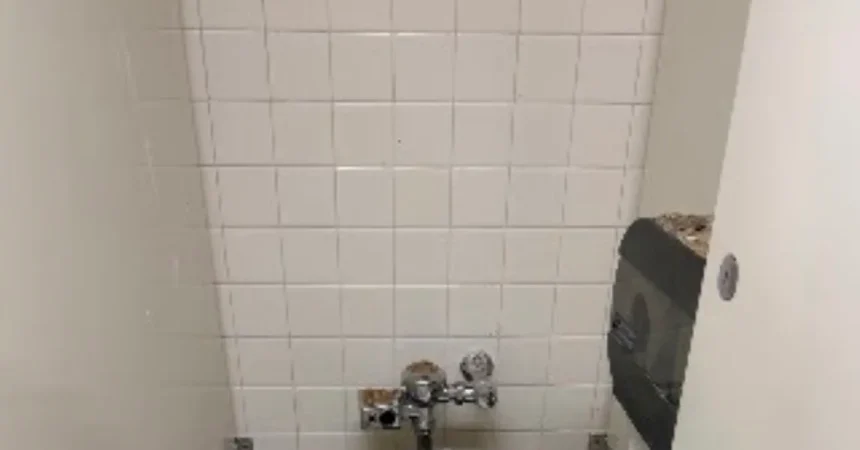
Once inside, the physical reality of the Theodore Roosevelt Federal Building immediately assaults the senses. For many workers, the first shock comes at the water fountain or the sink in the restroom. A sign, printed in plain bold text, instructs them to “run the water without your bottle for 5-10 seconds and wait for the water to run clear.” It is a bureaucratic acknowledgement of a deeply unsettling truth: the water pouring from the taps is not clear. It is a murky, rusty, or yellowish-brown stream, carrying sediment and discoloration that suggests aging pipes and potential contamination. Just a short distance away, in the men’s room on the third floor, the situation is even more grotesque. Photographs obtained by WIRED depict a toilet covered in debris from a caved-in ceiling, chunks of drywall, dust, and flaking paint scattered over the porcelain. Above the stall, there is a gaping hole in the ceiling, exposing the dark cavity of the building’s infrastructure, wires, and ductwork. Employees are left to navigate these hazards daily, wondering about the structural integrity of the very floor they walk on. The psychological weight of these conditions is immense; it transforms a simple workplace errand into a daily negotiation with decay, where a trip to the restroom becomes a gamble on safety and basic dignity, and where the act of filling a water bottle requires a forced pause to watch sediment settle at the bottom.
Adding to the squalor is the issue of vermin. In a corner of the office, a dead mouse lies stiff in a snap trap, a grim token of the building’s ongoing battle with infestation. One GSA employee, who spoke to reporters on the condition of anonymity due to fear of retaliation for speaking to the press, admitted that the presence of rodents was not, in itself, entirely shocking. “There are buildings all over D.C. that have vermin,” they explained, a weary resignation in their voice. But the combination of the decaying ceiling, the contaminated water, and the constant scuttling in the walls created a breaking point. “The ceiling pushed us over the edge,” the employee said. The dead mouse is not just a line item on a facilities report; it is a symbol of a larger systemic failure. It represents the gap between the polished rhetoric of governmental efficiency and the gritty, unsanitary reality faced by the people who are supposed to be implementing those policies. When basic environmental health and safety are compromised, the message sent to the workforce is unmistakable: you are dispensable, your comfort is irrelevant, and your workplace is merely a cost center to be minimized, not a valuable asset to be maintained. The employees are not just working in an old building; they are working in a monument to administrative neglect, a place where the strain of excessive cost-cutting has physically manifested in drywall and rodent droppings.
The irony of this situation is profound when juxtaposed against the stated goals of the DOGE initiative. The department, which has operated with unprecedented authority and opaque methods, championed a return to in-person work under the premise that physical presence would increase collaboration, productivity, and accountability. Yet, the conditions at the Roosevelt Building actively undermine any potential for productivity. Holding a video conference while water drips from a leaking pipe, or trying to focus on a complex procurement contract while wondering if the air quality is safe to breathe, is a recipe for distraction, anxiety, and illness. The zero-based budgeting philosophy, meant to ruthlessly eliminate waste, has instead gutted the very maintenance budgets necessary to keep federal facilities habitable. While billions of dollars were arguably saved by firing employees and reducing headcount, that savings has been immediately off-set by the hidden costs of an increasingly demoralized workforce, potential health insurance claims related to mold or poor air quality, and the eventual need for emergency repairs that will cost far more than routine maintenance would have. The driving mandate to “work harder and faster” becomes a bleak joke when an employee has to wait ten minutes for a sufficiently clear glass of water just to take their medication.
The GSA itself is caught in a profound paradox, torn between the ambitious, destructive orders from the DOGE leadership and the practical necessities of running the nation’s physical infrastructure. As the agency responsible for managing federal real estate, it was one of the first and hardest hit by the DOGE regime. Under pressure from Musk’s lieutenants, GSA listed hundreds of its buildings for sale, aiming to offload a massive real estate portfolio it deemed underutilized. It was this very divestiture strategy that likely forced the relocation of the 1,600 employees from the F Street office—a building that was probably among the properties slated for disposal—into the already crowded Roosevelt building. Yet, in a stunning twist of bureaucratic whiplash, after a year of calamitous firings and early retirements that left the agency hemorrhaging talent, GSA officials recently announced that they plan to hire roughly 400 new workers. The question that must be asked is: why would anyone accept a job at an agency that has demonstrated such callous disregard for its employees’ physical well-being? The hiring effort seems doomed to fail as long as the work environment resembles a post-disaster construction zone. The agency is simultaneously trying to sell off buildings that it cannot afford to maintain while trying to recruit staff into the dilapidated structures it has left behind.
Ultimately, this story is not merely about a leaking ceiling or a dead mouse in a government building; it is a profound reflection of the current state of the American bureaucratic state and the human cost of ideological austerity. The anonymous GSA employee’s final lament rings hollow and true in equal measure: “We’ve all been through a lot, but this really made me finally understand that they don’t care about us.” That sentiment is the real headline. It speaks to a broader erosion of trust between the federal government’s political leadership and its civil servants. When a government asks its citizens to trust it with their lives, their health, and their security, it must first demonstrate that it can take care of its own employees. The sight of workers running water for ten seconds to avoid drinking rust, and stepping over debris from a collapsed ceiling, is a visceral insult to the concept of public service. It sends a chilling message that under the guise of “efficiency,” dignity is negotiable, safety is a luxury, and the public realm is disposable. Until we collectively recognize that investing in the physical spaces where public servants work is an investment in the very concept of governance, incidents like this will continue to occur. The Theodore Roosevelt Federal Building will stand as a stark, crumbling symbol of what happens when administrative ideology overtakes common sense and basic human decency.