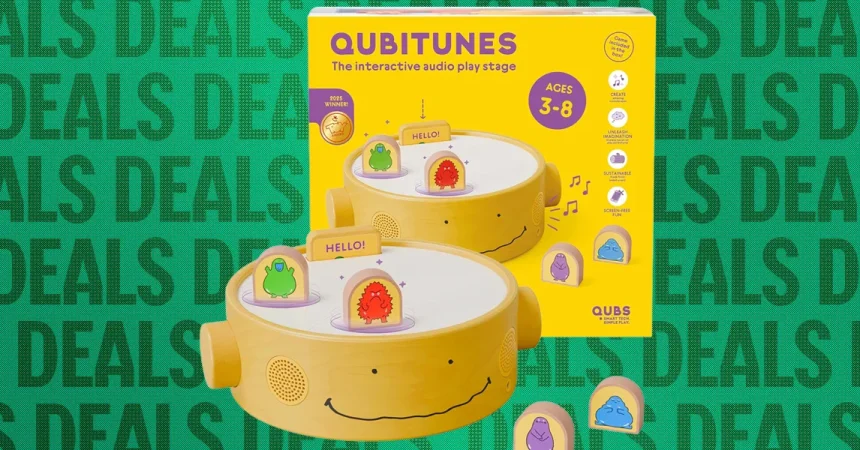
If you’ve ever spent an evening prying a tablet out of a small child’s hands, you already know the central dilemma of modern family life: we want kids to be entertained, engaged, and maybe even educated, but we don’t want them glued to a glowing rectangle. Parents worry about screen time, and for good reason, but it can feel impossible to find alternatives that are genuinely fun rather than just “healthy boredom.” Qubitunes is that rare product that feels like a real answer. Designed as a screen-free play stage and speaker for kids, it looks like a minimalist wooden device, almost like a small round music box that belongs on a shelf rather than in a toy chest. The magic happens through physical pieces: content arrives in little wooden cartridges that you slot into the top of the speaker, and children place wooden character pieces onto the circular soundstage, which is divided into four distinct sections. Depending on where you place those pieces, the audio changes, creating a sort of choose-your-own-adventure for the ears. It sounds simple, and it is, but that simplicity is exactly what makes it so brilliant. Kids aren’t tapping a screen; they’re manipulating the world with their hands, making choices, experimenting, and listening carefully. The device invites curiosity from the moment you hold it. It feels like a toy from another time, one that asks for attention and imagination rather than fingers swiping glass. For parents, teachers, and gift-givers, that promise alone is refreshing, but Qubitunes delivers far more than a nostalgic aesthetic.
What really makes Qubitunes special is the way it uses that simple design to create complex, interactive experiences. A child can load a story cartridge, place a character in one quarter of the soundstage, and hear that character’s part of the narrative unfold. Move the character to another section, and the story shifts in a new direction. Swap in a different character, and a dimension of the tale opens up that wasn’t there before. This isn’t just passive listening; it’s active storytelling. The same principle applies to music. In the Little Maestro set, which is my personal favorite, kids explore an orchestra that plays works by Mozart, Vivaldi, Beethoven, and Bach. But they don’t just press play and hear a symphony; they can layer different instruments by adding characters to different spots, building the music piece by piece. It’s like a tiny interactive composition lab that teaches kids how music works from the inside out. There are also themed games and quizzes that feel more like play than rote learning. A cooking game called Bernard’s Kitchen, for example, invites kids to gather ingredients by choosing the right blocks and placing them correctly, turning sound into a kind of tactile puzzle. The device encourages experimentation, because the only way to see what happens is to try something new: what if I put the wolf on the bridge instead of the grandmother? What if I add the trumpet to the middle of the movement? Each choice produces a result, and that immediate feedback loops into more curiosity. I have to admit, when my review unit arrived, I planned to spend fifteen minutes with it and move on. Instead, I spent hours. There’s a genuine joy in discovering all the little surprises hidden inside, and I can see how kids would feel the same. It’s not just a toy that keeps kids busy; it’s a toy that keeps their minds busy, all while developing listening skills, memory, pattern recognition, and even creative decision-making. It has earned a place in my guides to the best STEM toys and speakers for kids because it blurs the line between entertainment and education so seamlessly that children don’t realize they’re learning.
In terms of the hardware itself, Qubitunes is thoughtfully built. The stereo speakers are genuinely decent, far better than I expected from a wooden toy. There’s enough clarity to make music sound rich and stories feel immersive, not tinny or hollow. If you have siblings who want to play without disturbing the rest of the house, there’s a headphone port, which is a lifesaver for road trips and quiet afternoons. The device recharges via USB-C, and a full charge gives you up to six hours of play, which is plenty for long car journeys, classroom sessions, or rainy weekends at home. The design is sturdy enough to handle enthusiastic little hands, and the wooden blocks have a satisfying weight to them that feels far more durable than plastic tokens. After spending time with it at home, I sent it to my wife’s classroom, where it quickly became one of the most popular items during free-choice time. She teaches seven- and eight-year-olds, and they consistently pick Qubitunes first when they finish their work. That level of enthusiasm is not easy to earn from that age group, especially when there are apps and videos competing for attention. In fact, the age range is impressively wide. The recommended starting age is three, because even very young children can grasp the physical interaction and enjoy the stories and soundscapes. But older kids, even second and third graders, still find it irresistible, and I’d go as far as saying adults will enjoy it too, especially those who like experimenting with sound and music. There’s something almost meditative about placing pieces and hearing the audio respond, and I can imagine parents secretly using it after bedtime. The fact that it’s entirely screen-free makes it a huge win for teachers and caregivers who are constantly battling the lure of screens. It’s a toy that encourages small children to come together, share ideas, and ask questions like “What if we try this?” rather than silently staring at a single glowing device.
There is one important caveat, though: the content is sold separately. This isn’t a toy where everything comes in one box and you never think about it again. The starter kit gives you the device and enough to get going, but to really unlock the magic, you’ll likely want to add cartridges. These add-ons cost between $10 and $20 each, which is actually quite reasonable in the world of quality children’s toys, but it’s something to keep in mind when budgeting. Each cartridge contains content delivered through wooden blocks that slot into the device, and almost all of them come with three or four character blocks and a small labeled bag to keep everything organized. There is a Wi-Fi requirement for the initial content download, because the stories, games, and sounds need to be transferred to the device from the cartridge, and you’ll also need Wi-Fi for firmware updates. After that initial setup, however, you can play entirely offline, which makes it ideal for camping trips, airplane rides, or any place without a connection. The separate content system actually works in the toy’s favor when you want to grow your library. Instead of buying a whole new device, you buy a small wooden pack that expands the possibilities. My personal top pick remains the Little Maestro set at $20, which introduces kids to four iconic composers through playful orchestral combinations. There are also story sets with quirky original characters like The Groblies, themed interactive soundscapes, and quiz-based games that test listening skills and memory. If you have thinkers and creators, I’d steer you toward the more creative or learning-focused sets, but the pure stories and soundscapes are wonderful for toddlers and younger children. What I appreciate most is that these aren’t one-time experiences. Because the audio changes based on placement and character choices, children return to the same cartridge again and again, experimenting to discover every possible combination. That replay value turns a modest investment into a long-term companion, and it makes the separate purchase feel worthwhile.
The makers behind Qubitunes, a company called Qubs, have also been steadily expanding the library, so there’s always something new to look forward to. For example, there’s now a Maestro expansion cartridge at just $10 that adds four new composers to the existing orchestra setup, which is a lovely way to keep the music theme fresh without spending too much. There’s also a Jurassic Sounds Dinosaur Game for $20 that promises exactly what it sounds like: dinosaur facts and T-Rex roars that kids can trigger by placing pieces on the stage. For any child who is obsessed with dinosaurs, this feels like a slam dunk. If fairy tales are more your family’s style, there are versions of Little Red Riding Hood and Hansel & Gretel, along with a growing list of other stories. What I love about these new releases is that they show the system is not a one-off novelty. It’s a genuinely expandable platform that can grow with a child’s interests. A three-year-old might start with a gentle soundscape or a simple fairy tale, while a seven-year-old can explore music composition, dinosaur trivia, or more complex quiz games. This adaptability is rare in the toy world. Most toys are built for a single age, skill, or interest, and once the child moves past it, the toy sits in a closet. Qubitunes, on the other hand, can change its identity entirely just by swapping the cartridge on top. The sustainable, screen-free aspect is part of the appeal too. The wooden pieces feel like they’re made to last, not just for a season but for years, possibly even for the next sibling or a friend’s family. In a world where cheap plastic toys break and end up in landfills, Qubitunes feels more thoughtful, more intentional, and more aligned with the kind of childhood we all want to encourage.
As the gifting season approaches and Black Friday deals start popping up, I think Qubitunes should be high on your radar if you’re shopping for kids in your life. The starter kit is one toy to watch for a discount, because it makes a fantastic gift on its own and is even better when paired with a few cartridge add-ons. If you’re looking for a complementary product, Qubs also makes a clever wooden car STEM toy called Cody Block. It’s currently on sale, down from $100 to $70, and it introduces kids to basic coding concepts in the same hands-on, screen-free way. It’s a natural companion piece, and together they make a powerful statement: that learning and play can happen without a screen. I’ve tested a lot of toys over the years, and I don’t hand out praise lightly. Qubitunes has earned its place in my recommendations because it actually does what so many toys claim to do: it’s fun, educational, and engaging without relying on cheap tricks. It respects children’s intelligence and creativity. It gives them agency over a story or a song, which is a rare gift in an age where entertainment is usually passive. It’s also genuinely delightful. I’ve watched kids sit together, talk to each other about what they’re hearing, make predictions about what will happen next, and then laugh with surprise when the audio changes in ways they didn’t expect. That kind of active, social, imaginative play is exactly what parents and teachers are hoping to find. So if you’re tired of the screen battles, if you want a toy that will keep its magic long after unwrapping, or if you’re just looking for something that feels a little more human in a high-tech world, Qubitunes deserves a place in your home. It’s a small wooden stage with a big heart, and it just might become the favorite toy in your house, for kids and grown-ups alike.