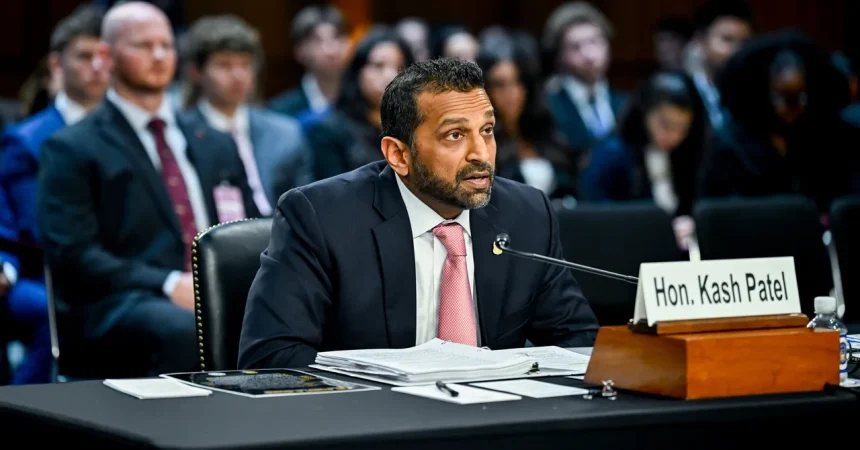
The hearing room on Capitol Hill was already thick with tension when Kash Patel, the director of the Federal Bureau of Investigation, sat before the Senate Judiciary Committee. Senators on both sides of the aisle were trying to make sense of a policy shift that had quietly changed how the FBI evaluates potential agents, and the conversation was growing more surreal by the minute. What began as a routine oversight hearing about hiring standards soon became a national spectacle over one of the most uncomfortable words in the English language: bestiality. Patel, who has become one of the most polarizing figures in American law enforcement under President Donald Trump, was there to defend a set of new hiring rules that Senate Democrats said had been quietly relaxed beginning in February 2025. Under the old rules, an applicant who had hired a sex worker, stolen from an employer, or engaged in animal cruelty would almost certainly be disqualified from serving at the FBI. Those standards were meant to protect the integrity of the agency and to guard against vulnerabilities that could be exploited by foreign intelligence services. But Patel insisted that the new standards were not a sign of weakness or laxness. Rather, he said, they were designed to protect an overlooked group of people: victims of human trafficking and abuse. The phrase he used, “victims of bestiality,” landed like a thunderclap, forcing senators and viewers at home to ask whether they had heard him correctly. It was a bizarre moment that captured the strange intersection of policy, politics, and human trauma unfolding in real time.
To understand how the conversation got there, you have to look at the history of FBI hiring standards. For generations, the FBI prided itself on being one of the most selective law enforcement agencies in the world. Background investigators dug into every corner of an applicant’s life, looking for anything that could compromise them down the road. Hiring a sex worker, for example, was considered disqualifying not necessarily because it was a crime in every jurisdiction, but because it created a vulnerability: an adversary could threaten to expose that behavior and turn an agent into a traitor. The same logic applied to stealing from an employer, financial impropriety, or engaging in bestiality. These were not simply moral judgments; they were security judgments. A person with a hidden secret, investigators reasoned, could be blackmailed. So the FBI barred such applicants categorically. But according to a letter from Senate Democrats to Patel, those categorical bars began to erode this year. The letter, which was first reported by CBS News and later obtained by outlets including WIRED, said the new standards allow for the hiring of someone who stole from an employer more than three years ago, or who paid for sex fewer than three times more than a decade ago, provided they were not in a position of “public trust.” Most alarmingly, the letter noted that a “history of bestiality or animal cruelty” is not automatically disqualifying under the new policy, as long as the conduct occurred before the applicant turned 18. The rationale behind these changes, according to multiple sources, was to facilitate hiring in some cases, widening the applicant pool at a time when the agency desperately needs people. But to critics, the changes looked like a dangerous lowering of the bar in the name of political expediency.
The tension boiled over when Senator Dick Durbin, a Democrat from Illinois, pressed Patel directly. With a tone of bewilderment, Durbin said, “You dropped automatic disqualification for applicants who have been engaged in bestiality. Not victims of bestiality, applicants who have been engaged. Do you disagree with that?” Patel did not flinch. Instead, he offered a response that left many in the room stunned. “Applicants who have engaged in bestiality means they were victims of bestiality because they were forced to do so,” he said. “At this FBI we are not going to criminalize and prevent victims from serving.” It was a grammatical and conceptual twist that reframed an act of animal cruelty as an act of abuse inflicted on the applicant. That framing opened the door to an even stranger exchange moments later, when Senator John Kennedy, a Louisiana Republican, tried to clarify Patel’s position. Kennedy asked whether old regulations had barred anyone who engaged in bestiality “on either side of it.” Patel agreed. “Either side of what, the bestiality?” Kennedy asked, his voice rising with incredulity. “So you disqualified the animal?” Patel, maintaining a flat and composed demeanor, replied, “We have great canines, but we’re not going to disqualify them.” The implication was that the FBI’s four-legged partners, the working dogs beloved by agents and handlers alike, were never the target of background checks. But the moment was ripe with absurdist comedy, and it underscored how difficult it was for even seasoned senators to get a straight answer about the policy. Kennedy, for his part, made clear his frustration. “Why would you even get into bestiality?” he asked. Patel responded, “We’re not into bestiality.” Kennedy shot back, saying the change in standards had “really hurt the FBI.” The exchange captured everything confusing, troubling, and strangely theatrical about the hearing.
In the aftermath of the hearing, the FBI sent a statement to WIRED in response to a request for clarification, and that statement added another layer of nuance. The FBI’s national press office said, “The FBI has and always will maintain the highest suitability standards for its applicants and employees in the US Government.” The statement went on to explain that the changes allow the FBI to consider “the whole of a person in certain circumstances.” It then offered a specific and striking example: “For example, the FBI has had a number of applicants in previous years who suffered sexual abuse in their past, causing questions about prostitution, bestiality, or other similar issues to affect their background check process through zero fault of their own. Previously, those applicants would be barred from consideration. Now they can be considered.” The statement closed with an emphatic denial that the changes amount to a free pass: “It is false to suggest criminal behavior like this is no longer disqualifying at the FBI—any applicant who has engaged in criminal sexual acts like those referenced would of course not be eligible for employment, and it is ridiculous to suggest otherwise.” This explanation grounded the policy in a more compassionate framework. The idea is that a child or teenager who was trafficked and forced into horrific acts should not be permanently branded as unfit to serve the country. That is a humanizing impulse, and it resonates with anyone who believes in redemption and second chances. But the statement did not fully resolve the confusion. It raised difficult questions: How does a background investigator determine whether an applicant was a willing participant or a victim? What proof is required? And in the rush to widen the applicant pool, might the FBI be opening the door to genuine threats to national security? Those questions remained unanswered.
The broader context makes the debate even more consequential. Under President Trump’s second term, the FBI has experienced a historic exodus of experienced personnel. The letter from Senate Democrats alleged that Patel orchestrated a “purge” that led to the departure of “over 5,000 nonpartisan career personnel, all six former Executive Assistant Directors, and at least 18 Special Agents in Charge,” as well as more than a thousand additional special agents. Whether described as a purge or as a reorganization, the numbers are staggering. Losing that many veteran agents and supervisors, people with years of institutional knowledge and deep familiarity with ongoing investigations, would strain any agency. It creates gaps in leadership, mentorship, and operational capability. It also changes the culture of an organization. New agents need experienced hands to guide them through complex cases, to teach them the unwritten rules of the Bureau, and to model the kind of judgment that cannot be taught in a classroom. When that experience disappears, the agency becomes more reliant on new hires, and the pressure to fill seats grows. That is likely why hiring standards were relaxed in the first place. But advocates for the changes argue that there is no contradiction between maintaining high standards and showing compassion. They point to the FBI’s own statement about applicants who were abused, insisting that this is about fairness, not lowering quality. Critics, however, see a dangerous pattern: a politically appointed director reshaping one of the world’s most important law enforcement agencies, discarding rules that were built over decades in the name of expediency. For Kennedy and other skeptics, the image of the FBI laughing off the bestiality question was not just a strange sound bite. It was evidence that something had gone seriously wrong.
In the end, the hearing was less about animals than about trust. It was about what sort of people Americans want to carry badges and guns, and how the country balances the need for security with the need for grace. Kash Patel’s answer, however awkwardly phrased, spoke to a real problem: human trafficking leaves scars that can follow a survivor for the rest of their life, showing up in background checks in ways that have nothing to do with their character. A person who was forced as a child to endure unimaginable abuse ought not be automatically excluded from a life of service because of what was done to them. That is a true and important principle. But the way Patel delivered that message, with shifting definitions and strange wording, left even sympathetic listeners feeling uneasy. It also did little to address the deeper concern that the FBI is being hollowed out at a moment when it needs stability and discipline most. The humanization of hiring policy is not inherently a bad thing. But it must be paired with rigorous processes that can distinguish between survivors and predators, between mistakes made in youth and patterns of behavior that indicate a danger to national security. The hearing on Thursday did not answer those questions. It only made them more visible. And as the days go on, the American people will have to decide whether they believe that Patel and his team are truly protecting victims, or whether they are quietly weakening the institution in ways that will take decades to repair. The phrase “victims of bestiality” may fade from the news cycle, but the debate it ignited will not. At its heart is a question with no easy answer: how do we protect the innocent and also protect the country, without losing sight of either?