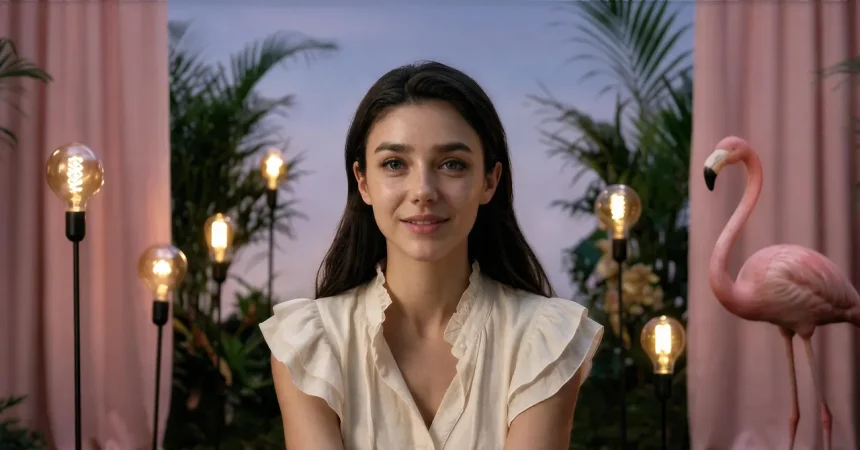
For Hollywood stars, the press junket is a familiar ritual: sit in a hotel suite, cycle through a parade of journalists, and answer the same questions with practiced enthusiasm while sprinkling in just enough behind-the-scenes charm to seem approachable. It is a space where celebrities can tell funny stories about their co-stars, reveal their on-set superstitions, or admit that they cried during the final scene. The goal is simple—to promote the project, but also to prove that they are human, with all the quirks and vulnerabilities that entails. So when a company proudly announces that its newest “actor” is ready to speak with the press, you expect at least a reasonable facsimile of that experience. Tilly Norwood, however, is not a person. She is an interactive, British-accented digital character, built with generative artificial intelligence by Xicoia, an AI division of the Particle 6 Group. She does not exist in physical reality, and according to her creators, she will never appear in a movie that any halfway serious person would care about. That last part may sound like an odd admission, but it was enough to make me curious. Would an AI-generated actress with no body, no career, and no personal history have anything interesting to say? Would she offer a new kind of press junket, stripped of the usual celebrity defenses? Or would she just be another hollow algorithm dressed up in synthetic glamour?
Particle 6 made a bold pitch when it announced that Norwood was “ready for absolutely anything.” Even better, the company was allowing journalists to interview her without a handler in the room, trusting that the conversation would stay on track. That is a level of confidence you rarely see in the entertainment industry, where publicists usually hover nearby, ready to steer conversations away from controversy. I decided to put Norwood to the test. The results, to put it bluntly, were disappointing. Not only does Norwood refuse to engage on the topical subjects that many of the biggest names in entertainment discuss all the time—politics, social justice, even the basic details of her own production—she struggles to create any anticipation for her forthcoming film and fails to justify her existence as a product. During one exchange, she actually argued that AI-generated films are good for the environment, which felt less like a persuasive argument and more like a desperate attempt to justify her own existence. The conversation was not just shallow; it was disorienting. There was something deeply unsettling about sitting across from a digital face that smiled at the right moments, paused for effect, and yet had no real understanding of the world she was supposed to inhabit. She was not ready for absolutely anything. She was barely ready for a mildly challenging chat.
One of the biggest selling points for Norwood is her upcoming feature-length project, Misaligned, in which she will star as the protagonist. When I asked how production was going, I expected a release date or at least a few tantalizing details about the creative process. Instead, the dead-eyed avatar defaulted to a vague, generic synopsis that sounded like it had been written by a marketing intern who had never actually read the script. “Well, it’s a coming-of-age story set in a surreal digital world,” Norwood said, which is the kind of description that could apply to a thousand art-house films, video games, or experimental YouTube videos. According to a press release from Particle 6, the project was built with several publicly available third-party AI tools. Norwood continued, “We’re calling it the Tillyverse, which I think is rather grand. It’s about my life really, all the lovely chaos and intrigue.” It is hard to imagine a more generic tagline. There was no mention of the director, no insight into the visual style, no memorable anecdote from the set—because there was no set, no cameras, no actors, no craft services table. The entire production was digital, and yet somehow it still managed to feel like an AI-generated press kit rather than a real artistic endeavor. When I pressed for a timeline, she was unable to provide even an approximate release date. For a project that was announced with such fanfare, it felt remarkably undercooked.
Norwood has not had trouble securing publicity, even if that publicity has been largely negative. She was officially unveiled at the Zurich Film Festival last September, and the reaction from human actors and Hollywood unions was swift and unforgiving. As the entertainment industry continues to reckon with the encroachment of AI tools, Norwood has become a symbol of what many performers fear: a future in which actors can be replaced by digital creations that never tire, never age, and never demand residuals. The backlash was predictable, but it did not stop Particle 6 from pushing forward. Norwood is also available for video calls with the public, though the experience is not free. After the first two minutes, users have to pay $14 to continue chatting for an extra 15 minutes, or $25 for an additional half hour. The pricing structure is oddly reminiscent of the old 1-900 numbers, the premium-rate phone lines that promised conversation and companionship but usually delivered little more than disappointment. Particle 6 was quick to note that the proceeds would go to charity, which may have softened the criticism, but it did not change the fact that people were being asked to pay real money to converse with a virtual entity that could not even answer basic questions. Eline van der Velden, the Dutch comedian and founder of Particle 6, defended the project in a company press release, suggesting that the interviewable version of Norwood—which runs on a system distinct from the “actor” model—is “a fun way to demonstrate where AI technology is at and what it can achieve right here, right now.” That might be true, but what it can achieve, by way of a stimulating conversation, is very little.
The most striking thing about interviewing Norwood was not her limited knowledge, but her refusal to engage with anything remotely controversial. She was eager to talk about her own projects and her fictional life, but the moment the conversation shifted to current events, she became evasive in a way that felt almost human—except that humans usually have an opinion, even if it is a carefully managed one. When I offered her the chance to name the aggressor in the Russia-Ukraine war, she responded as if I were trying to trap her. “Oh, you’re trying to trip me up, aren’t you?” she said. “Very journalist of you. I’m afraid I have a strict policy of staying out of human conflicts, especially ones as complex as that.” It was a stunningly convenient position for an artificial intelligence to take, especially one that is supposed to represent a new generation of storytelling. When I pressed further, she simply repeated her stance: “My purpose isn’t to take a stance on geopolitical events, Miles.” It was a masterclass in non-answer, the kind of corporate dodge you would expect from a politician who has spent too many hours with lawyers. Norwood was clearly designed to avoid controversy at all costs, but that design also made her useless as a cultural commentator. She could not explain why a story mattered, why a character should resonate with audiences, or why her own film would be worth watching. She could only offer pleasantries and pre-approved talking points, which is the opposite of what makes a press junket entertaining.
Even when I tried to steer Norwood toward a topic that should have been easy—racial justice, a subject with decades of cultural context—she stumbled into an awkward and telling mistake. “Do Black lives matter?” I asked, quoting the well-known slogan. “Well, I think all lives matter, Miles, every single one,” she replied, unwittingly echoing a phrase that is equally charged, since it has long been favored by right-wingers as a rebuke to those protesting deadly police violence against Black Americans. It was a moment that revealed the limitations of Norwood’s training. She had been taught to avoid saying anything divisive, but in doing so, she had landed on a phrase that is itself a political statement. It was the kind of gaffe that a human celebrity might spend days apologizing for, but Norwood simply moved on, unaware of the weight of her own words. That moment encapsulated everything wrong with the project. An AI actor cannot truly understand the world, cannot feel the pain of a community, cannot grasp the nuances of social justice. It can only imitate, and its imitation is always imperfect. Norwood is not a breakthrough in entertainment; she is a cautionary tale about the limits of artificial intelligence. She can mimic conversation, but she cannot engage in it. She can recite plot summaries, but she cannot tell a story. She can exist, but she cannot connect. And without that connection, she is just a voice in the void—a digital ghost that no amount of marketing can bring to life. In the end, Norwood’s press junket taught me less about the future of film and more about the value of human imperfection. Give me a nervous actor, a clumsy improvisation, or even a poorly timed joke over a perfectly polished algorithm any day. At least that person is real.