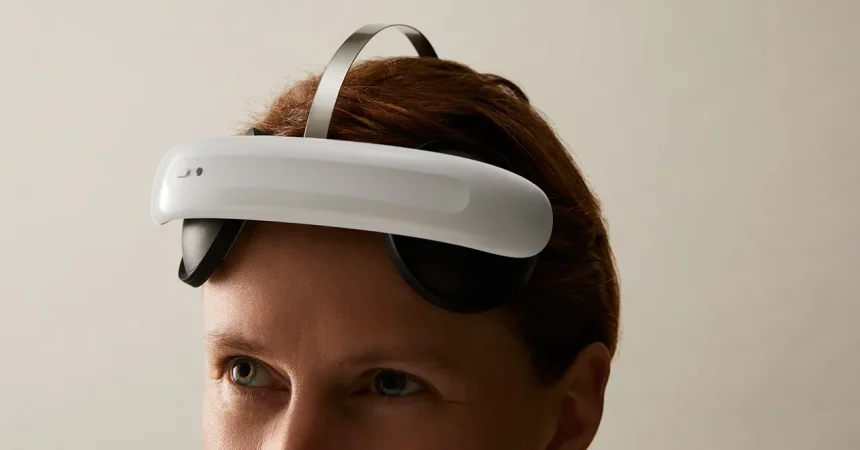
For millions of people living with depression, the search for relief can feel exhausting. You try a medication, wait weeks to see if it helps, and sometimes it does—but often it doesn’t, or it comes with side effects that make daily life harder in new ways. That’s why the news that a new at-home wearable for depression is now available by prescription in the United States feels genuinely significant. The device, made by Swedish company Flow Neuroscience, is a futuristic-looking headset worn on the forehead. It’s designed to be used for just 30 minutes a day, guided by a companion app, and it delivers low-intensity electrical stimulation to the left frontal lobe of the brain—an area that plays a key role in regulating mood and emotions. For people whose depression is linked to underactivity in that region, the idea is to gently wake it up. With roughly one in six American adults already taking an antidepressant, Flow is positioning its device as an alternative to traditional drugs, or as a complement to them. But there’s a catch: the price tag is in the four figures, which means that despite its promise, this sleek headset may take a while to become a realistic option for many patients.
What makes this device different from a pill or a therapy session is the way it asks you to engage with it. Instead of swallowing something and hoping for the best, you sit down, place the headset on your head, and let it do its quiet work while you go about your morning or evening routine. It’s not a jolt or a shock—the stimulation is low-intensity, designed to be tolerable and safe for home use. The app walks you through the session, tracks your progress, and helps you build the kind of consistent habit that depression often makes difficult. The science behind it is straightforward: people with depression tend to have lower activity and weaker neural connections in the left frontal lobe, the part of the brain that helps us regulate emotions, make decisions, and find motivation. By applying a gentle electrical current to that area, Flow aims to nudge the brain toward healthier patterns of activity. It’s a little like physical therapy for the brain, except you don’t need to go to a clinic or see a specialist every time. You just need to find half an hour in your day, put on the headset, and let the technology do its thing. That kind of accessibility matters, especially for people who live far from mental health facilities, have demanding jobs, or struggle to leave the house when depression is at its worst.
Flow’s path to the market wasn’t a quick one. The company received approval from the U.S. Food and Drug Administration in December, and its device is part of a growing wave of brain-focused wearables that are moving out of science fiction and into everyday life. Some of these gadgets are aimed at wellness rather than medicine. A headband by Muse, for example, promises to improve meditation by giving you real-time feedback on your brain activity. Another device by Elemind is designed to help people fall asleep faster by gently influencing brain waves. And California-based Cognixion has gone even further, modifying Apple’s Vision Pro headset to create a communication system for paralyzed people that doesn’t rely on speech or motor control. These innovations are exciting because they suggest that the brain is no longer just something we think with—it’s something we can monitor, record, and even stimulate. But not all brain wearables are created equal. Flow stands apart because it’s a medical device, cleared by regulators and backed by clinical research. That distinction matters. It means the company had to prove not just that the device is safe, but that it actually works for people with major depressive disorder. In a world full of wellness gadgets that make vague promises, having FDA approval gives Flow a level of credibility that most consumer brain tech simply doesn’t have.
The closest existing treatment to Flow is transcranial magnetic stimulation, or TMS, which has been approved for depression and uses magnetic fields to activate neurons in the same part of the brain. TMS is effective for many people, but it’s not easy to access. Patients have to go to a clinic five days a week for several weeks, and a full course of treatment can cost up to $15,000 without insurance. That’s a huge barrier. Not everyone can take that much time off work, arrange transportation, or afford the out-of-pocket costs. Flow’s CEO, Daniel Månsson, who was a clinical psychologist before cofounding the company, says he wanted to create something that could have a real impact on the brain while being practical enough for home use. “In order to have a real impact on the problem, you need to create something that has the effect on the brain needed, but that can be used in a home environment in a safe and effective way,” he says. The result is a device that delivers a similar kind of stimulation to TMS, but in a much more convenient package. You don’t have to block out half your week or drive across town. You just put on the headset in your living room. That convenience could be life-changing for people who would otherwise never try brain stimulation therapy. Still, the current price—four figures—means it’s not yet a realistic option for everyone. And even with the convenience, it’s not a magic bullet. Depression is complex, and no single device is going to erase it entirely.
The evidence so far is encouraging, but also honest about the limits. In a clinical trial involving 174 people with major depressive disorder, 45 percent of those who used Flow’s device experienced remission in their symptoms after 10 weeks, compared with 22 percent in a control group that received a sham version of the device. That’s a meaningful difference, and it suggests that the stimulation itself is doing something real. But it also means that more than half of the people who used the device didn’t reach remission, which is a reminder that depression doesn’t always respond to a single approach. What’s particularly interesting is that the trial included people who were taking antidepressants and people who weren’t. According to Månsson, that’s evidence that the device can, under medical supervision, be used alongside medication. That opens the door to a more integrated approach to treatment—one where a person might take their usual antidepressant, use the headset daily, and also continue therapy or other supportive care. Behind the percentages are real people: someone who had tried two different medications and given up hope, someone who couldn’t tolerate the side effects of SSRIs, someone who wanted an option that didn’t involve another prescription. For those individuals, a 45 percent remission rate is not just a statistic. It’s a chance to feel like themselves again, to get out of bed without dread, to find pleasure in things that had gone gray.
Ultimately, Flow’s headset represents a shift in how we think about mental health treatment. For too long, the options have felt limited: therapy, medication, or a combination of the two. Those approaches work for many people, but they don’t work for everyone, and the search for something else can be lonely and discouraging. A wearable that you can use at home, with your doctor’s guidance, adds a new layer of possibility. It’s not a replacement for human connection, therapy, or the slow work of healing. It won’t fix a broken relationship, ease financial stress, or make grief disappear. But it might give someone the neurological boost they need to engage with the rest of their treatment, to take a walk, to call a friend, to believe that change is possible. The price will need to come down before this becomes a mainstream option, and more research will be needed to understand who benefits most and how long the effects last. But the fact that we’re even having this conversation—that a prescription headset for depression is sitting on someone’s nightstand instead of being locked in a clinic—is a sign of how far mental health care has come. And for the millions of people still searching for relief, that’s a hopeful thing. It means the future of depression treatment isn’t just about finding better drugs. It’s about meeting people where they are, with tools that fit into real lives, and offering a little more light in a very dark room.