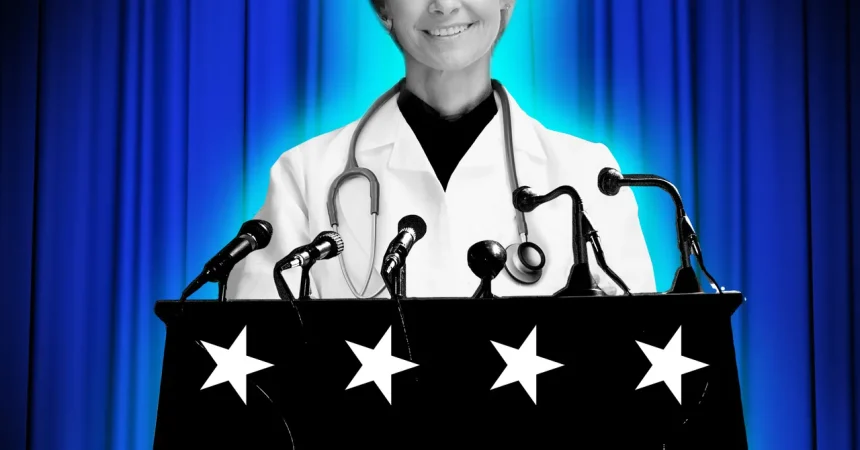
Ask most people to picture a winning candidate in a midterm election, and they’ll probably conjure a lawyer in a crisp suit, a career politician shaking hands at a county fair, or perhaps a wealthy businessperson with a catchy slogan. But this week, a different kind of candidate kept showing up in victory speeches—people who wear white coats, who talk about clinical trials and data sets, who see a community’s health as a political priority. Michigan senator-elect Abdul El-Sayed, South Carolina senator-elect Annie Andrews, Ohio governor-elect Amy Acton, and North Carolina representative-elect Jamie Ager all won their races, and beyond their shared success, they share something deeper: each is a doctor or a scientist. And each of them had the backing of an organization called the 314 Action Fund, a political action committee built around a simple but powerful idea—that having people who understand evidence, research, and public health at the governing table can change the way laws are made. In a moment when trust in institutions feels fragile, these wins signal something meaningful, not just for the winners, but for what voters seem to be asking for.
The story of 314 Action Fund begins with a woman named Shaughnessy Naughton, a chemist and former congressional candidate who lost her own race in 2016 and decided that losing wasn’t the real problem—the problem was that too few people like her were even trying. She founded the PAC to recruit, fund, and support pro-science candidates up and down the ballot. You don’t have to look hard to see why the organization felt necessary. Naughton watched from the inside as political campaigns became more about talking points and less about facts; she saw how easy it was to dismiss science when there was nobody in the room to explain it. Her own background taught her that good policy should be built on evidence, not ideology. So instead of walking away after her loss, she built a machine. This election cycle, 314 Action spent more than $30 million donating to and supporting campaigns, with some of that money going directly to high-profile races that would have been easy to overlook. They raised $3.6 million for pediatrician Annie Andrews, who took on what had been Lindsay Graham’s Senate seat in South Carolina, and another $3 million for physician Amy Acton in the tightly contested Ohio governor race. Naughton says the goal was never just to get scientists elected for the sake of having scientists in office; it was to change the culture of decision-making, to make sure that when laws are written about food safety, environmental protection, or pandemic response, there is someone in the room who has actually studied how those things work.
And the strategy appears to be working in a big way. The organization’s success rate topped 80 percent this cycle for congressional candidates, with 14 of its 17 candidates winning their races in the U.S. House of Representatives. Those numbers only grow when you look at down-ballot races: hundreds of science-minded candidates won seats in state legislatures and local offices. Nine of those races flipped seats from Republican to Democrat, which suggests that the appeal of scientific candidates isn’t just about party loyalty—it’s about a hunger for competence and credibility. Among those victorious congressional candidates who flipped their districts are an oncology nurse-practitioner, a mathematician, a microbiologist, a nuclear engineer, and an agricultural scientist. Think about what that means. These are people who have spent their careers studying how the world works, not how to raise money or craft attack ads. They know what it feels like to lose a patient, to analyze a contaminated water sample, to watch a virus rip through a community. Naughton called it a health care election, and that framing makes perfect sense when you consider that many of these candidates were inspired to run by the experience of seeing public health policy shaped by people with no medical or scientific background. Voters, it seems, noticed the difference and rewarded it with their ballots.
Experts who study Congress see this wave as both new and not entirely surprising. Richard Frank, the director of the Brookings Institution’s Center on Health Policy, points out that health care workers and scientists have always been part of the makeup of Congress, but never in this concentration. What’s unusual, he says, is how many came at once, like a dam breaking. That spike didn’t happen by accident. For years, the hostility toward medical and technical expertise from the Trump administration created a kind of pressure cooker. Scientists watched their agencies defunded, their recommendations ignored, their very credibility attacked. Frank put it plainly: science has been under attack, so it’s not surprising that scientists recognized that and decided to run. When a government tells you that you don’t matter, you have two choices—you can retreat back into the lab, or you can step into the public square and say, “I’m here, I know something, and I’m not going to stay quiet.” This year’s election suggests that a significant number of scientists chose the second path, and voters responded. It’s a reminder that expertise isn’t elitism, and that sometimes the best political movement starts not with a slogan, but with a stack of peer-reviewed studies and a genuine desire to help.
Historian Kristoffer Shields, who runs Rutgers University’s Eagleton Institute of Politics, sees even more layers beneath the rise of the science candidate. Some of it, he says, is certainly a reaction to what’s been happening at the federal level—the defunding of laboratories, the cancellation of research projects, the steady chipping away at scientific exploration. But he also sees this as a legacy of the pandemic, a moment that changed how many health care workers think about politics. When COVID-19 hit, doctors and nurses were suddenly at the center of a national crisis, dealing with shortages of protective equipment, confused messaging, and a public that didn’t know who to trust. They saw firsthand that politics affects public health in ways that go far beyond policy papers. A decision about reopening schools, a delay in vaccine rollout, a tweet about a miracle cure—all of it had real, sometimes deadly consequences. That experience stayed with them. When the immediate crisis eased, many of them didn’t just go back to their normal routines; they started asking bigger questions. What if the people making health policy actually understood how a health system worked? What if the people writing environmental regulations had studied biology or chemistry? What if public service attracted people whose first instinct was to gather data rather than to spin a narrative? That shift in mindset, Shields argues, is part of why so many scientists and doctors are now entering politics. They’re not fleeing the lab; they’re bringing the lab with them, and voters seem ready for it.
Earlier this year, Abdul El-Sayed, one of the newly elected senators, made that connection vivid when he pointed to the cyclospora outbreak that sickened Americans over the summer. He said the outbreak likely stemmed from bad choices made by the Trump administration, choices that dismantled the very agencies meant to keep food safe. He used a sharp phrase: “We DOGE’d our whole service that keeps the lettuce safe,” referencing the so-called Department of Government Efficiency that directed mass layoffs at the Food and Drug Administration. It was a simple, human way of explaining a complex failure—a lettuce supply chain that broke down because the people who were supposed to inspect it were no longer there. That story is exactly why Naughton and so many others believe this work matters. When you put a scientist in office, you aren’t just getting a vote on a bill; you’re getting someone who understands that a policy decision can end up on a dinner table thousands of miles away. You’re getting someone who knows that a public health crisis can be prevented before it ever becomes a headline. The wave of doctor-scientists and data-driven candidates who won this week won’t solve every problem overnight, but their presence changes the conversation. They make it okay to talk about evidence again. They make it okay to admit what you don’t know and to ask for help from people who do. And in a democracy ravaged by misinformation, that might be the most valuable campaign promise of all.