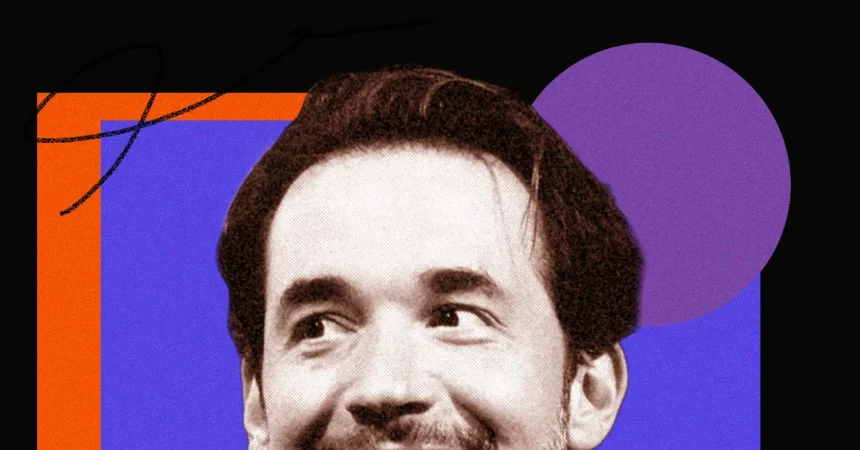
At the inaugural WIRED World Fair, Alexis Ohanian didn’t arrive with the swagger of a tech titan ready to unveil the next billion-user platform. Instead, the co-founder of Reddit stood before a captivated audience and delivered a startlingly candid eulogy for the internet as we once knew it. With the weary clarity of someone who spent his twenties building the ultimate monument to human expression, he declared that creating social media applications is now fundamentally “not cool anymore.” This is not the lament of a bitter founder; it is the strategic analysis of a venture capitalist who has watched the cultural energy of the web shift fundamentally. The original promise of user-generated content (UGC) was radical—it democratized voice, giving the kid in his dorm room the same megaphone as a media conglomerate. But over the last decade, that promise curdled. The comment sections that felt like raucous town halls have been transformed into rancid echo chambers, polluted by divisive algorithms, paid astroturfers, and the sheer toxic sludge of automated rage. The incentive structures of these platforms have warped, rewarding the loudest and most inflammatory voices while starving genuine, nuanced discussion. Consequently, Ohanian believes the next iteration of UGC won’t emerge from expansive public forums, but rather from something far more private, intimate, and resilient: “a better version of the group chat.” He isn’t talking about the current WhatsApp or iMessage threads, which have grown chaotic and fragmented. He is talking about a deliberate, intentional evolution of digital space—one designed for the specific people in your life, free from the algorithmically boosted noise and the lurking surveillance of data miners. It is an acceptance that the era of broadcasting to millions is over; the future of creation is curatorial, private, and rooted in peer-to-peer trust. Ultimately, his vision signals a massive cultural retreat: from the meaningless glory of public virality to the quiet, substantial value of a secured inner circle.
To understand why Ohanian feels this way, one must appreciate his fractured relationship with his own creation. Reddit was once the bastion of the unfiltered internet, a place where the front page proudly displayed everything from scientific breakthroughs to utterly depraved subcultures. For a long time, Ohanian wore that legacy as a badge of honor. He recently recounted a poignant moment when he came across a fan sporting a Reddit tattoo—a permanent ink mark that once signified tribal belonging and idealistic conviction. But when he encountered a similar tattoo recently, the owner had gotten it covered up with another design. “I don’t blame him,” Ohanian said, his voice tinged with a resigned acceptance. This anecdote cuts to the heart of his complex legacy. While Reddit gave birth to a new generation of creators and fostered genuine communities, it also became a notorious haven for violent rhetoric, harassment, and harmful conspiracies. The breaking point came in 2020, in the turbulent wake of George Floyd’s murder. Ohanian, confronting the social upheaval and the platform’s persistent failure to effectively moderate the hate that flourished in its darkest corners, made a radical decision. He resigned from the board, explicitly stating that he wanted to be replaced by a Black board member to inject a desperately needed perspective into the company’s leadership, and to force a reckoning over content moderation. It was a self-imposed exile from the throne he had built, an acknowledgment that the architecture of pure free speech, without robust ethical guardrails, cannibalizes itself. He is a founder who grew up alongside the monster he created, witnessing firsthand how a tool designed for connection can become a weapon of mass disembodiment. This experience haunts his current worldview. He understands that the utopian visions of the early internet were fatally flawed, and that tech leaders must shoulder a greater burden of responsibility for the social ecosystems they cultivate. His departure was less an abdication and more a desperate attempt to save the soul of a company by sacrificing his position at its head.
Leaving Reddit, Ohanian didn’t just mourn the loss of a platform; he began looking for signs of life in the broader digital ecosystem—and found fewer and fewer humans. He has become a prominent proponent of the “Dead Internet Theory,” a creeping, unsettling hypothesis that suggests the lively web of human interaction we remember is now a ghost town populated by automated shells. The theory posits that the vast majority of online activity—the comments, the reviews, the threads, the video views—is not generated by flesh-and-blood users, but by bots designed to simulate engagement, pump traffic, and manipulate stock prices or political narratives. While this theory was once considered a paranoid fringe belief, the recent explosion of Large Language Models (LLMs) has turbocharged it into a terrifying reality. AI agents now write the emails we read, generate the customer support tickets we submit, and post the beautiful, insipid images we scroll past on social media. These agents have moved so rapidly that they now outnumber the human users. As a result, Ohanian argues, the very fabric of the internet’s interface is about to undergo a tectonic shift. The graphical user interfaces, the forms, the buttons, and the design aesthetics that were painstakingly created for human eyeballs and clumsy thumbs are becoming obsolete. “The internet that I grew up on… that was really built for humans first; user interfaces and experiences are going to go away,” he warned. We are entering an era where online spaces are being constructed primarily for machine-to-machine communication—for APIs, autonomous agents, and data brokers to transact with each other invisibly. Human beings will increasingly find themselves trapped in a walled-off pocket of the web, staring at a landscape that no longer speaks to them. The feeling is profoundly alienating. We go online to find connection, but we are met with a cacophony of simulated voices. We search for answers, but are served SEO-optimized gibberish written by software. The internet Ohanian helped usher into existence—a chaotic, human, breathtakingly weird place—is being replaced by a sterile, optimized, and deeply lonely machine.
Yet, in a masterstroke of painful irony, it is precisely this wave of generative AI that has made the remnants of the human web staggeringly valuable. Reddit, with its vast archive of real, unvarnished human conversations—the arguments, the jokes, the shared traumas, the niche expertise—has become a goldmine for AI developers. The platform has signed lucrative licensing deals with tech giants like Google and OpenAI, selling them the right to train their massive models on the messy, organic corpus of human thought. Ohanian acknowledged this with a wry smile, noting that “platforms like ours became very, very valuable to LLMs.” On paper, this would seem like a win-win: the platforms get massive cash infusions, and AI gets smarter. But the technology has immediately turned around and bitten the hand that fed it. In a stark market warning last week, Reddit’s shares plunged a staggering 29 percent after the platform revealed that Google’s AI-powered search overviews—which synthesize answers at the top of the page—have severely hurt the referral traffic that drives users to Reddit threads. Why click through to read a hundred authentic comments when Google’s AI has already scraped and condensed the best ones for you at the top? The ground beneath Reddit’s feet has shifted. But Ohanian’s concern runs deeper than a quarterly earnings report. He worries that the very commercialization of these human transcripts has corrupted the wellspring. Because the internet is now so incredibly valuable to manipulate—whether for ad revenue, political sway, or to train AI to skew a certain way—the content itself is increasingly full of “bullshit.” Brands astroturf, bots shill, and even human users perform for the algorithm rather than for each other. The pristine human signal that made these datasets so precious to LLM trainers is being rapidly degraded by the very economic pressures that arise from their value. If you pump enough sewage into the reservoir, eventually even the most advanced purification system can’t make it drinkable. Ohanian sees this as a fundamental crisis of authenticity: the internet is becoming a hall of mirrors, where the reflections are not of ourselves, but of an algorithm’s ideal, endlessly looping back.
Confronted with this onslaught of automation and manipulation, platforms are scrambling to differentiate the wheat from the chaff. Earlier this month, Reddit announced that users would be required to log in to access the site’s content in certain contexts, effectively erecting a wall of access to combat third-party scraping—the practice where AI companies mine data without permission—and to keep engagement metrics within their own walled garden. When pressed on this decision, Ohanian gave a nuanced, hedged response. He declined to openly endorse the login requirement, acknowledging that friction often kills user growth. But his underlying philosophy was clear: “there has to be provable humanity on the internet without being creepy.” This is the central tightrope walk of the post-AI internet. How do you prove you are a human without sacrificing the anonymity or privacy that fosters true authenticity? How do you verify identity without turning the web into a surveillance state? It’s a paradox that may not have a clean technical solution. If you ask for a phone number, you lose the marginalized voices who can’t afford one or who fear government tracking. If you ask for an ID, you exclude the whistleblowers. Yet, if you don’t require some proof, you are instantly drowned by bots. It is this exact exhaustion with the digital mess that has driven Ohanian to a radical new investment thesis: physical sports. Within his venture capital firm, Seven Seven Six—which manages over $1.3 billion in assets—he has pivoted his focus significantly toward athletics and real-world communities. He sees sports as the ultimate antidote to “AI slop” and a “manipulated” internet. A live soccer match, a packed tennis stadium, or a bustling basketball court offers a tangible, unfakeable reality. The emotions are real, the sweat is real, and the community is physically unified. In an age where digital spaces are compromised, the stadium becomes the last authentic town square. Investing in sports isn’t just about equity returns for Ohanian; it is a philosophical wager that the human need for physical presence, shared adrenaline, and grassroots human interaction cannot be fully replicated or corrupted by lines of code. He is betting that the future of community is analog.
Given his grim diagnosis of the current internet, one might expect Ohanian to be a technophobic doomsayer. But that would be a misreading of his character. He remains an optimist, though a “sober” one. As an early investor in Anthropic—the parent company of Claude AI—he has placed his financial chips on the responsible advancement of this very technology. He refuses to yield entirely to the chaos, instead choosing to focus on the profound, demonstrable benefits that AI can confer, particularly in the realm of medicine. “There is still a very real chance that this technology can cause a lot of harm for sure,” he admitted, his pragmatism cutting through the hype. “I think we have to be sober about how we’re building and what we’re doing, but I still can’t help but see all of the things that can get so demonstrably better.” He speaks with an infectious excitement about the medical breakthroughs lurking on the horizon—AI models that can analyze massive datasets of protein folding to develop personalized cancer cures, that can diagnose rare diseases from a simple scan in seconds, and that can accelerate the timeline for drug discovery from decades to months. The technology that is currently polluting our public square and derailing his former company’s stock price is the very same technology that could extend human lifespans and cure the incurable. Ohanian sees both sides of the coin, and he suspects the medical upside will ultimately eclipse the social downsizing. He is willing to hold the tension of the paradox: knowing that AI is gutting the digital ecosystem he helped plant while simultaneously believing that the harvest—the wonder drugs and life-saving therapies—will be worth the desolation of the fields. The overarching theme of his worldview is humility. Having built a machine too big to fully control, he has learned to listen to the signals of entropy and adjust his course. He doesn’t have a neat utopian solution for the broken web, just a grounded acceptance that we are building something new, and that the process will be messy. The future, he suggests, won’t be found in the next sleek app, but in the resilient, uncertain, and gloriously human spaces we carve out for ourselves—whether in a private chat or a cheering stadium—while the AI agents churn away in the background.