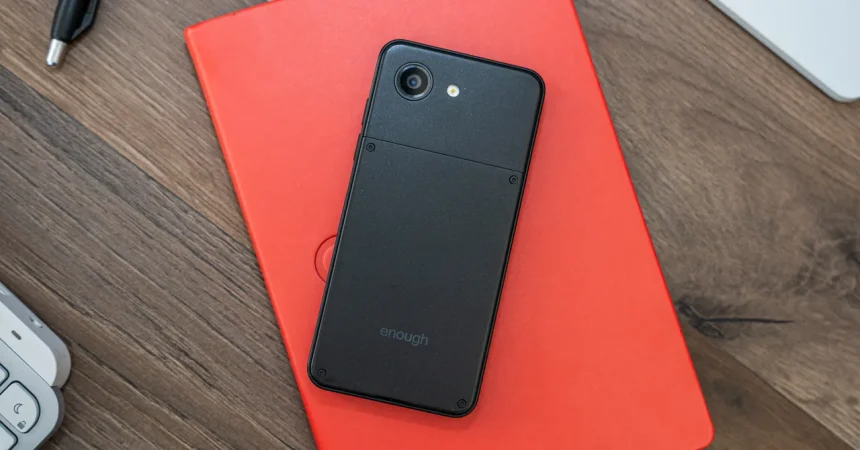
Imagine waking up with your phone face-down on the nightstand, and instead of feeling a familiar pull to check social media, you feel something closer to indifferent. That quiet indifference is the entire premise driving the Enough Phone, the creation of Austin Boer, Brennan Jordan, and William Stults. These are not the usual Silicon Valley founders with years of smartphone-industry pedigree. Boer and Jordan run Sleke, a small company founded in 2024 that buys used Google Pixel phones and breathes new life into them with a restricted operating system called OdysseyOS. The operating system is both the brain and the gatekeeper: it allows access to utility apps that you genuinely need to move through life — Uber to get to appointments, Google Authenticator for two-factor logins, WhatsApp to keep up with friends, and Spotify for music and podcasts — but it ruthlessly strips away social media, games, browsers, and essentially anything else that has been designed to keep your eyes locked on the screen long after the original reason for looking is gone. The result is a phone that feels familiar enough to be practical, yet quiet enough to let your mind wander. The idea isn’t to punish people with a useless brick, but to offer a responsive, everyday device with an emotional off-switch. It’s a step forward by removing steps, and in a market where every new flagship is faster, brighter, and more addictive, the Enough Phone proudly positions itself as the device that helps you stop wanting it.
The third founder, William Stults, comes at the problem from a different angle. With his girlfriend, Stults runs Dumbwireless, an ecommerce platform that tests and sells dumb phones that still work in the modern world. The duo have made it their mission to vet the limited market for minimalist phones and offer them alongside a mobile plan powered by Gigs, which makes the switch to a less demanding device about as frictionless as possible. Stults had crossed paths with Boer and Jordan years earlier, and Dumbwireless actually carries the Sleke Phone. What convinced Stults that Sleke had cracked something was that, out of all the dumb phones he had tried, the OdysseyOS felt the least punishing. Plenty of minimalist phones force you to choose between a simple life and a functional one, making it almost impossible to survive modern errands without a second, secret smartphone hidden in a drawer. Sleke’s approach was software-based, turning a refurbished Google Pixel into a device with a full touchscreen but a deeply reduced app ecosystem. You can still request a ride, message a colleague, or scan a QR code; you just can’t sink into an infinite feed. That balance felt like enough for Stults, and when the three began talking about what a true, dedicated device could look like, they realized that a dumber smartphone shouldn’t have to be a refurbished Pixel with an understated operating system. It should be a purpose-built machine, built from the ground up for people who are exhausted by their phones but who can’t exactly throw them out of the car window on the way to work.
The Enough Phone was born from a simple observation: the big mobile players had clearly abandoned small phones. Every year, Apple and Samsung pushed flagship devices with screens that creeped ever closer to tablet territory, leaving a tiny percentage of users who genuinely wanted a compact, functional handset without a billion features. The trio decided to build the phone they wanted to use — one that would be small, sober, and sufficient. There is an unusual humility in their origin story: Boer, Jordan, and Stults have no direct experience in the smartphone or feature-phone industry. They are not engineers who spent two decades designing chipsets, and they are not executives who learned supply chains at Samsung and Apple. A handful of Sleke’s engineers do have meaningful hardware experience, but the founders themselves own none of the usual credentials. When asked what each of them officially does, Jordan admitted they haven’t given each other titles yet. There is no chief design officer, no head of product marketing, just three people convinced that the tech industry has gone wrong in a small but deeply human way. That outsider energy is exactly what makes the project interesting. They don’t carry the baggage of a company that needs to sell you a new phone every year, and they don’t feel pressure to make the device flashier or more powerful. They just want a phone that quietly does the essentials, one that doesn’t make you feel guilty for switching it off at the end of the day. Their inexperience may even be an advantage: by ignoring the known rules of the industry, they can ask a much more naive and generous question — what do we actually need a phone to be?
When you look at the Enough Phone, the specs tell a story of intentional restraint. It’s a 5.3-inch Android handset with a straightforward polycarbonate shell. It only comes in black, which may sound boring until you realize that boring is exactly the point. It is not a piece of jewelry, not a social signal, not a way to show strangers which brand you belong to. It’s simply a tool, and the design makes that clear at first glance. On the back, you’ll notice four Torx screws, the same kind you might use to work on a piece of furniture. Unscrew them, and you can pop out the battery yourself, reminiscent of the Fairphone’s commitment to repairability. This is not merely a nostalgic gesture; it is a deliberate move to comply with upcoming European Union regulations around removable batteries and repairability. Big companies often resist these rules, but for a small team, designing the phone around a user-serviceable battery is a natural fit. The phone is also extremely thick by modern standards, measuring 12 millimeters, which is more than double the thickness of an iPhone 13 Mini and significantly chunkier than the iPhone 17 at 7.8 millimeters. That thickness serves a practical purpose: it leaves room for a large battery, likely between 3,500 and 4,000 mAh, which should deliver all-day battery life without requiring you to babysit a charging cable. Where other phones compete to be paper-thin and then suffer from standby drains, the Enough Phone gleefully chooses thickness as a trade-off for durability, battery life, and repair. It feels like a quiet middle finger to the race toward ever-thinner devices, a reminder that a phone can be rugged, dependable, and comfortable in your hand without pretending to be a piece of origami.
The deeper message of the Enough Phone is not “throw away all your technology and move to a cabin in the woods.” It’s more honest than that. It acknowledges that smartphones have become essential infrastructure for modern life: we need them to navigate, to communicate with employers, to pay for things, to verify our identities. The problem is that those legitimate uses have been drowned out by an attention economy engineered to keep us scrolling. The trios’ answer is not a return to the flip phone, but a conscious downsizing of digital appetite. By combining practical app support with a deliberate lack of infinite feeds, the Enough Phone tries to shift your relationship with your device from compulsion to convenience. It’s a phone for people who still have to use a phone but wish they didn’t have to use it so much. That logic is why the design choices matter so much: the removable battery means you won’t throw it away when the lithium cells start to fade, keeping the phone in your life longer than the two-year upgrade cycle. The simple, black, polycarbonate body means you won’t obsess over a scratched camera frame or a dainty glass back. And the restricted operating system means the time you spend with the device is time spent doing something useful, not time accidentally lost in a recommendation engine. It’s a philosophy that feels almost rebellious in 2025, a year when every company is racing to cram generative artificial intelligence into every corner of the software experience, when your phone is increasingly a tool that can do everything for you, but somehow also knows more about you than your family does. The Enough Phone is a counterweight to all of that.
What remains to be seen is whether the Enough Phone can actually survive in a market where the giants have enormous advantages in price, distribution, and software polish. It is always difficult to launch a new hardware company, especially one rooted in restraint rather than novelty. But the founders are used to working at the edges of the industry. Sleke has already found an audience by turning existing hardware into something more mindful, and Dumbwireless has carved out a niche helping people escape their screen addiction without losing access to essential services. The Enough Phone is the logical next step for people who have been waiting for a true small, repairable, focused Android device. It will not win on camera specs, screen brightness, or benchmark scores. It will win, if it wins, on honesty. The phone does exactly what it promises and no more. In a world where every product promises to change your life, the Enough Phone offers something much rarer: it promises to take something away. It offers you a screen that you can look at without vanishing into it, a battery you can replace instead of throw away, and a black slab that will never be the center of the room. That is not a depressing vision. In many ways, it’s a hopeful one. It suggests that we can still reclaim our attention, that we don’t need to go cold turkey, and that the things we enjoy — music, messages, maps, a ride home — can exist without the dark patterns that tie them to our anxiety. If the Enough Phone finds even a modest audience, it might not even matter whether it outsells the nearest flagship. It will have proven that a small group of people with no industry pedigree can build a phone that treats human attention as sacred, then charge their own replacement battery, and quietly go back to the rest of their lives.