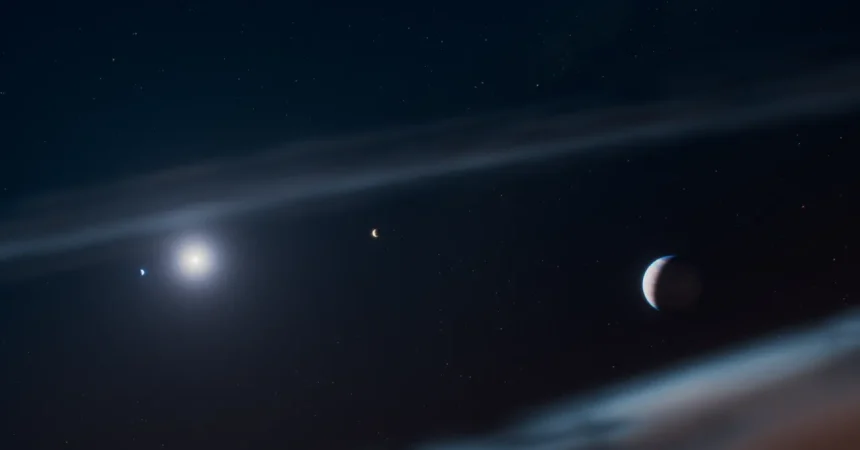
Imagine a family portrait taken not of people but of planets, captured around a distant star some 63 light-years away. This is the Beta Pictoris system, and it is startlingly young—so young that by cosmic standards, it is still in its infancy, less than one percent the age of our own solar system. If our Sun and its planets were a wise, middle-aged figure who has seen billions of years of history, Beta Pictoris would be a bright-eyed child just beginning to form its identity. At its heart sits a star more massive than the Sun, shining with a fierce, youthful energy. Orbiting that star are at least three giant planets, along with a vast, sprawling disk of dust and debris—the leftover building blocks of worlds. This disk is not a quiet, distant ornament; it is a dynamic, chaotic reservoir of material, colliding and swirling, a reminder that planetary systems are not born fully formed but grow through violence and time. For astronomers, Beta Pictoris is nothing less than a time machine, offering a glimpse of what our own corner of the universe may have looked like more than four billion years ago, when the planets were still assembling and the future was unwritten. It is rare to find a system that is both close enough to study in detail and young enough to show the process of formation in action, and that combination makes this star a beloved subject for observatories around the world. Every new finding about this system is like reading a new chapter in an old story—the story of how families of planets come to be, and how fragile and astonishing that process truly is.
The most famous member of this youthful family is Beta Pictoris b, a gas giant weighing in at several times the mass of Jupiter. Despite being called a planet, it is not the kind of world anyone could ever visit or stand upon; like Jupiter and Saturn, it is a colossal sphere of swirling gas, its deep atmosphere gradually transitioning from clouds to dense, crushing layers far below. In human terms, Beta Pictoris b is a newborn, just a few tens of millions of years old—an eternity by our standards, but barely the blink of an eye for a planet. Its youth is precisely what makes it so scientifically precious. Because it is still cooling down from its formation, it glows brightly in infrared light, emitting its own heat rather than relying entirely on the light of its star. This glow, combined with the fact that its orbit carries it at a distance from Beta Pictoris similar to the distance between our Sun and Saturn, means that powerful telescopes can actually see it directly, as a tiny point of light separate from its brilliant parent star. That may not sound impressive, but directly imaging an exoplanet is an extraordinary feat, like spotting a firefly buzzing next to a blazing searchlight from miles away. Over the years, Beta Pictoris b has become one of the most studied exoplanets precisely because it is so accessible, so bright, and so young. It is a natural laboratory for understanding how gas giants evolve, how their atmospheres behave, and what life might be like on worlds that are completely unlike our own.
And then there is Beta Pictoris d, a third planet whose presence was only recently confirmed, hidden in reconstructed imagery from NASA’s James Webb Space Telescope. This is a reminder that even the most well-charted systems still hold surprises. While Beta Pictoris b orbits its star at a distance akin to Saturn’s, Beta Pictoris d appears to follow a path that echoes the region of our solar system occupied by Neptune—farther out, in the cold and dimly lit outskirts of the system. The discovery of this new world adds texture and complexity to the planetary family, suggesting that the system is not merely a simple arrangement of companions but a dynamic, layered assemblage of worlds that formed in diverse environments. Scientists are still piecing together exactly how all three planets interact with each other and with the great debris disk that surrounds them, but each new discovery reshapes the picture. The James Webb Space Telescope, with its extraordinary sensitivity and infrared vision, is opening a new window onto this system, revealing details that were previously hidden in the glare of the star and the chaos of the disk. Finding a third planet is not just a catalog entry; it is a clue to how the entire system assembled itself over millions of years, and it raises new questions. How did these worlds migrate? Did they form where they are now, or did they move? Did their gravity shape the debris disk, or did the disk shape them? In this way, every planet discovered becomes a piece of a larger puzzle, and Beta Pictoris is becoming one of the most intricate and rewarding puzzles in planetary science.
Now, a new study from researchers at Harvard and the University of Oregon has thrown a dramatic twist into the story. The team claims that Beta Pictoris b is the source of something that has never before been unequivocally detected on another world: radio emissions. The signal was recorded by the MeerKAT radio telescope in South Africa, an array of dishes that scans the sky for faint whispers of radiation from the cosmos. Before anyone gets carried away, the authors are quick to emphasize that this is not a message from an intelligent civilization. There are no alien broadcasts hidden in the static. The radio waves appear to be entirely natural, the product of intense magnetic activity around the planet itself. While the study has not yet been peer-reviewed, it has been made available for other scientists to examine, and the authors argue that their evidence points strongly toward a remarkable phenomenon: a planet generating its own radio aurora. This is not the kind of thing we can see with ordinary optical telescopes; it requires the ability to tune into a different part of the electromagnetic spectrum, where the universe speaks in crackles and bursts rather than in calm light. The detection is a long-awaited milestone, a first step toward hearing exoplanets with our ears, so to speak.
But what exactly is causing these radio waves? The answer lies in the planet’s magnetic field. Young, massive planets like Beta Pictoris b are thought to possess extraordinarily powerful magnetic fields, far stronger than anything we see in our own solar system. Charged particles, whipped up by the star’s wind and by the planet’s own surroundings, can become trapped in these magnetic fields, spiraling along invisible field lines as the planet turns. As the particle streams accelerate, they release energy in the form of radio waves—the same fundamental process that produces auroras on Earth, those shimmering curtains of light in polar skies. But on a planet like Beta Pictoris b, this process is not a delicate, occasional glow. It is an enormous natural broadcast, a planet’s magnetosphere essentially shouting into the emptiness of space. The team detected several of these energetic pulses and, crucially, for the first time managed to pinpoint their origin directly to an exoplanet. That precision has been a goal astronomers have chased for years, because capturing a signal is one thing, but proving exactly which world it came from is another challenge altogether. Imagine hearing a voice echoing in a vast hall; you know it is there, but finding the speaker can take time. Here, for the first time, astronomers have traced the voice not just to a room, but to a specific mouth.
The implications of this discovery are as thrilling as they are profound. If confirmed, this would be the first unequivocal radio detection of an exoplanet, a scientific milestone that opens up a whole new way of studying worlds beyond our solar system. Magnetic fields are invisible, but they shape planets in profound ways; they protect atmospheres from stellar winds, drive auroras, and even play a role in whether a planet can hold onto the ingredients for life. Being able to study exoplanet magnetospheres directly would give us a new tool for understanding not just gas giants like Beta Pictoris b, but perhaps, in the future, smaller, rocky worlds closer to their stars—worlds where magnetic activity might be linked to habitability. For now, the finding awaits the scrutiny of peer review, and scientists will need to carefully consider alternative explanations. But perhaps the most beautiful part of the story is what it represents: a distant, newborn planet, shrouded in dust and light-years of space, still somehow making itself heard through the roar of the universe. It is easy to think of planets as silent and passive, but Beta Pictoris b is showing us that worlds can be loud, restless, and full of raw energy. As our telescopes grow sharper and our techniques more refined, we will continue to listen to the cosmos, and this young system will undoubtedly keep whispering its secrets to anyone patient enough to pay attention. For now, the radio waves from Beta Pictoris b remind us that the universe is not a quiet place—it is alive with signals, bursting with youthful storms, and full of worlds waiting to be discovered.