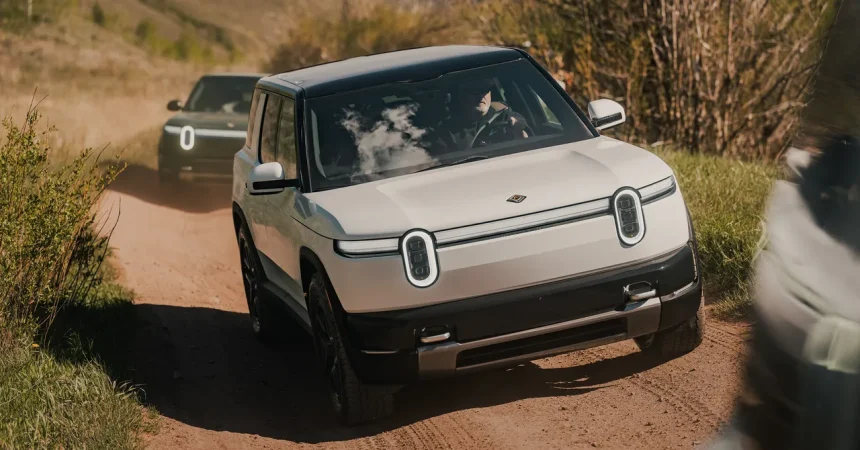
The story of RJ Scaringe and his company, Rivian, is a masterclass in the audacity of modern entrepreneurship. Scaringe, who earned his PhD from MIT focusing on the mechanics of internal combustion engines, did something ironic: he dedicated his career to making those very engines obsolete. Emerging from academia in 2009 with a vision for a cleaner future, he spent nearly ten years in near-total silence, quietly building a brand that the public wouldn’t truly recognize until a stunning reveal at the 2018 LA Auto Show. When Rivian finally emerged, it didn’t just offer a car; it offered a new, rugged identity for electric vehicles that caught the entire automotive industry off guard.
However, the reality of transitioning from a visionary startup to a mass-market manufacturer has been grueling. Rivian’s balance sheet tells a story of immense ambition paired with daunting financial pressure, having burned through nearly $25 billion over the last eight years—a rate of spending that dwarfs most of its pure-play EV competitors. While the company celebrated a record-breaking IPO in 2021 that briefly valued it at over $100 billion, the market’s enthusiasm has cooled significantly, with stock prices retracting as the gap between Rivian’s output and giants like Tesla—which has sold 8 million cars compared to Rivian’s 175,000—remains vast. The financial weight, punctuated by a $3.6 billion loss in 2025 alone, underscores the precarious nature of disrupting a century-old industry.
Yet, where others might see a sinking ship, industry titans have seen a critical partner worth betting on. In a massive vote of confidence, the Volkswagen Group committed up to $5.8 billion in 2024 to co-develop the backbone of future software and electrical architecture with Rivian. Adding to this momentum, Uber recently pledged up to $1.25 billion to help steer Rivian into the world of autonomous robotaxis, with plans to deploy a fleet of 50,000 vehicles. These strategic partnerships suggest that while Rivian is still struggling to scale its own volume, its underlying technology is viewed as sophisticated and valuable enough to underpin the future mobility strategies of some of the world’s largest logistics and transportation networks.
The true test for Scaringe is no longer just about survival; it is about the success of the R2 platform. The R2 SUV is the company’s “make or break” moment, designed not merely to exist as a niche premium product, but to sell in significant, sustained numbers. The pressure surrounding this launch has led to a soul-searching introspection at the top of the company. Scaringe is currently grappling with difficult questions about the company’s past design choices—such as the “dead-end” technology used in the original R1—while simultaneously preparing for a future where Rivian must compete with increasingly aggressive Chinese manufacturers and defend its philosophy against the polarizing design trends popularized by competitors like the Cybertruck.
In a recent, candid conversation, Scaringe revealed a leadership style that is as much about design philosophy as it is about engineering. When asked about his thoughts on the Ferrari Luce—a polarizing subject in the 2026 automotive world—his response was telling. He bypassed the typical CEO-speak, instead expressing admiration for the “intentionality” behind the work of designers Jony Ive and Marc Newson. He pointed specifically to the haptics and the tactile nature of physical buttons and switches as a mark of true quality. It was a subtle, humanizing admission: even for a man leading a high-tech EV charge, the core of a great driving experience still resides in how a machine feels under the driver’s hand, rather than just the code running in the background.
Ultimately, Scaringe’s journey from a graduate student to the helm of a multi-billion dollar, high-stakes battleground serves as a reminder that innovation is rarely a straight line. Whether he succeeds in cementing Rivian as a household name will depend on his ability to pivot from the “stealth mode” dreamer he once was into the pragmatic, high-volume steward that the automotive market demands. He is currently navigating a path that requires balancing the artistry of design, the cold reality of Wall Street, and the relentless competitive pressures of the transition to electric mobility. Through the lens of his upcoming R2 launch, we are witnessing a pivotal moment where the vision of a cleaner future meets the unforgiving mathematics of the assembly line.