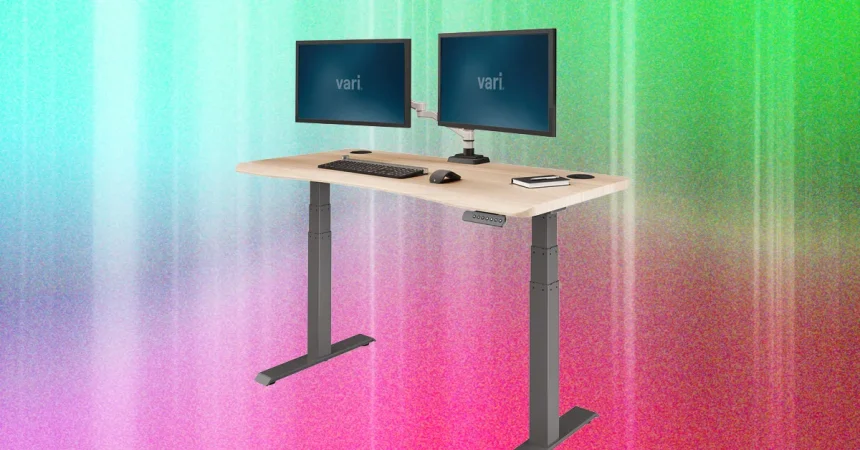
In my line of work as a product reviewer, I have learned to greet large boxes with a very particular kind of dread. It does not matter how excited I was about the item inside; the moment the delivery person drags a huge flat box over the threshold, that initial thrill is quickly replaced by a quiet sigh. Large boxes are the great equalizers of the modern world. They might contain an office chair, a pellet smoker, a treadmill, or a standing desk, but for the most part, they all arrive with the same promise: a lot of bundled pieces, a diagram full of tiny numbers and arrows, and enough screws to assemble a small airliner. Some part of me always knows that before the day is done, I will be kneeling on the floor, peering at a grayscale image, holding a screw that simply will not stay in the hole I have been aiming at for the last five minutes. I have spent more hours than I care to admit in contorted positions, twisting my body under a table, trying to align a bolt while balancing a leg panel on my knee. That is why, when the Vari Ergo electric standing desk arrived and the first thing I saw was a four-step instruction manual, I felt a wave of calm and something close to gratitude. For those of you who do not understand this form of celebration, let me make it perfectly clear: four steps is not normal. Four steps are what easy, from the universe to the person that has reached the end of a long, painful assembly process. Vari has a long history of doing things this way. The Texas-based standing desk company started rolling out standing desk conversion kits in the early 2010s, originally under the name Varidesk, and from the very beginning they made ease of assembly something of a brand promise. It sounds like a small thing, but I would argue it is wildly underrated. We forget that furniture has to be brought into our lives and put together, and that experience colors everything. If a desk takes me four hours to build, I will feel a bit of resentment toward it every time I sit down. If it takes me ten minutes to build, I’m already likely to love it.
By the time I had the Ergo upright and plugged in, about ten minutes after pulling it out of the box, my desk and I were already pretty good buddies. Honestly, I had to stop and remind myself that this was real, because people do not get that lucky with office furniture. The pieces felt substantial and clearly labeled. The instructions did not contain secret steps or a time-consuming process. I did not have to ask myself whether a certain screw was meant for a certain side, because everything simply lined up the way it was supposed to line up. There was no drama, no moment of panic, no sinking realization that I had done something wrong at step two and would have to take apart the entire structure just to fix it. I just followed the calm, logical process, and then I plugged the electric mechanism in, set the control panel, and pressed a button. The personality of the desk came alive. It moved up and down with a quiet hum, like a piece of furniture actually designed for real people. I couldn’t help but I need to use it, set my keyboard, and even give the desk a little pat. A relationship formed in that moment, the kind that only comes when an object does what it is supposed to do without turning my after afternoon into a wresting match. And that relationship has not gone anywhere. I have spent months now living with the Ergo, using it daily, adjusting it constantly, testing it under all kinds of conditions. It has been a genuinely peaceful part of my workstation, and that is something you rarely get to say about a piece of office furniture.
The Ergo’s basics are easy to love. The desk is broad enough that I can set up a normal monitor, a laptop, a keyboard, and still have room to use a mouse. It has T-shaped legs that look simple but do a lot of work, and the structure feels confident beneath all the weight. I have typing, papers, and all the general chaos of a working life placed on it, and it has almost never complained. It is much less unstable even at the highest setting, and I am someone who tested it while leaning, while tapping heavy keys, while gesticulating during a video call. The stability is a major comfortable point, because standing desks in this part of the broader price range can get jumpy and empty, especially once you raise them above a certain level. The Ergo, with its three-stage legs and solid base, manages to avoid this problem. It also adjusts across an impressively wide range, from 25 to 50 inches. That means my daughter, who is young enough to need a lower desk, can still use it for a craft project, and I can set it to standing height without worrying that my hands are hitting an unnatural level. The motor system is a dual-motor arrangement, and it runs surprisingly quietly. There was a time when I expected desk motors to sound like a freight train grinding its way across a ridge; the Ergo makes a discreet hum, almost like a kitchen appliance in the next room. The controls are simple enough, and I can program a range of preset heights. I have four presets available, although I have to be honest that I only really need three: one for sitting, one for standing, and one for Zoom calls. That last one, the perfect face height for a webcam, is truly useful. It lets me stand into the camera without changing my posture and look like I know what I’m doing. The fourth preset may one day be used by someone else in the house or for a different task, so it is hollow. But having all those memory options is helpful; I can switch from sitting to standing in one tap, and the desk does not jolt or shake while it moves.
What I appreciate even more is the desk’s minimalist nature. The design is clean and uncluttered, almost to the point of asceticism. It does not come with drawers. If you need a place to store your notebooks, your paper clips, your phone charging cables, or your bric-a-brac, that part is not on the desk. There is no integrated shelf, no pull-out tray, no pen enclosure, and that is not the office desk compromise. Instead, you are meant to be visually minimal and work with your own storage. At first, I was a little unsure about this design decision, because my and clutter can get out of hand. But as I used it more, I found that a desk without drawers and built-in chaos forced me to keep the surface cleaner. It also made the workspace feel lighter, less like a old cubicle and more like my own corner of a modern office. The one drawback I would mention is that there is no built-in cable management system, at least not enough that I would like. The power cable and the descending control panel cable can seem, especially when you are moving the desk up and down. I solved it with a small cable tray that I attached underneath, something I would have loved to have been included in the package, but the problem is not a huge deal. It is a small DIY step and once done, the desk remains clean and wire minimal. When the desk is set up, it has a quiet elegance that works well in almost any room. It is not flashy; it is not trying to shout at you. It just exists in a beautifully simple way that says I am here to help you work, not to overwhelm your space. That phrase, if anything, is what I have come to recognize as its defining personality trait.
Beyond the physical specs, I have started to appreciate how much a desk like this can change your daily rhythm, and that is the part that actually keeps it in my head after the review period ended. We spend so many hours at our desks, often without thinking about the position of our bodies, and my previous desk was a fixed-height basic with all the adjustment of a park bench. I used to sit for hours in the same self, not because I couldn’t stand, but because getting out the desk was heavy. The Ergo makes movement effortless. When I feel myself leaning back in my chair of fatigue, I will take one this desire to get up. I hit the standing preset, the motor hums, and without even leaving my mouse, I spend the next 45 minutes working on my feet. The process is so easy that I no longer think about it. It has become an integrated part of the day, and I’m not someone who keeps track of hours or goals because I would rather be distracted through a good habit than drown in data. I also use the memory settings more than I was expected. I set the seated height to match my chair perfectly, so my arms are nice and relaxed; I set the standing height so my wrists are comfortably flat; I set the face height for Zoom calls, which means I no longer have to hunch down toward the camera or look like me leaning back into a cave. That one preset alone has made video meetings feel infinitely more human. Instead of being a face in the corner of the frame, I am upright and present, and the desk does most of the work. It has also been nice to share with other people who work from home. The fact that there are four memory presets means that my partner can leave the pre-saved for them, and we can switch from one height to another without having to re-add things every time. It feels like a small touch of family in a world where so many workstations are designed for a single version of the day.
After all this time, it would be fair to ask whether I recommend the Vari Ergo electric standing desk, and the answer is honestly yes. It is not flawless: I wish it had better cable management, and I would not have minded a drawer or a small organizational tray if one could be added without losing the clean look. But those are small and easily fixed by your own preferences, and they are nothing compared to the positives. The desk is strong, quiet, adjustable, and simple to set up. It works with a lifetime warranty on manufacturing defects under normal rules of operation, and that adds a level of confidence that is rare in the world of affordable furniture. It is not the most expensive desk in its class, nor the cheapest plastic heavy option that you see in discount catalogs. It is a glass of sweet in the middle: good quality, durable components, and none of the ball in. The best part, though, is that this desk has taught me, me and my own sort of lesson: the big and large boxes aren’t always weak to fear. There are still companies that care about the experience beyond the product itself, from the very first moment you meet the furniture to the months later, when it just works in the background. And there is something good in having a relationship with your desk, of all things, because you are going to spend a huge part of your life with it. If a desk can be your product, a desk maker has done something rare. I still don’t race to the door when another giant box appears, but maybe I am a little less worried now. If more desks were made the way this one is made, my lonely would start to heal. The Ergo wasn’t just a piece of office kit; it was a reminder that simplicity is a gift, and that good furniture shouldn’t ask you fight for it.