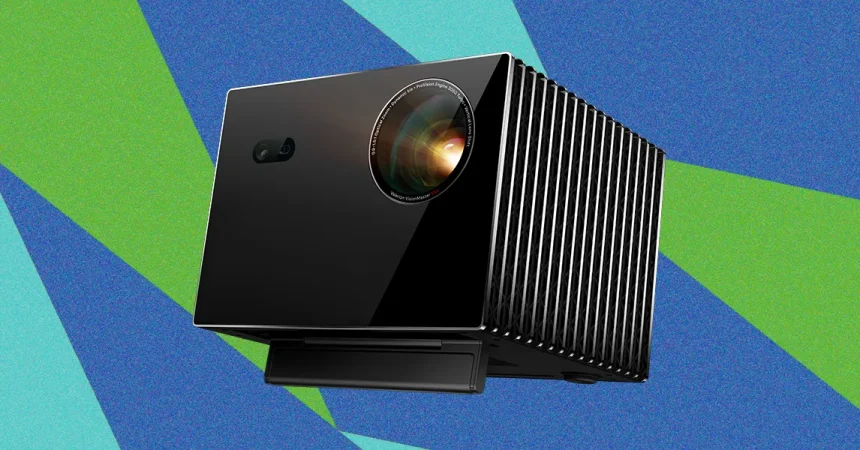
I’ll be the first to admit that I’m not a hardcore gamer. My idea of serious competitive play is a frantic Mario Kart battle on a Nintendo Switch, with everyone crowded around a coffee table and accusing each other of throwing blue shells. So when the VisionMaster Max landed in my living room, I was not the obvious person to put its gaming claims through a rigorous trial by fire. I can’t tell you how it handles the latest first-person shooter at 240 frames per second, because that’s not how I spend my weekends. But I can read a spec sheet, and I know enough about display technology to be genuinely impressed by what Valerion has packed into this compact projector. It supports refresh rates up to 240 Hz at 1080p, which is the kind of number that makes serious players sit up and pay attention. The claimed input lag is as low as 4 milliseconds, which, if true, is essentially imperceptible to human reflexes. For 4K gaming at a more conventional 60 Hz, the rated input lag is still a very respectable 15 ms. There are two HDMI 2.1 inputs, so you can connect a modern console and a streaming device without juggling cables. Auto low-latency mode is built in, meaning the projector can automatically drop into a gaming-friendly state when it detects a signal from a console or PC. The only notable omission is variable refresh rate, or VRR, which would dynamically smooth out frame-rate fluctuations and eliminate tearing. If you’re the kind of gamer who obsesses over that, you’ll need to look elsewhere. For everyone else, those numbers are more than enough to suggest that the Max can keep up with fast-moving action, even if I was too busy launching shells to properly verify it. What surprised me, though, was that the gaming features aren’t bolted on as an afterthought. They’re part of a broader design philosophy that treats the Max as a serious AV component, not a toy. The same attention to low latency and high refresh rates is what makes the image feel crisp and responsive even when you’re just scrolling through menus. It’s a projector that respects your time and your content, whether you’re gaming, streaming, or watching a film.
Now, about that picture. The VisionMaster Max is a projector that practically demands you stop and stare. Before I even began to worry about speaker placement or Bluetooth latency, I was simply drawn into the image. It’s extraordinarily bright for a device this size, the kind of brightness that allows you to enjoy a movie in the late afternoon without pretending you’re in a cave. Pull down the blackout blinds and wait for the sun to sink, and it becomes something else entirely: black levels that feel deep and rich, shadows that still contain detail, and a cinematic quality that makes the projector feel less like a gadget and more like a portal. Valerion clearly designed this machine for people who care about how their films look, not just how large they can make the screen. There are extensive picture controls to tweak, which is both a blessing and a mild curse—blessing because you can dial in exactly the look you want, curse because you might find yourself fiddling with settings instead of watching the movie. Pair it with a good screen, and you get a pixel-perfect image that makes you forget you’re looking at a projected light source. The Google TV interface, for what it’s worth, is a welcome addition. It makes finding your favorite apps easy and keeps the whole experience feeling modern. You don’t need a separate streaming box, and that matters when you’re already dealing with a projector, a screen, cables, and a soundbar. This is not a casual, point-and-shoot projector; it’s one that rewards attention and care. And yes, that makes the wobbly little sound system built into the box all the more frustrating. It also means the Max has a personality: it wants to be tuned, calibrated, and treated seriously. You could set it to a dynamic mode and leave it on a wall, and it would still look great, but that would be like buying a sports car and only ever driving it in traffic. The real magic happens when you spend time with it, adjusting the brightness, contrast, and color to match your environment and your taste.
The problem, as is so often the case with lifestyle projectors, is sound. The VisionMaster Max has two 12-watt speakers, and in a quiet room with the volume down, they sound perfectly acceptable. Dialogue is clear, effects are neatly separated from the voices, and there’s a level of detail that suggests somebody at Valerion actually bothered to tune the audio. But the laws of physics are hard to beat. This is a box projector, and a box that small simply cannot produce the kind of spacious, room-filling sound that matches the size and drama of the image it throws onto your wall. Push the volume past 25 on a scale of 100, and it doesn’t really get richer or more immersive—it just gets loud. There’s no real bass to speak of, no sense of depth, no soundstage that makes you feel like the action is happening around you. It also doesn’t help that the speakers are placed so close together in that compact chassis. There’s no physical way to create a wide soundstage from a box that’s only a foot or so across, no matter how clever the digital processing is. You can hear the sound coming from a single point in the room, which is fine for a tiny apartment but feels wrong when the image in front of you is ten feet wide. To be fair, this is a common weakness in the category. Unless you go for something like Anker’s Nebula X1, which cleverly uses removable satellite speakers to create a makeshift surround setup, most all-in-one projectors prioritize picture over audio. I get that. The size constraints are real, and the market clearly values a bright, beautiful image over a tiny speaker that can’t compete with a soundbar anyway. But at this price point—more than most people pay for a television—I think it’s reasonable to expect audio that comes closer to matching the visual magic. As it is, the built-in speakers are fine for casual viewing, especially if you’re watching a sitcom or a news channel. For a cinematic movie night, you’re going to want something better. I found myself constantly wrestling with the volume control, trying to find a level where the sound felt full rather than merely loud, and I rarely succeeded. It’s not that the Max sounds bad; it sounds exactly like a small projector with small speakers. That’s the problem.
Thankfully, you don’t have to settle for the built-in sound. The VisionMaster Max supports both DTS and Dolby Atmos, which means it can hand off a proper surround-sound signal to the rest of your home theater gear. If you already have a 5.1 or 7.1 speaker system, you can connect the projector to it and let the big images finally get the audio they deserve. That’s the route I’d recommend for anyone who wants a true cinema experience without a separate projector receiver making their setup look like a server rack. There’s also the wireless option: you can pair a Bluetooth speaker directly to the Max, which sounds lovely in theory and can make for a very clean living-room aesthetic. No cables, no extra boxes, just a projector and a speaker sitting together like they’re meant to be. But Bluetooth is Bluetooth, and latency is a fact of life. The audio can drift just enough out of sync with the visuals to be distracting, especially for dialogue. You might not notice it during a music playlist, but when actors start talking, the timing matters. For reliable synchronization and true surround sound, the better move is to use the HDMI eARC port. That gives you a direct, high-bandwidth pipe from the projector to your soundbar or AVR, with no lip-sync headaches and no compression. It’s a slightly less tidy setup, sure, but once you’ve heard a film through a proper system, you’ll never want to go back to the little speakers rattling around inside the projector. The fact that the Max includes these options is a sign that the company understands its audience: people who want a compact projector but refuse to compromise on audio. It just would have been nice if the integrated sound had been good enough to make those extra connections feel optional rather than necessary. Maybe that’s why I ended up spending most of my time with the Max connected to a soundbar. The difference was night and day, and it made me wonder why projectors in this price range don’t just include a detachable speaker like the Nebula X1. It’s a small complaint in the grand scheme of things, but it’s worth knowing before you buy. As it stands, the Max is a projector that practically begs to be connected to something better, and once you give it that, it stops being a compromise and starts being a proper home theater centerpiece.
Of course, the VisionMaster Max isn’t the only compact projector trying to earn a place in your home. The category has become crowded in the best possible way, and Valerion is facing stiff competition—including from itself. Take the Nebula X1, for example. It offers a similarly simple Google TV setup and a rated brightness of 3,500 lumens, with the added party trick of optional wireless surround-sound speakers. For casual living-room movie nights or outdoor backyard screenings, the X1 is arguably a better fit. You get convenience, versatility, and sound that actually keeps up with the picture, all without turning your setup into a project. Then there’s the Leica Cine Play 1, which WIRED has recommended highly, combining superb optics with a more lifestyle-friendly design. Leica brings serious lens heritage to the table, and its projector looks like something you wouldn’t mind leaving on a shelf in a stylish living room. The Max is still incredibly impressive, but it’s not the only game in town. If you’re looking for a more affordable way into Valerion’s world, the company’s own VisionMaster Pro 2 costs $2,999 and keeps many of the key features that make the Max so attractive: Google TV, the RGB triple-laser projection, optical zoom, and the enhanced black level technology that Valerion calls EBL. What you give up are the iris and the vertical lens shift, which are important for fine-tuning the image but not essential for everyone. If I were just looking for a fun, casual movie setup and wanted to save a few hundred dollars, I would be perfectly happy with that compromise. The Pro 2 feels like the smart buy for casual viewers; the Max is for people who want the last few percent of performance. And that last few percent is real: the iris gives you deeper, more controlled blacks, and the vertical lens shift makes it much easier to mount the projector exactly where it needs to be without resorting to digital tricks. Those are the kind of details that matter to people who are building a dedicated theater room, not to someone who just wants to project movies onto a blank wall in their apartment. The competition is genuinely tough, and the fact that Valerion can still stand out says a lot. I’ve seen projectors at this price that look great in a darkened room but fall apart with any ambient light. The Max doesn’t. It holds its ground, and it does so while offering a feature set that makes even high-end home theater fans do a double take.
At its heart, then, the VisionMaster Max is a projector for a specific kind of person. It’s not necessarily a casual device, although it can certainly be used casually if you just want to point it at a white wall and press play. But it’s at its best—and honestly, it’s at its happiest—when it’s being treated like a serious piece of home theater equipment. The weight of the unit, the depth of the picture controls, and the sheer brightness all seem to be saying: give me a proper screen, give me a real sound system, give me a few hours to adjust the settings just right, and I’ll reward you with an image that rivals a commercial cinema. The black levels are superb, the motion handling is smooth, and the colors feel rich without tipping into cartoonish oversaturation. This is not a projector that apologizes for existing. It wants to be the center of the room. The company apparently agrees. At the time of publication, Valerion is so eager to get you into its ecosystem that it’s offering some genuinely wild deals. You can bundle the $3,999 Max with your choice of a screen and four different stands—including both a tripod and a ceiling mount—without paying an extra cent. That takes some of the sting out of the premium price and turns a $4,000 projector into a complete home theater package. Is it overkill for someone who only streams the occasional football game or watches a movie every couple of weekends? Absolutely. You could buy a much cheaper projector, a decent soundbar, and still have money left over for snacks. But if you know what you want—a compact, high-end projector that can anchor a serious home theater without taking up too much physical space—the VisionMaster Max is very easy to recommend. I’d even go so far as to say it’s one of the most impressive compact projectors I’ve had the pleasure of reviewing. There’s also something to be said for the way it makes movie night feel special. In an age of binge-watching on laptops and phones, having a projector that turns your living room into a cinema is a reminder of why movies matter in the first place. The Max doesn’t just show you a film; it invites you to sit down, stay a while, and forget about the world outside. Just earmark some of your budget for a good external audio setup, and don’t be afraid to spend a little time making the picture yours. Do that, and the Max will reward you night after night with the kind of cinematic glow that makes ordinary TV feel like an event. It is, in the most literal sense, a big-screen experience in a small box—and if that’s what you’re after, you won’t be disappointed.