The HTC Vive Eagle glasses are not trying to reinvent the wheel, but they are trying to make the wheel a lot less annoying to carry around. Battery life has always been the quiet Achilles’ heel of smart eyewear, and HTC’s answer is honest about the limitations. You get four and a half hours of continuous music playback on a single charge, which is roughly enough for a long flight or a full commute-heavy day if you are not constantly glued to the audio. Standby life is far more generous, stretching to 36 hours, so if you forget to charge them overnight, they will still be waiting for you the next morning like a reliable friend who doesn’t hold grudges. For those who need more juice, HTC sells a separate clip-on battery pack called Power Boost for $49. It attaches directly to the frame, and while you will definitely notice it is there, it is not as clunky or ridiculous as you might imagine. There is something reassuring about having that little extra reservoir of power clipped to your temple, especially if you are the kind of person who runs out of battery at the worst possible moment. It does not make the glasses look sleek, exactly, but it also does not transform them into some kind of futuristic headset monster. It is a practical, slightly inelegant solution to a very real problem, and in that way it feels refreshingly human.
The AI assistant, Vive AI, is where things get both interesting and a little complicated. It can draw on OpenAI’s ChatGPT or Google’s Gemini, giving you access to a fairly intelligent conversational partner right from your glasses. What sets this apart is the privacy-first approach: there is no login required, and users are effectively “de-identified” in a way that prevents the AI services from retaining personal information. That means the assistant cannot keep a dossier on your habits, your favorite coffee order, or the names of your coworkers. On one hand, that is a huge relief at a time when every app seems desperate to vacuum up your data. On the other hand, it also means you miss out on the personalized magic that these chatbots can offer when they are allowed to peek at your emails, messages, and calendar. It is a deliberate trade-off, and HTC seems to understand that some people would rather have privacy than convenience. The glasses come with Vive’s AI Plus included free for the first two years, which is a nice way to let people try the feature without commitment. After that grace period, the subscription costs a modest $2.50 per month. That is cheap enough that it feels more like a coffee-shop tip than a real financial burden, but it does mean the glasses’ smartest feature is not entirely free forever. Still, for people who are deeply wary of AI and data collection, this is about as gentle an introduction as you could ask for.
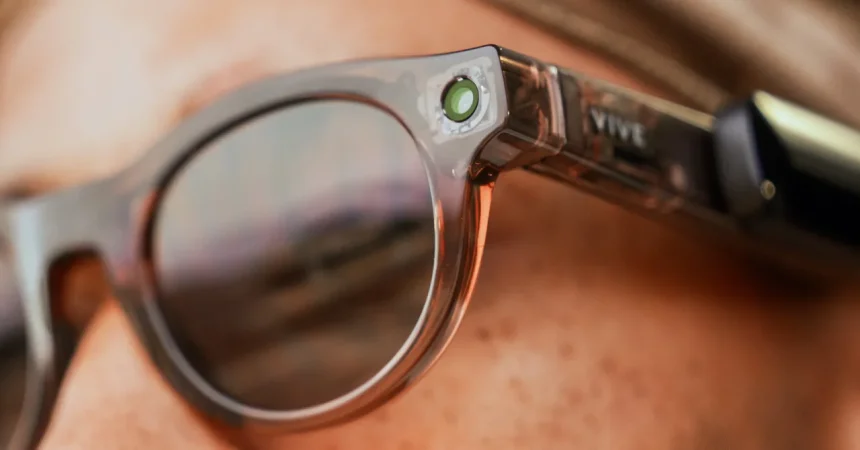
The privacy story goes far beyond the AI assistant, though. Right next to the cameras sits a bright indicator light, and that little LED is doing a lot of heavy lifting. If you cover the light, the glasses will not record. If someone around you says “stop recording,” the glasses will actually stop. That is a surprisingly direct form of consent, and it makes the device feel less like a surveillance tool and more like a polite guest. Video footage is encrypted and stored directly on the glasses themselves, not automatically pushed to your phone or to some distant cloud server. If you want to import your photos or videos, you have to do it manually in the app. This is a small but significant design choice. It means the default setting is privacy: nothing leaves your glasses unless you actively decide to move it. There is no silent background syncing, no accidental auto-upload, no quiet little data packet sneaking off into the night. You are the gatekeeper, and that is a rare thing in the world of connected gadgets. It also means that if someone steals your glasses, they have a locked device rather than an open treasure chest. The encrypted storage is not just a marketing bullet point; it is an actual barrier between your personal moments and the entire internet.
Of course, HTC is not operating in a vacuum, and they know it. Meta has faced intense scrutiny over its own smart glasses, particularly around that same indicator light. Some paranoid or privacy-sensitive users have tried to block the LED with stickers or even ripped into the hardware to disable it. Meta’s response has been to push software updates that disable the camera entirely if someone tampers with the indicator light, along with other privacy-focused safeguards. This cat-and-mouse game has made a lot of people understandably suspicious of any camera-equipped glasses. HTC’s Daniel McDowell is clearly aware of this, and he makes a point of differentiating the company from the social media giants. “We’re not a social media company,” he says. “There’s no benefit to me to have any of your info. We don’t train our AI model or any third-party AI models with any of the information that is used on the glasses.” That is a strong statement, but it also runs into the classic “trust me, bro” problem. Every company says they care about privacy, and consumers have been burned often enough to be skeptical. HTC’s argument is that their business model is fundamentally different: they sell hardware, not ads, not personal data, not targeted profiles. That could be true, but it is a hard story to tell to someone who has already been burned by the tech industry’s long history of broken promises.
The bigger, more awkward problem is that all smart glasses kind of look the same. The Vive Eagles look a lot like Meta glasses, and for the average person on the street, there is no easy way to tell one brand from another. If people associate that general shape—black frames, small cameras, little indicator lights—with Mark Zuckerberg and the machinery of social media, then HTC has an uphill battle. The author of the original piece notes that friends have seen him wearing them and immediately asked if they were smart glasses. When he said yes, but not the ones they were thinking of, that did not seem to ease their suspicion. In a way, the entire category is stained by association. People are not worried about one specific pair of glasses; they are worried about what that pair of glasses represents. They see a camera on your face and they imagine being recorded without consent, having their images stored somewhere, or being turned into fodder for a recommendation algorithm. The fact that HTC stores footage locally, encrypts it, and requires manual imports does not change the visual first impression. The glasses look like glasses, but they also look like the glasses everyone has been taught to distrust. That is a branding problem that no amount of clever engineering can fully solve, at least not yet.
HTC’s hope is that more players with better privacy practices will eventually change the cultural attitude toward smart glasses. Multiple companies are moving in that direction, some by dropping cameras altogether, like Even Realities, Viture, and Halliday. Others are building privacy shields into their designs or focusing entirely on virtual displays that hover information in front of your eyes without recording the world around you. The market is becoming more diverse, but no one has captured the public imagination quite like Meta. That dominance creates a strange paradox: the company that triggers the most privacy anxiety is also the one that normalized the product category. HTC, by contrast, is trying to carve out a smaller, quieter niche where privacy is woven into the design rather than bolted on as an afterthought. McDowell puts it beautifully: “We’d like to make sure that our technology adapts to society’s expectations, not the other way around.” That is a lovely principle, and it is also an enormous challenge. Society’s expectations are shaped by fear, experience, and a healthy dose of suspicion. The only way to change those expectations is to consistently show up, with the indicator light on, with footage stored locally, with no hidden data harvesting, until people start to notice that not all smart glasses are created equal. It may take a long time, but perhaps the road to trust is paved by exactly these small, deliberate, privacy-respecting choices. As McDowell says, “I hope that everybody that’s making products like these takes steps in the right direction.” Maybe that hope is the most important feature of all.