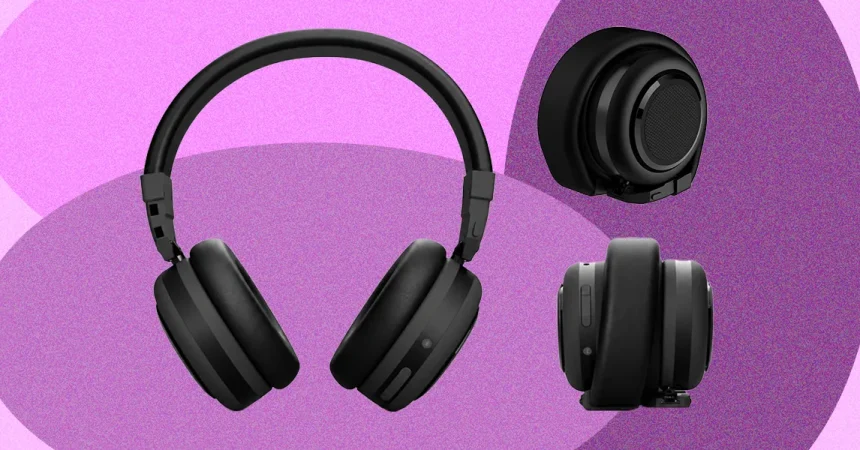
Some gadgets make you smile before you even switch them on, and the TDM Neo did exactly that to me. The concept is genuinely clever: a pair of on-ear headphones that fold down into a compact Bluetooth speaker. It’s the kind of idea that feels like it was dreamed up by someone who spends too much time packing for trips and hating every separate device that has to go into the bag. I love the engineering. I love how small the whole thing becomes. I love the neatness of having one gadget that can sit on your head for a flight and then transform into a little speaker on your hotel nightstand. But after spending real time with the Neo, I found myself wrestling with a familiar question: is a clever idea enough to make a product worth recommending? The short answer is no, not yet. The Neo is not a bad product, but it is a compromised one, and those compromises touch nearly every part of the experience. I wanted to love these headphones. I really did. But between the tight fit, the heavy weight, the slightly claustrophobic sound, and a speaker mode that doesn’t sound as good as it should, the Neo left me feeling more tired than delighted. It’s a product I admire in principle and struggle to live with in practice.
Let’s start with the most personal thing: how they feel on your head. The TDM Neo do not have active noise cancellation, so they block out the world the old-fashioned way, with passive noise isolation. That means the earpads need to press against your head firmly enough to create a seal, and they do. There’s no doubt the isolation works to a degree. On a noisy street or in a busy office, the Neo do cut down a fair amount of ambient sound just by clamping around your ears. But it’s not the same as active noise cancellation. It’s not that eerie, peaceful silence you get from the best noise-canceling headphones, where the world simply disappears and all you’re left with is the music. Instead, you get a muffled version of reality, with voices and traffic still poking through. And here’s the catch: the physical seal that makes the isolation possible comes at a cost. The earpads are relatively firm, not plush, and the whole headphone feels tight on my admittedly large skull and less than dainty ears. After an hour or so, I started to feel the pressure, not just around my ears but across the top of my head and even my jaw. It’s a constant, low-grade reminder that you’re wearing something. For a pair of headphones you’re likely to take on a plane or a train, that’s a problem. You want to forget you’re wearing them. The Neo never let you forget.
Then there is the weight, and this is where the Neo’s dual personality starts to feel especially heavy. At 11.9 ounces, they are heavy for on-ear headphones. That’s not a huge number in absolute terms, but when you think about how little material actually rests on your head, it’s a lot. The reason is obvious: there are four 40-millimeter drivers inside, two for each ear, plus the extra hardware that lets the headphones fold into a speaker. It’s an impressive feat of engineering, but you can feel it. I noticed the weight within the first few minutes of wearing them, and it never really faded. For comparison, the Sony WH-1000XM6, which are full-size over-ear headphones with excellent active noise cancellation and a reputation for comfort, are about 3 ounces lighter. The more affordable Soundcore Space One Pro is 1.9 ounces lighter. The on-ear Beats Solo 4, which are not particularly heavy hitters in the comfort department themselves, are a full 4.25 ounces lighter. That’s a significant difference. The Neo are heavier than headphones that offer more features, better noise cancellation, and generally more luxurious comfort. On a long journey, that extra weight, combined with the firm clamping force, starts to wear you down. I kept shifting them, adjusting the headband, taking them off for a break. It was exhausting in a way that had nothing to do with the music.
Sound quality is where the Neo almost win me back, but not quite. Let me be fair: they sound detailed and pleasant in a lot of ways. The bass is clear and present without being muddy. Vocals are distinct and sit nicely in the mix. There’s a lot of information being delivered, and you can hear the care that went into tuning the drivers. But the presentation feels boxed in. Music lacks the scale and openness that I expect from great headphones. There’s no sense of space, no wide stage where instruments can breathe. Instead, everything feels crowded, like a band all trying to play in a small closet with the door closed. Individual instruments are pushed together, competing for room, and the overall effect is tiring. I don’t want to say it’s bad, because it isn’t. But it’s not on par with similarly priced alternatives, and it’s especially disappointing when you consider that the Neo have four drivers per pair. You’d expect a richer, wider, more immersive sound from that kind of hardware. Instead, you get a sound that’s detailed but cramped. I suspect that if the Neo were more comfortable to wear, I’d enjoy the audio more, because comfort affects everything. When your head is aching and your ears are sore, you’re not in the mood to appreciate subtle vocal textures. But as it was, I found myself wanting to take them off before I wanted to hear another song. That’s a bad sign for headphones.
Now, the party trick: the Bluetooth speaker. I really do like the idea, and I love how the Neo fold up into this compact little block that looks cool and feels satisfying to handle. There’s something genuinely appealing about having a speaker on hand whenever you have your headphones, just because the two are literally the same object. You can pull them out of your bag, unfold them, listen to a few tracks, and then fold them back into speaker mode to share something with friends. That convenience is real. But as a speaker, the Neo are underwhelming. There’s enough volume for casual listening in a small room, but the sound is thin and lacks body. It keeps pace with the tiny-but-mighty JBL Go 5, which is impressive for something so small, but the Neo have twice the power and double the drivers. They really should sound better. I played them side by side with my favorite current portable speaker, the $120 JBL Flip 7, and the difference was enormous. It was like racing a speedboat and a paddleboard. The Flip 7 has warmth, depth, and a sense of room-filling presence. The Neo sound flat and small in comparison. If you’re only going to use the speaker mode occasionally, it’s fine. It’s a nice bonus, not a reason to buy. But if you’re expecting a premium audio experience from your two-in-one gadget, you’ll be disappointed.
So where does that leave us? The obvious benefit of the Neo is having just one device to carry and charge. That’s a genuine advantage for minimalist travelers, and I can’t dismiss it. But the compromises pile up quickly. You lose active noise cancellation, which means you’re stuck with a tight, firm fit that does its best to block noise but never reaches that blessed silence of the best ANC headphones. You gain a lot of weight, and you feel it. The sound quality is decent but boxed in, and the speaker mode is convenient but not good enough to compete with even modest dedicated speakers. The Neo are not awful. I want to say that clearly. They are well-built, cleverly designed, and there’s a real future for this kind of product. But they feel compromised in every direction, and the price makes them a tough sell. You could buy a comfortable pair of headphones with excellent ANC and a small Bluetooth speaker separately, and both would probably sound better than the Neo. You’d carry two devices instead of one, but you’d enjoy the journey and the destination more. For the right person, maybe someone who values novelty and compact design above all else, the Neo might be a fun toy. But for anyone who wants a pair of headphones that vanish on their head and a speaker that fills a room, this isn’t it. I appreciate the engineering, and I hope the next version gets softer earpads, active noise cancellation, and a lighter frame. For now, the Neo is a clever idea that asks you to give up too much in exchange for the magic of folding. And in the end, that’s a compromise I’m not willing to make.