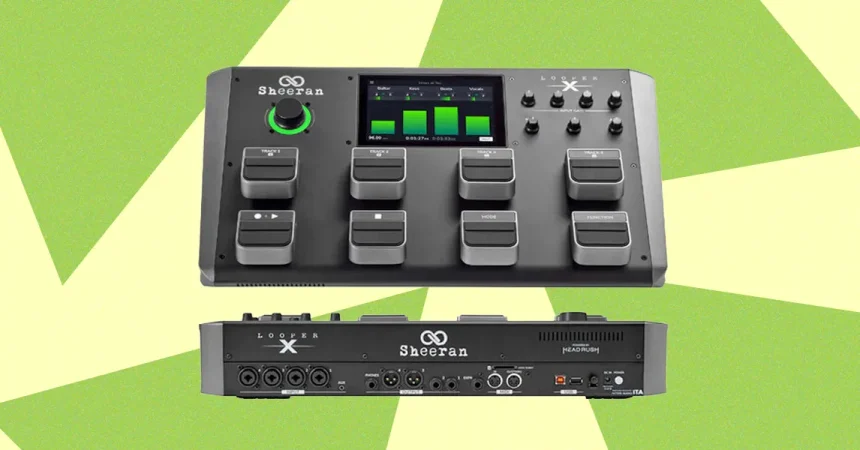
For musicians who thrive on experimentation, the Akai Looper X offers a fascinating playground of functionality that goes well beyond your standard four-track looper. Its core versatility lies in its three specialized playback modes. The “Song” mode provides the freedom for each track to have its own independent length, perfect for complex arrangements, while “Band” mode strikes a balance by synchronizing parts together. For those who prefer to abandon the rigidity of a click track and drift into ambient textures, “Free” mode disables all sync constraints, allowing you to layer soundscapes into a beautiful, chaotic wash. It feels less like a strict studio tool and more like an instrument designed for those who want to get lost in the process of sound design rather than just playing by the book.
Managing a complicated multi-track session is made surprisingly approachable through the device’s three distinct visual interfaces. The “Track” view uses a simple, color-coded vertical bar system to indicate the status of each loop, which is great for a quick glance while performing. For most users, the “Wave” view will quickly become the home base; seeing the horizontal waveform with a scrolling playhead provides a level of visual feedback that makes syncing your next overdub feel intuitive rather than guessed. The “Mixer” view rounds out the experience by putting essential controls—mute, solo, and FX—right at your fingertips. Perhaps most conveniently, the mute and solo sections allow you to trigger backing tracks directly from the device’s internal library, which you can easily populate via USB or an SD card.
One of the most frustrating aspects of working with hardware loopers and samplers is the inevitable battle with file formats. Akai has clearly learned from the headaches caused by other industry giants, providing a free, dedicated file converter app that handles the heavy lifting for you. Simply drag and drop your samples, and the software ensures they are properly formatted to the device’s 16-bit 44.1 kHz WAV requirement. It’s a small detail, but for anyone who has lost an afternoon fighting with incompatible files, this streamlining of the workflow is a massive investment in your sanity, saving you from the technical troubleshooting that usually keeps musicians from actually making music.
The device’s true strength for a performer lies in its deeply customizable “Mode” button, which acts as a gateway to your personalized workflow. You are essentially given a blank slate for those eight physical buttons, allowing you to map functions like the reverse effect, the tuner, or loop multiplication exactly where you want them. What makes this implementation truly brilliant is that these settings are saved on a per-loop basis, not trapped in a global menu. This means that if you’re moving from a syncopated rhythmic section to an ambient textural shift, you can have entirely different foot-control layouts ready to go with a single tap, making the transition feel seamless and professional.
However, the Looper X isn’t without its caveats, particularly when it comes to the internal effects ecosystem. Given the premium price point of $1,500, many players would naturally expect the device to replace an entire pedalboard of stomps. While Akai does provide curated “racks” of virtual pedals for specific instruments like guitars or drums, the results are underwhelming. The signal chains are rigid and the effects themselves feel a bit bare-bones—sufficient for a light touch of compression or room reverb, but lacking the high-end character or deep tweakability required to replace dedicated processors. You would likely find more sonic inspiration and utility in a cheap, used multi-effects unit from a local pawn shop than you will in the internal software of the Looper X.
Ultimately, the Looper X is a powerful, highly capable piece of hardware that acts as a central hub for complex looping, but it requires a realistic expectation of what that money is actually buying. You are paying for a robust, reliable, and intelligently designed looping engine with a fantastic interface that makes navigating long sessions a breeze. While the internal effects fall short of being a standalone replacement for a professional pedalboard, the structural brilliance of the device—its file management, its versatile sync modes, and its highly customizable control scheme—makes it a compelling choice for the serious looper. If you value a streamlined workflow over all-in-one sonic processing, the Looper X is an investment that will fundamentally change how you construct your sound.