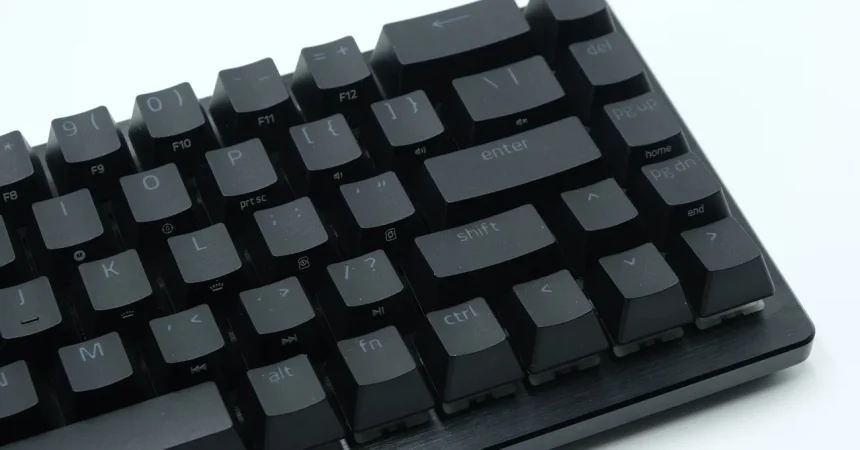
The latest Razer Huntsman keyboard marks a significant step forward in manufacturing quality, particularly when it comes to the stabilizers. Anyone who has spent time in the mechanical keyboard hobby knows that stabilizer rattle is the bane of an enthusiast’s existence—it turns a premium experience into a cheap-sounding mess. It is genuinely impressive to see Razer finally nail their factory lubing process. Every keypress feels consistent, smooth, and impressively quiet, proving that the company has finally cracked the code on an issue that continues to plague many of their competitors.
When you look at the physical construction, the keyboard follows a familiar blueprint: a brushed-metal top plate grounded by a plastic bottom shell in a standard tray-mount configuration. The aesthetics are classic Razer—sleek, professional, and understated—and I am relieved to report that they’ve abandoned those flimsy plastic clips that make maintenance a nightmare. Instead, the two halves are secured by countersunk screws. While this makes for a clean look, the keyboard does have a bit of flex when you handle it firmly. Despite the metal top plate, the thinness of the plastic base keeps the board from feeling like a truly premium, “tank-like” peripheral.
The internal design suggests the manufacturer is leaning into a more modular philosophy, despite some limitations. Inside, you’ll find a split board architecture with a main PCB and a smaller daughterboard, connected by a robust ribbon cable. Sound-dampening foam is placed strategically between the plate and the PCB, as well as at the bottom of the case, in an attempt to deaden vibration. However, my assessment is that the thinness of the bottom shell undermines these efforts. While the internal layout is thoughtful, the acoustics fall a bit flat, failing to produce the deep, satisfying “thock” sound that users have come to expect from higher-end custom chassis.
The tray-mount assembly is a double-edged sword. On one hand, it is a dream for anyone who likes to tinker or repair their own gear; the screws are evenly distributed and easy to access, making disassembly a fairly painless affair. On the other hand, because the support posts are anchored into plastic, you have to be careful. Over-tightening those screws during a reassembly job could easily strip the threads, which would permanently compromise the integrity of the shell. It’s an accessible design, but one that demands a gentle touch rather than brute force.
One of the most interesting aspects of this keyboard is its Hall Effect (HE) technology, which brings unique challenges regarding customization. Unlike traditional mechanical keyboards where you can swap switches to your heart’s content, the HE market is fragmented; there isn’t a single “standard,” which often leads to poor compatibility with aftermarket parts. That said, I had a surprisingly positive discovery during testing. Despite the official word suggesting otherwise, I managed to swap in switches from a Wooting 60HE without a hitch. This hints that the ecosystem might be more open than we initially thought, which is a massive win for users who want to customize their typing feel.
Despite these highlights, the experience wasn’t without its growing pains. Perfection is elusive, and I encountered a frustrating “sticking” bug where the N-key would ghost, inputting an infinite stream of characters until interrupted. Swapping the switch provided only temporary relief for some keys, while others simply went dead, requiring a full factory reset to get things back to normal. It’s a reminder that beneath the refined stabilizers and the clever internal architecture, this is still a piece of software-driven hardware that requires polish. If Razer can address these stability glitches in their next firmware update, they will have a truly formidable entry on their hands.