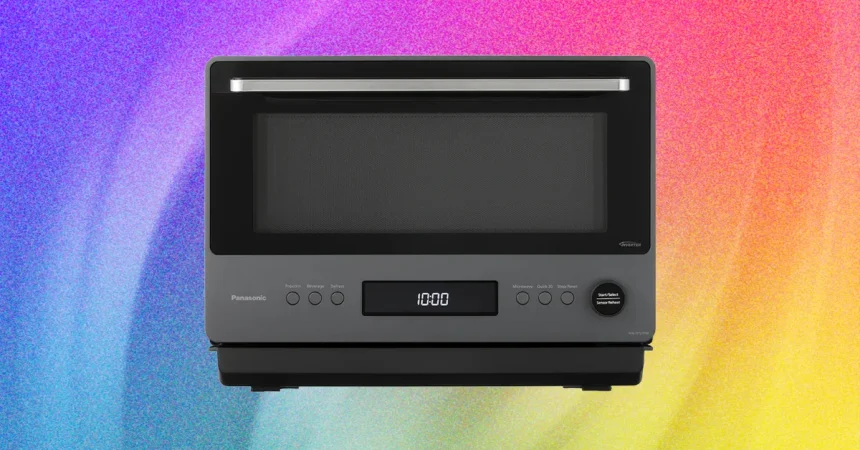
When it comes to performance, this microwave truly bridges the gap between high-end precision and everyday convenience. While it’s not perfectly uniform across the entire cavity—you might notice the front corners near the door stay about 20 degrees cooler than the rest—it is still miles ahead of the clunky, old-school rotating turntables that limit your cooking space. In reality, you are getting an incredibly consistent heating profile that makes the most of the oven’s footprint. That said, it’s worth remembering that this machine uses sophisticated sensors to do the heavy lifting. If you insist on covering your food while using the “Sensor Cook” mode, you will effectively blind the oven, leading to mediocre, uneven results. It’s a tool that works best when you trust its eyes rather than trying to micromanage it with traditional covers.
Speaking of those sensors, there is one specific nuance to keep in mind regarding how they interpret your food. While the oven is a wizard with flat, evenly spread platters that allow the sensors to get a clear read, it can occasionally trip up on complex, multi-layered dishes. For instance, when I tried to reheat a Korean rice bowl with ribs piled on top of cabbage and rice, the cabbage didn’t quite reach the same temperature as the meat. I ended up having to give it a quick stir and a brief extra burst of heat to even things out. Is this a dealbreaker? Hardly. It’s what I’d expect from almost any microwave on the market, but it serves as a reminder that even the most advanced technology has its limits when faced with a “mountain” of ingredients.
The true beauty of this appliance lies in its elegant simplicity; it’s designed to be a “set it and forget it” companion that frees up your mental energy. I rarely find myself hovering over the door or worrying if my lunch is going to end up as a lava-hot mess or a frozen brick. The main sensor reheat function is nothing short of genius, consistently bringing food to a perfect 180 degrees Fahrenheit. If you prefer your meal a bit more subdued, there are five lower settings to choose from, giving you total control. I’ve reached the point where I don’t even second-guess it—I just hit the button and trust the result.
Beyond the standard reheat, the secondary menu functions are genuinely practical for the stresses of daily life. The Beverage button, for example, is a highlight; it brings a mug of coffee or tea to a perfect 170 degrees—steaming hot but still perfectly drinkable without waiting for it to cool down. Even the Defrost function surprised me, successfully reviving a frozen chicken breast in just ten minutes without actually cooking the edges or turning the meat into rubber. By following the simple instruction to let the meat rest for five minutes afterward, the residual heat perfectly balances the temperature throughout the chicken. It’s a reliable, no-nonsense system that actually delivers on its promises.
Then there is the popcorn setting—a feature that, let’s be honest, is usually a gamble. Because infrared sensors can’t peek through a paper bag, Panasonic wisely treats this as a weight-based timer rather than a “guesswork” sensor function. I threw in a standard grocery store bag, punched in the weight, and walked away. The result was genuinely impressive: no scorched corners, no clouds of bitter smoke, and only a negligible handful of unpopped kernels. Compared to the old method of hovering over the machine and listening for the gap between pops—which often feels like waiting for a fire alarm to go off—this is a massive upgrade for movie night or late-night snacking.
Finally, while the microwave offers plenty of advanced manual power adjustments and traditional timed functions, it also includes a massive library of preprogrammed “scratch cooking” recipes. You can whip up everything from chicken noodle soup to spaghetti Bolognese using raw ingredients. While these functions act as a fascinating nod to Japanese kitchen culture, where compact appliances often serve as full stoves, they feel a bit like a relic from the 1980s for the average American kitchen. They are a cool technical parlor trick that showcases the machine’s ability to modulate power, but for most of us, this machine will be the ultimate reheat and defrost champion. It’s not just a box that zaps your food; it’s a reliable, efficient partner that respects your time.