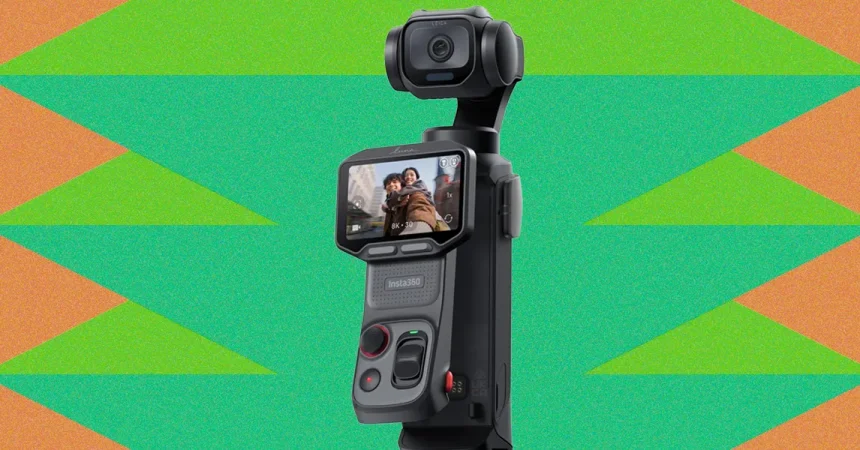
There’s something almost romantic about the idea of a tiny camera that can keep up with your creativity. You imagine yourself walking through a city at golden hour, capturing smooth, cinematic footage with nothing more than a device that fits in your palm. That’s the promise of the pocket gimbal camera, and it’s why so many solo filmmakers, journalists, and content creators find themselves drawn to products like the Insta360 Luna series and DJI’s Osmo Pocket line. But the real question isn’t whether these cameras are useful—it’s which one is right for you. The answer, as with most things in life, depends entirely on how you work. If you’re a YouTuber filming talking-head videos, a multimedia journalist grabbing quick interviews on the go, or a travel creator who needs reliable stabilization without dragging along a full rig, these compact cameras are designed with you in mind. They’re not meant to replace your cinema camera or even your smartphone entirely. They’re meant to be the camera you actually have with you when the moment happens. And because they’re built around gimbals and smart software, they let you move naturally—walking, running, turning—without worrying about shaky footage. That’s a huge deal for solo creators who don’t have a camera operator following them around. The Luna Pro and Luna Ultra are two flavors of the same idea, but they’re not identical. The Pro is simpler, with a fixed lens and a lower price. The Ultra adds a mechanical zoom lens and more flexibility for certain types of shots. And then there’s the Insta360 X6, a completely different beast that shoots 360-degree video and lets you “reframe” your shot after the fact. All of these options have strengths, and all of them have trade-offs. So before you open your wallet, you need to think carefully about what kind of creator you are, what you’re shooting, and where you’re shooting it.
Let’s talk about zoom, because it’s one of the most misunderstood features in modern cameras. Digital zoom is convenient—it’s built right into the software, and you can activate it with a pinch or a button press. But convenience comes at a cost. The moment you start zooming digitally, the camera is essentially cropping into the image and then scaling it back up to full resolution. The processor does its best to keep everything looking sharp, applying noise reduction and edge enhancement, but even under the best conditions, the loss of quality is noticeable. Details get soft, edges lose their crispness, and fine textures turn into smudgy mush. If you’ve ever taken a photo with your phone and tried to zoom in on something far away, you know exactly what I’m talking about. The Insta360 Luna Ultra has a built-in 3X optical zoom, which is genuinely useful because optical zoom uses the lens to magnify the image before it hits the sensor. That means you’re not losing resolution—you’re actually getting closer. But what if you need even more reach? Insta360 recently released an external zoom attachment that adds another 1.5X of optical zoom, bringing the total to 4.5X. That’s roughly the equivalent of a 90mm lens on a full-frame camera, which is a solid focal length for portraits, interviews, and certain kinds of documentary work. The best part is that this attachment preserves image quality much better than digital zoom. In my testing, I found almost no discernible loss of quality when I combined the optical zoom attachment with digital zoom, all the way up to about 200mm equivalent. Beyond that, if you max out the digital zoom entirely, you can push the camera to the equivalent of a 450mm lens—but the image does start to get noticeably softer. So the takeaway is simple: if zoom is important to you, the external attachment is worth the investment. It gives you genuine telephoto reach without turning your footage into a pixelated mess, as long as you don’t push it to the absolute limit.
Now, let’s dig into the differences between the Luna Pro and the Luna Ultra, because they’re more nuanced than just “one has a zoom lens and the other doesn’t.” When the Luna Pro first launched, it had a feature that the Ultra lacked: 4K vertical video. For a lot of creators, that was a deciding factor. Vertical video is everywhere these days—TikTok, Instagram Reels, YouTube Shorts—and being able to shoot in true 4K vertical format without cropping or rotating in post is a huge advantage. It saves time and preserves quality. The Ultra, on the other hand, launched without that capability, which seemed like a strange omission for a camera aimed at content creators. But Insta360 listened to the feedback and rolled out a firmware update that added 4K vertical video to the Ultra as well. So now, both cameras can deliver the same social-media-ready vertical footage. That levels the playing field somewhat, but it doesn’t erase the price difference or the physical differences between the two devices. The Luna Pro is probably the better value for most people. You give up the zoom lens, but that’s really about it. You still get the same sensor, the same gimbal stabilization, the same intuitive touchscreen interface, and the same high-quality image output. And you save $170, which can go toward a spare battery, a carrying case, or that telephoto attachment if you ever decide you need it. The Luna Ultra, meanwhile, only makes sense if you genuinely need a longer focal length. It’s not that the zoom lens is bad—it’s actually quite good—but the added cost and complexity only pay off if you find yourself constantly wishing you could get closer to your subject. And even then, I don’t think going beyond the 3X optical zoom is worthwhile for most people. The digital zoom is there in a pinch, and the telephoto attachment can extend your reach without degrading quality as much. So unless you’re shooting wildlife, sports, or other distant subjects on a regular basis, the Pro is the smarter buy.
But there’s another option that deserves serious consideration, especially if you’re the kind of creator who loves to shoot yourself while moving. Think about walking through a city, riding a bike down a scenic trail, or skateboarding through a park. With a traditional gimbal camera like the Luna, you have to point the camera at yourself and hope the framing works out. You’re locked into whatever angle you set, and if you want to show your surroundings, you have to rotate the gimbal—which takes time and can interrupt the flow of your shot. The Insta360 X6 solves this problem in a completely different way. It shoots 360-degree footage, capturing everything around you all at once. Then, in post-production, you can crop into the frame to create a perfectly stable video that follows your movement, pans across the scene, or even changes perspective after the fact. That’s an incredible amount of creative flexibility. You can shoot first and decide your composition later, which is a huge advantage for solo creators who can’t always predict what’s going to happen. In terms of pure image quality, the Luna cameras do produce marginally better-looking video—there’s a little more detail, a little more dynamic range, and a slightly more natural color response. But the X6 makes up for that with its versatility. You can use it as an action camera, because it’s waterproof and virtually indestructible. You can use it as a 360 camera, for immersive virtual reality content or interactive experiences. And you can use it as a traditional vlogging camera, as long as you pair it with the folding selfie handle that keeps the camera safely away from your body and makes it easy to hold. That handle also gives you a shooting experience that feels surprisingly similar to using a Luna camera. You can walk, run, or ride with it, and the footage will be smooth and stable thanks to the camera’s software stabilization. So if you’re an active person who wants one camera that can do everything, the X6 is a compelling choice.
So how do you decide? Let’s break it down. First, ask yourself who you are as a creator. If you’re someone who values image quality above all else—someone who wants the cleanest possible footage for a client project, a documentary, or a polished YouTube video—then the Luna cameras are the clear winner. They offer better overall image quality than the X6, and they’re specifically designed for that “cinematic vlog” look. Between the two Lunas, the Pro is the better choice for the vast majority of users. It gives you everything you need for most shooting scenarios, and it saves you $170. The Ultra only becomes worth it if you really need that built-in zoom lens. And even then, I’d recommend pairing it with the external telephoto attachment to get the most out of your reach without sacrificing sharpness. On the other hand, if you’re primarily shooting yourself while moving—if your content is all about action, travel, or adventure—then the Insta360 X6 might be the better fit. It’s not just a camera; it’s a system. You can take it anywhere without worrying about damage. You can use it underwater or in dusty environments. You can shoot in 360 and then reframe your shots in post, which gives you the freedom to capture more dynamic footage than you could ever get with a fixed-lens camera. The X6 also pairs beautifully with a folding selfie handle, giving you that same “invisible cameraman” effect that makes gimbal cameras so popular. The trade-off is a slight decrease in image quality, but for many creators, that trade-off is worth it because of the added flexibility and peace of mind.
In the end, there’s no single “best” camera—only the best camera for you. If you’re a solo filmmaker or journalist who needs professional-grade footage and doesn’t mind being a little more careful with your gear, the Luna Pro is an exceptional value. It’s reliable, compact, and capable of producing beautiful video that will make your work stand out. If you need zoom, the Ultra is a fine upgrade, especially now that it has 4K vertical video and can work with the telephoto attachment for impressive reach. And if you’re someone who loves to move, explore, and experiment, the Insta360 X6 is a fantastic companion that opens up a whole new world of creative possibilities. It’s rugged, versatile, and fun to use, and it might just change the way you think about camera stabilization and storytelling. The main question you need to answer is simple: do you need the higher-quality video of the Luna cameras? If you do, then the Luna lineup is the clear winner. If you’re more concerned about flexibility, durability, and the ability to reshape your shots after the fact, then the X6 is going to make you happier. Whichever you choose, remember that the best camera is the one you’ll actually carry with you and use. It’s the one that lets you stop worrying about gear and start focusing on the story you want to tell. And that, more than any spec sheet, is what truly matters. So take your time, think about your own shooting style, and don’t be afraid to go with your gut. You might find yourself over the moon with your choice.