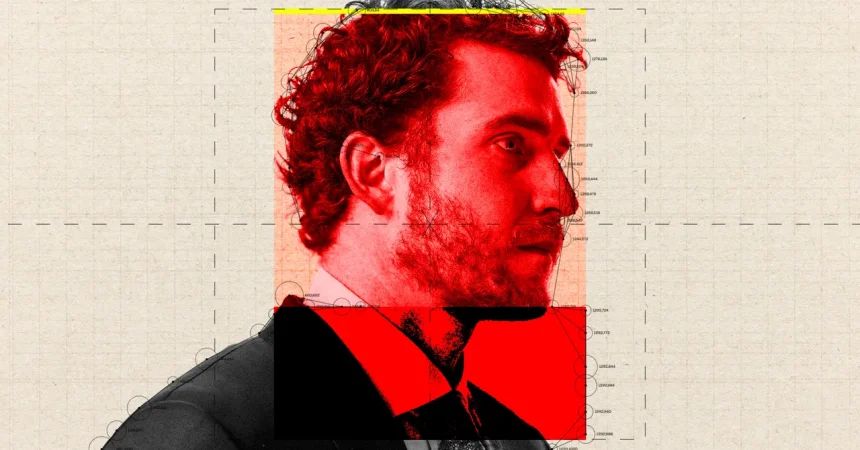
There is a particular kind of intimacy that forms when two people find each other in the wreckage of what the rest of the world has decided is a disaster. Elizabeth Holmes and Billy Evans have been the subject of endless headlines, almost all of them about her deception, her trial, and her downfall. But the new documentary You Can See Everything, directed by Nathan Fielder and Lance Oppenheim, chooses to look somewhere far quieter: into the strange, stubborn, deeply human relationship that grew up inside that wreckage. Even before the cameras arrived, Holmes and Evans were an unusual couple by any measure. At the time of Holmes’s sentencing in 2022, Evans wrote a letter that seemed almost defiantly tender. He admitted that Holmes may have failed to change the world in the way she once set out to, but he insisted that she had undeniably changed his. He spoke of being taught a kind of patience he would once have dismissed as unnecessary and soft—a patience he learned, strangely enough, during the hardest years of her life. The letter was not an argument for her innocence. It was something more complicated: an argument for her humanity. And that, in a curious way, is exactly what the film tries to make visible. It asks us to set aside the image of the black turtleneck and the voice deepened by performance, and to see instead a woman who is still loved, still seen as worthy of devotion by someone who knows exactly what the world thinks of her.
To understand the man making that argument, it helps to go back to San Diego and a childhood shaped by money, privilege, and expectation. Billy Evans grew up in one of the city’s more prominent families, heirs to a Southern California tourism empire built by his grandparents, William and Anne Evans. In 1953, the two young hoteliers looked at a mudflat in Mission Bay and saw the future, opening a resort that would eventually grow into a family business of several properties, including a third in La Jolla. That legacy passed in part to Billy’s father, also named William, and it gave the Evans name a certain weight around town. Billy attended the Francis Parker School, one of the most prestigious private schools in San Diego, and seemed to many to have everything already handed to him. A contemporary who worked for the family as a teenager remembers the Evans family as well respected, but describes Billy as a constant source of drama, someone who would try to pick fights just to get a reaction. The old words used by people who knew him then are not flattering: “affluenza,” “classic spoiled rich kid.” It is a picture that sits uneasily beside the gentle, devoted husband we see in the documentary. But that contrast is part of the point. People are not one thing forever. The compassion that emerged in Evans later in life was not a default setting; it was something he had to grow into. Whether he grew because of Holmes, or in spite of everything around them, or simply because love forced him to become someone soft enough to survive it, is one of the more haunting questions the film leaves lingering.
The couple’s relationship has always existed in the shadow of legal catastrophe, but the details that have leaked out through sentencing letters and friends paint a more intimate picture than the public might expect. One friend wrote that after a monthslong camping trip, Evans returned with “a new level of compassion in his demeanor, a strong sense of intention with his actions, and a heightened desire to listen to and look at others with purpose.” There is a gently comic image in that description: the two of them, the most infamous fraudster of her generation and the wealthy hotel heir, driving through the wilderness in a trailer, trying to live a normal life while the legal wheels ground on. But there is also something real. Evans was not merely standing by his woman. He was allowing himself to be transformed by her. In his own letter, he made clear that Holmes, despite her public failures, had taught him something essential—something he had never expected to learn, and certainly not from a woman the world wanted to lock away and forget. Holmes, for her part, became a wife and mother in these years. The couple now have two children: a son named William and a daughter with the unusual name Invicta, which means unconquered. That name feels deliberate, a private declaration that the family is not defined by public disgrace. Whether that declaration is noble or delusional is hard to say. Perhaps it is both. But in the film’s framing, naming a child “unconquered” is not a publicity stunt. It is a form of hope, and hope, especially for people in impossible situations, can be the most honest thing they have.
The family is not only surviving; they are also, in some strange sense, building again. Evans has started a company called Haemanthus, and he has been eager on social media to reassure anyone who will listen that it is absolutely, most definitely, “not Theranos 2.0.” That denial is so specific that it almost invites the comparison it tries to block, and the documentary plays with that tension openly. A person familiar with the business told The Wall Street Journal that Holmes is not involved, yet in You Can See Everything, Evans watches himself agree with the idea that he and Holmes are essentially attempting exactly that: a second act, a new company, a chance to prove that the lessons of the past have been learned. On camera, they discuss the long road toward making a working prototype of something—a detail so vague it feels like an echo of the old Theranos language. They also talk about collaborating on product ideas from prison. It is a dizzying contradiction. Holmes may not hold a title at Haemanthus, but she is clearly still part of the project, if only as an idea, a dream, a voice on the other end of a prison phone line. Evans says the company is not Theranos 2.0, but he does not seem entirely sure what it is yet. Maybe the truth is simpler than the business talk suggests. At its core, Haemanthus is a way for Evans to say to the world: we are not finished. It may fail, and fail publicly, but in his telling it is already an act of faith—a second chance he is trying to build with the woman he loves, even if no one else believes either of them deserve it.
What makes all of this even more complicated is Evans’s own stated reason for participating in the documentary. “To meet her, to spend time with her, that was the intention of the film,” he told David Friedberg, a cohost of the podcast All-In. Evans, who is based in Austin, Texas, admitted that he had not yet seen the finished film, and that he might think it was the dumbest thing he has ever done. That confession is striking. Here is a man who has already been cast as either a loyal romantic or a fool, depending on who is watching, and he is willing to open himself up to even more public scrutiny. He knows he cannot control how he appears. He knows the internet will have its way with him. And yet he allowed Fielder and Oppenheim to follow him around, to capture the ordinary moments, to ask uncomfortable questions, to let audiences decide what they think. In a world where public figures desperately try to manage their images, Evans did the opposite. He declined to be interviewed for the original reporting behind this story and did not answer specific questions, but he let the film be the answer. That might be courage, or it might be a lack of judgment, or it might be both. But the title You Can See Everything suggests an almost radical willingness to be known—not as a hero and not as a villain, but as a real person with messy motives, clouded vision, and a love he knows the world will never fully understand.
In the end, the question of who Billy Evans is and what he is really building cannot be answered by looking at a company website or a biography page. He is a man who grew up with every advantage and used some of that time to get into fights and cause drama. He is also a man who learned patience, who came back from a long camping trip softer and more present, who wrote love letters to a convicted woman and meant them. He is the father of a son named after himself and a daughter named “unconquered,” as if to say that failure does not have to be the final word. And he is a man who cannot, or will not, separate love from delusion. That may not be a flaw. Love has always been a kind of selective seeing, a choice to look at a person not only as they are but as they could be. The documentary asks something uncomfortable of its audience: not to forgive Holmes, not to erase the victims or the seriousness of her crimes, but simply to see her as a human being—capable of inspiring love, capable of being changed, capable of being the center of someone else’s world. Evans’s project may collapse. Haemanthus may amount to nothing. The phrase “not Theranos 2.0” may one day sound like the most painfully ironic thing he ever said. But the deeper thing he is trying to build—a life with Holmes, a sense of purpose, a reason to wake up every morning and try again—has already proven more resilient than almost anyone expected. Whether that is wisdom or self-deception is not for the film to settle. It simply asks us to look, and to let what we see remind us that even the most public stories are lived, privately, by real people.