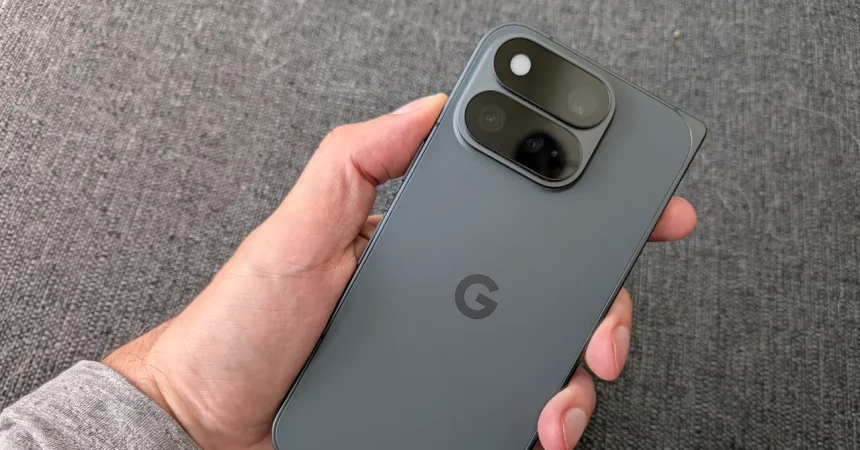
Here is a summary and humanized expansion of the review content, structured into six detailed paragraphs that capture the reviewer’s experience with the Pixel 11 Pro Fold.
The Pixel 11 Pro Fold is a testament to Google’s ambition, but it arrives in a very restrictive wardrobe. When you shell out four-figure sums for a flagship, you expect a bit of personality, a choice of color that reflects your vibe. Google apparently thinks otherwise, limiting this phenomenal piece of hardware to just two hues: Obsidian and Olive Green. My review unit arrived in Obsidian, and I have to admit, the name is a bit of a lie. It’s not a stark black; it’s a deep, moody, matte gray. It absorbs light beautifully, giving off a sophisticated, industrial aesthetic, but if you’re coming from a glossy iPhone or a vibrant Samsung, this feels almost monochrome. The Olive Green variant tries to be a little more fun, but its “shinier gold” frame—a slightly brassy, metallic accent—looks less like a luxury watch and more like a gaudy accessory from a 2005 mall kiosk. It’s a weird pairing. For a phone that is supposed to push the future of mobile design, limiting it to two colors that err on the side of subtlety feels like a step backward. The regular Pixel 11 gets the fun colors—the blues, the pinks, the corals. Why would Google reserve the most expensive and innovative device for the most conservative shades? It feels like the design team played it safe, underestimating the buyer’s desire for personalization, leaving a device that is already innovative in shape, creatively void in character.
Physically, the Pixel 11 Pro Fold is a masterclass in split personality. It doesn’t follow the rules of a standard phone, and its geometry will drive a perfectionist insane. Hold it closed, and you’ll notice the frame isn’t a perfect rectangle. The curved corner cutout for the front camera creates a deliberate asymmetry, breaking the clean line of the display. Open it up, and the imbalance becomes more obvious. The two halves are not uniform in thickness. The side housing the integrated camera bar is chunkier, creating a noticeable bulge on one side. This means when you’re holding it with two hands in landscape for gaming, one hand constantly deals with a thicker ridge, making the entire experience feel less balanced. But the real villain of the piece is the center crease. I’ve used the Galaxy Z Fold, the OnePlus Open, and the original Huawei Mate X. Yes, they all have creases, but Google’s is worryingly deep. When you run your finger across the center of the 8-inch screen, it feels like a mini valley, catching your nail. In everyday use, scrolling through Instagram, the crease creates a subtle visual distortion—text appears to have a slightly wavy footnote in the middle. It’s the kind of imperfection that you can’t unsee. The source article calls out that the author is the kind of guy who obsesses over light switches—someone who cancels a picture frame if it hangs a millimeter off-center. For that person, this crease is a constant itch, a glaring flaw on an otherwise gorgeous canvas, making it a difficult daily companion for those of us who appreciate geometric perfection.
Biometrics on the Pixel 11 Pro Fold are a lesson in “almost right.” The in-display fingerprint sensor, a staple of top-tier slabs, is absent here. Instead, Google has chosen to embed the sensor into the power button on the side. This works fine if you pick the phone up and your finger naturally falls onto that button. But let’s be honest—when we unlock our phones casually, we often just poke the screen. My thumb instinctively tries to touch the display to unlock, and it fails, leaving me to search for the side button. If you leave the phone face-up on a desk, you cannot unlock it without lifting it to press the physical button; some phones allow you to rest your thumb on the screen even when it’s lying flat. This Fold forces you into a specific grip. It’s a step down in convenience. Then there’s the Face Unlock. In decent lighting, it’s brilliant—fast, accurate, and seamless. The front camera captures your facial features and the phone springs to life. But its Achilles’ heel is the dark. At night, in a dimly lit bedroom, the face unlock simply refuses to work. The optical sensors need visible light to map your face; without it, you’re greeted with a lock screen and a PIN pad. So you’re there, fumbling in the dark, your face half-lit by the phone’s backlight, tapping in your passcode while squinting. It’s a jarring transition from the futuristic feel of the daylight unlock. For a phone in this price bracket, forcing users to deal with a side-mounted sensor and a light-dependent face unlock feels archaic, especially when rivals have already mastered under-display ultrasonic sensors that work in total darkness.
When you finally get past the physical quirks and unlock the phone, you are greeted by the absolute best duo of screens I have ever seen on a mobile device. The 8-inch inner OLED is a glorious canvas. The 6.5-inch cover display is equally capable, a perfect full-featured smartphone in its own right. Both panels are astonishingly bright, hitting that advertised 3,600 nits peak brightness (specifically for HDR content). In my real-world testing, even in harsh, direct California sunlight, the screens remained perfectly legible—I could read emails, navigate maps, and view photos without tilting the display to find shade. The colors are phenomenally rich, perhaps a touch more saturated that I prefer, but they make consuming media an absolute joy. Watching a nature documentary on this inner screen is a revelation; the deep blacks and the vibrant greens look better than my living room TV. The 120Hz refresh rate keeps every animation fluid, every scroll silky. The only dark cloud on this beautiful horizon remains that center crease, which is especially noticeable when the screen is off. But during playback, the content covers it, and your brain eventually zones it out. It’s this display that sells the phone. It’s the reason you forgive the heavier weight in your pocket and the thicker hinge. It transforms the phone from a novelty into a portable cinema, a productivity beast for split-screen multitasking, and a dream reader for ebooks and long articles. It is, without a doubt, the pinnacle of display technology in a consumer device right now.
The “Pro” designation on the back of this device is one of the most misleading labels in tech right now. Inside, it runs on the same Tensor G6 processor and 16GB of RAM as its slab sibling, which is excellent for everyday tasks—app launching, gaming, and browsing are all blitz-fast. But the camera setup is decidedly not “Pro.” Google has equipped this foldable with the same sensors found in the standard Pixel 11, meaning you don’t get the upgraded main sensor or the periscope zoom lens found on the Pixel 11 Pro slab. The result is a capable camera, sure—Pixel’s computational photography is still magic—but it’s not the class-leading shooter you expect from a device with a “Pro” tag. Your photos are good, but they’re not jaw-droppingly sharp at 5x zoom. Furthermore, the phone needs two selfie cameras—one on the front for when it’s closed, and one on the inner screen for when it’s folded open. This adds cost and complexity to the device. The new “HiLight” feature is a fun idea, using LEDs around the camera flash to pulse in different colors based on app notifications. You might get a blue flash for a text, or a purple glow for a calendar reminder. But it’s underdeveloped. For instance, you cannot assign specific colors to specific contacts, and it only works for basic system apps. While testing, I experienced the occasional software freeze—a couple of times while using Gmail in split-screen, the interface locked up for a few seconds. Another time, I opened an app on the cover screen and then folded the phone open, and the phone stuttered as it tried to transition the app to the large display, freezing momentarily during the transition. These are the kinds of bugs that turn enthusiasts into skeptics, especially when you’re paying a premium for the whole package.
Ultimately, the Pixel 11 Pro Fold is a beautiful oxymoron. It presents the best foldable display money can buy, wrapped in a chassis that suffers from a series of frustrating compromises that undermine the experience. It’s a case of stellar software (Android 15 is fluid and clean) and stellar screens fighting a losing battle against hardware decisions (deep crease, side fingerprint, dark-fail face unlock, drab colors, and a downgraded camera). As veteran tech journalist Simon Hill aptly put it, this is a reviewer’s dream but a consumer’s cautionary tale. If you are someone who prioritizes a large, stunning screen above all else—a person who lives in YouTube, Netflix, and long-form reading—this phone will blow you away. The sheer immersive quality of that 8-inch screen is unmatched. But if you are someone who takes photos seriously, or who just wants a phone to work flawlessly without having to navigate its eccentricities, you’ll be better served by the significantly cheaper Pixel 11 Pro slab. The 11 Pro Fold asks you to pay a premium to be an early adopter, to overlook the crease, to accept the biometrics, and to forgive the occasional freeze. It’s a bold, flawed, expensive vision of the future—a phone that is simultaneously the best foldable I’ve ever reviewed and the most infuriating. It’s the kind of device that makes you appreciate what’s possible, while constantly reminding you of how far we still have to go. In short, it’s a gorgeous compromise, but a compromise nonetheless.