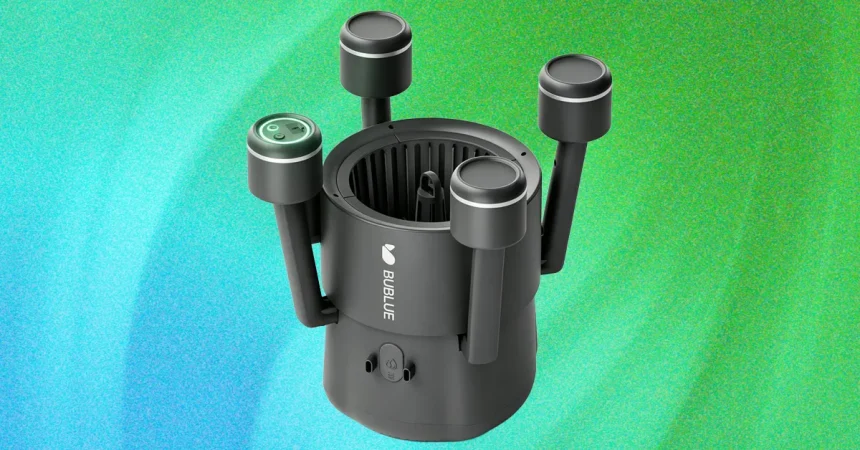
The BuVortex V5 presents itself as a modern solution for pool maintenance, built around a central cylindrical body supported by four strategically placed arms that keep it buoyant and stable on the water’s surface. Its design is minimalist and straightforward, featuring a power port and manual controls—including a Bluetooth pairing button for the Bublue mobile app—tucked away into one of those stabilizer arms. Beneath the hood, the system relies on a basic mesh filter held securely within a circular frame and basket assembly. Comprising only five primary components, the device is ostensibly easy to disassemble, though its physical footprint is quite large. To function effectively, the robot requires a depth of at least 1.5 feet, meaning it isn’t an option for shallow wading areas or smaller, low-profile pools.
The most notable departure from conventional pool technology is the BuVortex V5’s complete reliance on internal battery power. While many robotic skimmers on the market today integrate solar panels to provide continuous, autonomous operation, this model requires a direct plug-in charge. The unit houses a 7800 mAh battery that demands a hefty four-hour charging session to net roughly three to four hours of active runtime. For a device intended to keep a pool pristine, this necessity for manual tethering feels like a significant regression. In a world where convenience is king, having to constantly remove, plug in, and monitor a pool device is a chore that most homeowners are specifically looking to avoid when they purchase a robot.
The absence of solar integration is, for many, a deal-breaker that fundamentally alters the user experience. With a traditional solar-powered skimmer, the relationship between owner and machine is “set it and forget it”—the robot wakes up with the sun, works throughout the day, and rests when the light fades, maintaining a clean surface week after week without intervention. Because it is self-sustaining, the only time you actually think about the device is when you need to perform a quick cleaning of the filter basket. By stripping away this solar capability, the BuVortex V5 shifts from being a helpful automated assistant to a needy appliance that requires a disciplined, active maintenance schedule.
When you analyze how this affects daily pool care, the operational shortcomings become even more apparent. During peak seasons, such as autumn, when leaves and debris are constantly raining down into the water, consistency is everything. A single four-hour cycle is simply not enough to combat the constant influx of organic material. Even if you were diligent enough to retrieve the robot, recharge it, and set it out for a second shift, you would still only be covering a fraction of the 24-hour cycle. In practical terms, this leaves the pool vulnerable for the vast majority of the day, allowing debris to become waterlogged and sink to the pool floor, where it transforms from a surface nuisance into a much harder-to-clean mess.
This performance gap means that the BuVortex V5 struggles to compete with the sheer utility offered by its solar-powered predecessors. Instead of preventing the buildup of detritus, the robot acts more like a temporary band-aid, skimming only what is visible at the moment of activation before dying out. By the time the battery runs dry, the wind and currents have likely moved plenty of leaves out of the robot’s reach or pulled them toward the bottom. For a product that is supposed to save time and effort, the amount of babysitting required to keep it running effectively makes it a difficult recommendation for the average pool owner who expects “hands-free” operation.
Ultimately, the BuVortex V5 serves as a reminder that in the world of smart home garden and pool tools, autonomy is the most valuable feature. While the device is physically well-constructed and easy to handle due to its limited number of parts, the decision to omit solar charging creates a bottleneck that limits its effectiveness. Unless a user is prepared to make pool maintenance a semi-frequent, manual task—recharging the battery multiple times a day—the robot will likely fail to keep up with the natural demands of a backyard environment. For most people, the convenience of a solar-powered system that works around the clock will always outweigh the appeal of a manually charged alternative.