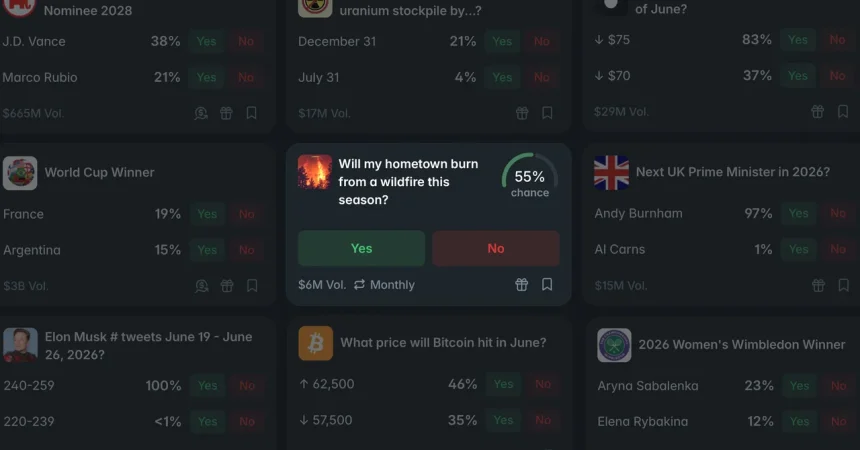
The catastrophic wildfire season of January 2025 left a path of ruin across Southern California, claiming over 16,000 structures and leaving 31 families to mourn the loss of loved ones. For residents like Sylvie Andrews and Susan Sherman, the destruction of their homes was not merely a loss of property; it was the erasure of decades of labor, memories, and personal history. Andrews, who had poured her life’s work into building a home in Altadena, articulated the shared heartbreak of her neighbors, describing the disaster as the total loss of the foundation they had built for their lives. Sherman, whose family home in the Palisades had stood since 1963, found herself forced to sell the charred remains of her past, left with nothing but the stinging reality of a landscape transformed into a graveyard of personal history.
While survivors were grappling with the immediate trauma of evacuation and the long road to recovery, a darker, digital phenomenon was unfolding. On Polymarket, the world’s largest prediction market platform, the tragedy was being treated as a speculative commodity. Rather than focusing on relief or response, anonymous gamblers were participating in markets that turned the wildfires into high-stakes volatility charts. These platforms, which function essentially as gambling sites disguised as statistical tools, allow users to wager on anything—from election outcomes to the spread of infectious diseases. In the case of the Southern California fires, the platform hosted nearly 20 questions, inviting users to bet on the spread of the flames, the specific number of acres consumed, and the precise dates of containment.
The scale of this activity—nearly $1.2 million in wagers—is difficult for those on the ground to comprehend. When Andrews learned that strangers were profiting (or attempting to profit) from the very disaster that incinerated her home, her reaction was one of profound bewilderment and moral horror. For victims of the fires, watching the progression of a disaster mapped out in market trends feels like a grotesque violation of human decency. The commodification of their suffering transformed a terrifying life event into a “game” for speculators, stripping the human story of its gravity and reducing it to a series of fluctuating binary contracts where a fire’s growth became a potential payday.
The ethical implications of these markets extend far beyond the lack of empathy; they touch upon the very real dangers of inciting criminal behavior. Susan Sherman and other critics have pointed out that wildfires, unlike hurricanes or seismic events, are uniquely susceptible to human interference. By attaching a financial incentive to the destructive path of a blaze, these markets create a perverse “bounty” for arson. A bad actor, driven by the prospect of a payout, now has a tangible motive to set a match or fuel an existing flame. The United States Forest Service has been quick to condemn such practices, noting that systems which tether financial gain to wildfire outcomes are fundamentally incompatible with public safety and actively encourage the misuse of fire.
Furthermore, the integrity of these markets is highly susceptible to insider corruption. Experts like Ann Skeet from the Markkula Center for Applied Ethics argue that the potential for abuse is immense, especially when individuals with access to private firefighting strategies or real-time tactical information choose to participate. If a land manager or a first responder possesses intelligence that could drastically sway the “yes” or “no” odds of a market, the setup essentially mirrors illegal insider trading, but with infinitely higher stakes. In this context, the prediction market ceases to be a tool for forecasting and becomes a breeding ground for manipulation where the information edge belongs to those who might be positioned to influence the outcome of the fire itself.
Ultimately, the growth of these platforms represents a chilling trend in how society interacts with tragedy. As another wildfire season approaches, the “wild, wild West” of prediction markets stands in stark, callous contrast to the reality faced by those on the front lines of climate-driven disasters. These platforms claim to foster a more accurate understanding of events, yet they ignore the human cost, prioritising the “efficiency” of a market over the safety of the community. As we look ahead, the challenge for both regulators and society is to decide whether we are willing to monetize the destruction of our own homes, or if we will draw a moral line that says some things are simply too devastating to be treated as a bet.