Here is a humanized, expanded summary of the text, structured into six flowing paragraphs that explore the mission, the technology, and the brilliant people behind it.
Paragraph 1: The Dawn of a New Cosmic Eye
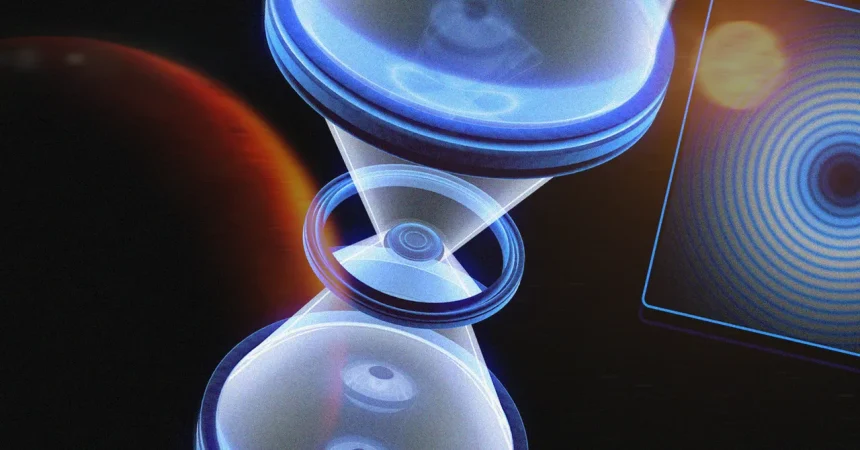
Sometime in the not-so-distant future, a rocket will thunder off the launch pad carrying humanity’s latest cosmic sentinel: the Nancy Grace Roman Space Telescope. Tucked inside its intricate machinery, safe from the violence of launch, are two mirrors so small they could rest comfortably in the palm of your hand. While they look deceptively simple—almost like polished bits of high-tech jewelry—they represent one of the most ambitious engineering challenges ever attempted in astronomy. For decades, scientists have known that there must be other worlds out there, orbiting distant suns. We have even discovered thousands of them. But those far-off planets are typically found indirectly, by the way they tug on their parent stars or dim the light as they pass in front. What we haven’t been able to do is see them directly—to catch the faint, reflected glow of their surfaces. These two little mirrors, working in tandem with the Roman telescope’s massive primary mirror, are designed to change that. They are the heart of a sophisticated coronagraph, a device intended to do what was once thought impossible: to block out the blinding glare of a star completely, and reveal the tiny, precious pinprick of light bouncing off a planet’s atmosphere or ocean.
Paragraph 2: The Firefly and the Floodlight
To understand why this is so hard, you have to picture the cosmic equivalent of trying to photograph a firefly perched on the rim of a floodlight from a hundred miles away. A star, by its very nature, is staggeringly bright. A planet, by contrast, merely reflects a tiny fraction of that light. If you look at the star directly, the planet is utterly lost in the wash of photons. Even the most powerful telescopes in history—including the Hubble Space Telescope and the James Webb Space Telescope—have struggled with this. They do carry coronagraphs, but these older instruments are what astronomers call “brute force” devices. They are essentially physical pieces of metal placed in the telescope’s optical path to cast a simple shadow over the star’s disk. This method works to a point, but it isn’t precise enough to tease out the light from a rocky, Earth-sized world. The starlight leaks around the edges, scatters off the optics, and overwhelms the faint signal. The Roman coronagraph must achieve a level of contrast that is a million times better than these previous attempts. It’s the difference between using a piece of cardboard to block the sun, and using a razor-sharp, custom-designed aperture that can cast a perfect, velvet-black shadow.
Paragraph 3: The Magic of Bending Light
So how does Roman plan to accomplish this impossible feat? The secret lies in the two palm-sized mirrors mentioned earlier. They aren’t rigid like standard telescope mirrors; they are deformable. Beneath their polished surfaces, they are wired with roughly 2,300 tiny mechanical actuators—tiny “muscles” that can push and pull on the mirror’s surface with incredible precision. When a jolt of electricity is applied, these actuators expand or contract by microscopic amounts, causing the mirror to ripple, bend, and reshape itself tens of thousands of times per second. This is known as adaptive optics, and it’s a technology that has revolutionized ground-based astronomy. Here on Earth, our atmosphere is a churning, turbulent ocean of air that makes starlight shimmer and blur. By deforming the mirror in real-time to counteract that turbulence, scientists can effectively see as clearly as if the telescope were in space. But Roman is already in space, far above that messy atmosphere. So why does it need adaptive optics? Because the act of blocking a star causes light to scatter internally within the telescope itself, creating a messy halo of noise. The deformable mirrors will actively smooth out this internal optical chaos, sculpting the starlight into an impossibly sharp, clean point that can be completely obscured by the coronagraph’s masks, leaving the surrounding field dark and pristine for the planet to shine through.
Paragraph 4: The Engineering and the Experts
This technology is so new that NASA is treating it as a high-stakes experiment. Margaret Turnbull, an exoplanet scientist at the SETI Institute who leads a science team for the mission, puts the challenge in stark terms. “Any little bit of starlight that gets in the wrong place could just destroy a whole portion of the image,” she explains. A single stray photon hitting the wrong pixel could wipe out the signal from an entire distant world. The masks that do the heavy lifting of blocking the light are also unlike anything ever flown. Bruce Macintosh, an astronomer who leads the University of California Observatories, describes them as “beautiful, complicated shapes”—intricate patterns that look like abstract art but are mathematically designed to suppress light as efficiently as physics allows. He contrasts this with the Hubble coronagraph, which he jokingly dismisses as “just literally a little piece of metal that gets in the way of the star.” The Roman team, however, has to worry about exact tolerances measured in nanometers—a millionth of a millimeter. If one of the 2,300 actuators were to fail, or the mirror’s elaborate dance of shape-shifting were to stumble, the entire observation could be ruined.
Paragraph 5: A Stepping Stone to Another Earth
The ultimate goal of this mission isn’t just to take pretty pictures of Jupiter-like exoplanets. Those are relatively large and bright, and Roman’s coronagraph should have an easier time with them. The real dream is to prove that we can one day see an Earthlike planet, a rocky world orbiting in the habitable zone of a Sun-like star—the “Goldilocks” region where liquid water could exist. To do that, the instrument needs to detect extraordinarily individual photons. The cameras behind the coronagraph are “supersensitive detectors” that can essentially count single particles of light. When we look at an exoplanet, we’re often looking at light that has traveled for decades or centuries to reach us—a faint whisper of a star’s brilliance. NASA is very open that Roman’s coronagraph is a technology demonstrator. It’s a stepping stone. The knowledge gained from building and flying these palm-sized mirrors and their intricate deformations will directly inform the design of a future, dedicated space telescope specifically built to find and photograph a true “pale blue dot” around a nearby star. As Macintosh points out, the engineering isn’t just about this one mission; it is about laying the groundwork for a future civilization’s map of its nearest stellar neighbors.
Paragraph 6: A Giant Leap for Mankind
When you step back and consider it, there’s something profoundly hopeful about these two small mirrors. They are a monument to human ingenuity—a testament to our ability to solve problems that once seemed impossible. For most of human history, we assumed the planets we could see with our naked eyes were the only worlds that existed. Now, we are building machines that can peer across the vastness of space and see other solar systems in detail. The Roman telescope itself is named after Nancy Grace Roman, “the mother of Hubble,” who fought to prove that space telescopes were worth the colossal expense and effort. In a way, this new coronagraph continues her legacy. It takes the humble concept of a camera and pushes it to its absolute physical limit. It is, quite literally, a machine designed to catch the ghost of a world. When the telescope finally launches and the first images come back, we might see a distant planet as a single dot of light. That dot won’t just be a scientific data point; it will be a reminder that the universe is teeming with places we have yet to visit, and that with hard work, courage, and two beautifully engineered pieces of glass, we can glimpse the edge of what’s possible.