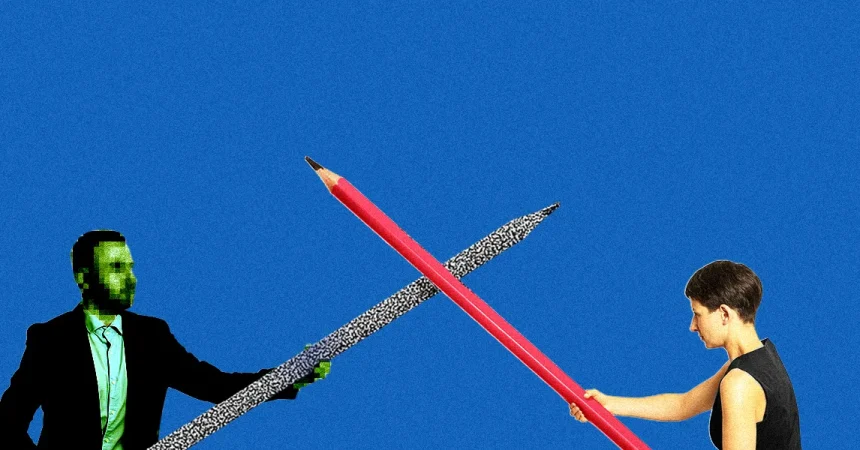
In the wake of generative AI’s rise, a fascinating shift is occurring within the literary world: authors are actively curating an “anti-AI” aesthetic to prove their humanity. As large language models (LLMs) proliferate, they tend to lean on predictable, polished, and somewhat sterile structures—the familiar “rule of three,” the overuse of em dashes, and passive, balanced arguments. In response, writers like novelist Laura Brooke Robson have begun to treat their craft as an act of deliberate divergence. Robson, currently penning a story about the intersection of tech and romance, intentionally avoids smooth, automated-sounding rhythms. She opts for longer, winding sentences and invented phrases, injecting her prose with stylistic “winks” that signal a living, breathing pulse behind the page. For these writers, the goal is no longer just to communicate, but to be unmistakably, jarringly human.
This movement is defined largely by what it rejects. If you’ve spent any time reading AI-generated content, you recognize the patterns: those perfectly symmetrical lists, the overly cautious “not x but y” phrasing, and the bland, middle-of-the-road tone that never takes a risk. The new literary counterculture is intentionally breaking these rules. Writers are favoring eccentricity, esoteric vocabulary, and deeply personal—even messy—anecdotes. By prioritizing the idiosyncratic over the efficient, they are attempting to reclaim the “drudgery” and the struggle of the creative process. It is a rebellion against the optimization of language, based on the belief that if writing becomes too easy or too polished, it ceases to be art and becomes a mere data stream.
The stakes for this shift are high, especially as the publishing industry grapples with the anxiety of authenticity. We have already seen the fallout in cases where writers were accused of cutting corners with AI, leading to public backlashes and cancelled contracts. Authors are now under immense pressure to prove their work hasn’t been automated, sometimes even facing the irony of being accused of using AI when their style happens to align with the generic, sanitized output that models often produce. This climate has created a defensive posture; writers are now explicitly detailing their creative processes, and some are even wary of their own editors, fearing that professional polish might accidentally strip away the authentic, jagged edges that prove a human mind was at work.
Interestingly, this trend is also forcing some writers to abandon stylistic habits they once loved. Take Ellena Savage, a novelist who prides herself on complex, Victorian-style prose. She finds herself in a bind: the very syntax she mastered—the satisfying rule of three or the well-placed em dash—has been co-opted by bots to the point of cliché. To avoid being mistaken for an algorithm, she must now experiment with new structures, essentially mourning the loss of tools that have been commodified by software. This creates a strange paradox where the presence of machines is forcing human writers to move away from classical, time-tested rhetorical flourishes simply because those forms now lack the “fingerprint” of a living creator.
Beyond fiction, the editorial world is undergoing a parallel transformation. Richard Fisher, an editor at Aeon, is actively encouraging his contributors to leave the “rough edges” in their work. Instead of the pristine, smooth copy that editors traditionally sought, there is now a premium on “spikiness”—those strange, awkward, or uniquely worded parts of an essay that a machine would likely smooth over. The philosophy is simple: if a piece of writing feels too safe or too perfectly formatted, it’s failing the test of human relevance. Editors are now in the business of safeguarding the unpredictable, recognizing that, in an era of infinite content, the only thing that retains value is the presence of an inimitable, subjective perspective.
Ultimately, this movement signals a transition toward a more experimental and personal era of literature. As Mano Sundaresan of Pitchfork noted, there is a renewed, urgent focus on the first-person perspective, mandating that writers anchor their work in their own singular lived experience. While the fear of AI has caused significant disruption, it has also provided a clarifying wake-up call to the writing community. By forcing writers to double down on what makes them strange, inconsistent, and deeply emotional, AI may paradoxically lead to a more vibrant and distinct landscape of human expression. We are entering a period where the “flaws” in our writing are no longer mistakes to be corrected, but the very credentials that verify we are still here, thinking and feeling for ourselves.